
Let’s talk about a small bathroom-door makeover that involved more hiccups than expected. Back in January we decided the mirror on our master bedroom door could stay (unlike the one on the guest-bath door, which we got rid of because you could see your entire body from the toilet). We agreed to keep the bedroom mirror on the condition that we’d build a thicker frame around it so it wouldn’t look like one of those flimsy $5 dorm mirrors. The idea sat for months, and only in September did we finally tackle it.
We liked keeping the mirror since it’s useful for checking outfits and hair, but the plastic clips holding it were unattractive. Inspired by other bloggers who trimmed mirrors, we figured it would be an easy project: remove the mirror, reattach it with adhesive so the clips wouldn’t interfere, cut molding with a miter saw, and glue the trim to the door. Simple enough—right?
First I removed the door from its hinges to work with it flat. Before taking the mirror off I traced its outline with a red pen so we could realign it precisely when reattaching. After unscrewing the clips, the mirror lifted off easily.
We bought Liquid Nails Mirror Adhesive because it’s made to avoid damaging the mirror’s reflective backing. We sanded the door where the mirror would be to roughen the paint as recommended, then moved the gluing to the sunroom because the adhesive smelled strong. Following the product’s guidance, we set the mirror in place and left it to cure for 72 hours.
For trim we first grabbed a narrow profile that looked like it would sit over the mirror edge, but after measuring, cutting, and almost gluing it on, we realized it made the mirror look even cheaper. We returned to Lowe’s for a wider molding—about three inches—wide enough to add presence but not so wide that it would interfere with the doorknob.
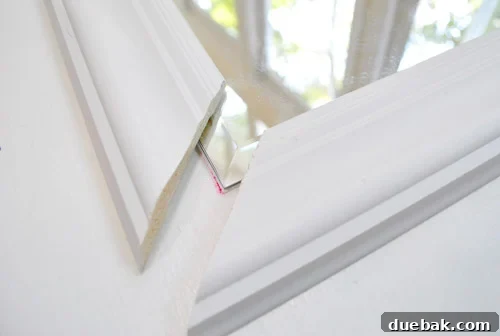
To match the mirror’s beveled corners, I placed painter’s tape along the bevel line to extend the corner and used it to guide 45-degree miter cuts. After confirming that the pieces fit together well, I used heavy-duty Liquid Nails for the trim. I usually prefer mechanical fasteners, but I avoided nails near the mirror edge. I applied adhesive to the trim pieces’ door-facing side, pressed them in place, and taped them down to prevent shifting while drying.
After a day of drying, I rehung the door and later took a shower. Shortly after, the mirror slid off the door and broke the bottom trim piece. The top three trim pieces held the mirror up, so it didn’t crash to the floor, but the chipped corner was a stressful surprise. We had to scrape off the old glue and start over.
Reading the adhesive directions more carefully revealed a few crucial tips we’d missed: don’t rely on the product without a permanent support system, allow a full week for cure time, and apply adhesive to the mirror’s back rather than the door. Learning from that, we re-glued the mirror directly on its back with more evenly sized beads and some criss-cross lines to ensure better contact. For a permanent support we added small finishing nails around the mirror edge; the nail heads act as stops and helped prevent sliding while remaining subtle under the trim.
This time we waited seven full days with the door removed to let the adhesive fully cure. Before reattaching the trim, we performed an extra overnight test by standing the door up on a pillow to make sure the mirror would not shift. It passed. The next morning I glued the trim pieces on and left the door flat for several more days so the trim adhesive could cure fully. Finally, we rehung the door, and our daughter immediately resumed admiring her reflection with joyful phrases like “sah pretteh!” and “iss baby!”
The end result is a subtle but definite upgrade. The white trim on the white door doesn’t pop dramatically in photos, but in person it adds a layered, architectural detail that harmonizes with other elements in the room. The goal wasn’t to create a dramatic focal point but to cleanly finish raw mirror edges and eliminate the unsightly plastic clips, which we accomplished.
In total, the thicker trim cost about $12 and the mirror adhesive added a few dollars, so the project totaled roughly $17—assuming you don’t inadvertently buy a cheaper, too-thin trim profile like we did the first time (which cost another $10). Update: we later learned that many home centers accept returns of cut molding over 12″ in length, so you may be able to recoup the cost of a mistaken purchase.
Have you attempted any small upgrades that turned out to be bigger adventures than planned? As of this writing, the door has survived multiple steamy showers and several nights without incident, so for now: success. We’ll keep an ear out for any future crashes, but for the moment the mirror is secure, the clips are gone, and the finished look is a quiet, polished improvement.