
This week I was inspired by a request from Clara, relayed through John’s mom. She laughed as she told me she overheard Clara telling her cousin that she didn’t have a clock in her room. Random, right? I realized I’d never made a clock before, but I thought it would be a fun, interactive project for Clara. Clock kits are sold everywhere, so how hard could it be?
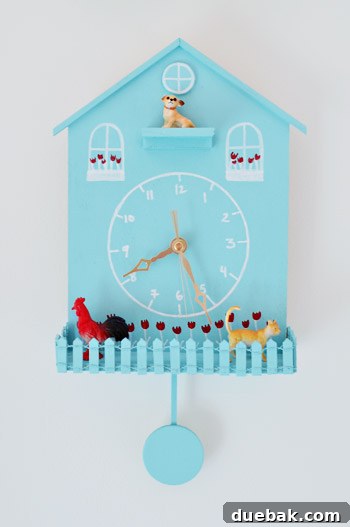
Here’s what I ended up making.
And here it is, hung on the wall in Clara’s room.
I originally considered using a birdhouse and adding clock hands, but most birdhouses stuck too far from the wall or didn’t have a flat enough face for the clock mechanism to turn freely. Then I found a DIY cuckoo clock idea that I loved for its house-like shape and playful details, and used that concept as a starting point. I wanted to adapt it with a few three-dimensional touches I thought Clara would enjoy.
I stopped by JoAnn and bought a 12 x 12″ sheet of 1/4″ plywood for about $3 with a coupon, and cut it into a simple house shape with a miter saw. If you don’t have a saw, this thin plywood can likely be scored deeply with an X-Acto knife and snapped off cleanly.
I also picked up a few small craft items while I was there: a tiny picket fence, a bag of wooden disks in various sizes, and a thin trim piece to suggest a roofline. I used craft glue to create a ledge along the bottom and a smaller shelf about three inches below the roof. I added the trim along the roofline and glued a round wooden disk beneath it to mimic a small round window.
One of my favorite details was the tiny picket fence: I glued it in place and reinforced it with small picture nails so it wrapped around the bottom ledge securely.
Next I marked the center for the clock hands and drilled a hole large enough for the clock mechanism spindle to pass through.
For paint, I asked Clara which color she wanted. Expecting pink, I was surprised when she asked for blue. I used a leftover test pot of Behr’s Embellished Blue and applied two even coats.
After the paint dried, I sketched the face and details. I traced a circle with a white paint pen for the clock face using an old coaster as a guide, then freehanded a few charming details: a window frame around the round disk under the roof, other windows, stems rising from window boxes, and small stems behind the picket fence. I planned to add red flowers later with a sharpie.
Once the paint pen dried—about ten minutes—I assembled the clock kit I’d bought for around $6. The kit was simple to install: place the mechanism on the back, pass the spindle through the drilled hole, and attach the hands and hardware in the order recommended by the instructions. I liked the vintage gold finish on the hands and left them unpainted to keep that cuckoo-clock charm.
To make the back sit flush and stable on the wall, I glued three small pieces of scrap wood behind the mechanism so it projected the same amount top to bottom. I attached a metal hanger to the top block to hang the clock securely.
I also drilled a small hole in the base shelf and inserted a 4″ piece of trim topped with a larger wooden disk, which I painted blue to match the clock. It doesn’t swing, but it contributes to the whimsical cuckoo-clock feel.
The whole project—shopping, cutting, gluing, drilling, painting, sketching, and assembling—took me around two hours. My total cost was under $15: about $6 for the clock kit, $3 for the wood, and roughly $6 for the accessories like the picket fence, disks, and trim.
This turned out to be one of those crafty projects that would make a sweet holiday gift. If you simplify it—paint the house white and add metallic details with a paint pen, and skip the extra shelves and fence—you could make a version for under $10.
The best part is that Clara absolutely loves her clock. I knew the shelves would be perfect for her to arrange little animals, dragons, and fairies, and it’s become a bedtime ritual. Each night she chooses who goes on the top shelf and who belongs on the bottom, and we tuck her in with her tiny friends watching over her.
Have you ever made a clock using one of those kits? The trickiest part here was drilling a large enough hole for the spindle; I used progressively larger drill bits until the hole fit the mechanism snugly, and that solved the problem easily.