
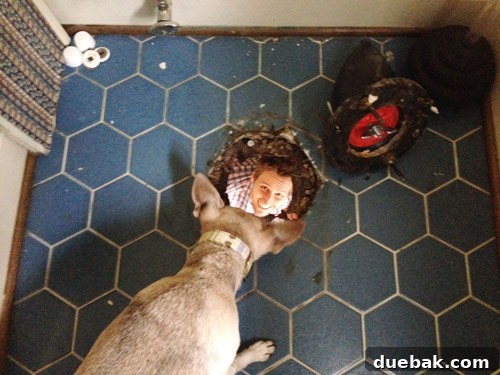
Lemme tell you, our bathroom’s wallpaper wasn’t the only problem we had to fix recently. This plumbing story stretched over the last few weeks and only wrapped up a few days ago. We share the good, the bad, and the ugly here—this one fits squarely into the “bad” and “ugly” categories, with a generous side of “gross.” For everyone’s sake, I’ll spare you the photos.
When we bought the house we noticed a tiny, dried water stain on the living room ceiling beneath the bathroom. The stain was only about three inches across and looked long cured, so the inspector and we assumed it was from a long-ago toilet overflow. We weren’t worried—just a little primer and paint and it would be fine. We didn’t even photograph it, but it was there.
Then, this fall, the toilet started acting up. It would occasionally clog, and when we tried to plunge it the water backed up into the shower. If you’re eating, you might want to set that down. The situation was gross, and since one of us was already queasy with pregnancy, I handled the dirty work. A few rounds of plunging and sometimes snaking usually cleared things, so we chalked it up to intermittent clogs and delayed calling a pro until we remodeled.
But last month we got a backup that plunging couldn’t fix.
***PHOTO OMITTED TO PROTECT YOUR DELICATE RETINAS***
During my vigorous plunging I created a new water stain on the living room ceiling. Later we learned that the pressure had compromised the wax ring under the toilet and water started leaking again. That was our cue to call a professional. The plumber removed the toilet, ran a 150-foot snake, and dislodged what he described as “years worth of paper build-up” deep in our pipes. Problem solved—at least for a little while.
But it wasn’t over. A week later the shower backed up again—this time while I was filling a steamer during a wallpaper-removal session. Not only was stripping wallpaper miserable on its own, I was doing it with an unclean, smelly shower nearby. We were frustrated that the first plumber hadn’t fixed the true cause.
When the new plumber arrived, he listened to the whole history and had a solid theory: they needed to look inside the ceiling. So we learned what owning a two-story home can entail—unlike single-story houses where you can often access pipes from a crawl space or attic, this one required cutting into finished ceilings.
His diagnosis was correct. The bathroom plumbing had been installed incorrectly when the house was built over 30 years ago. The main drain pipe was sloped the wrong way. Instead of allowing gravity to carry waste away, the pipe sloped slightly uphill, so water and sewage pooled and eventually backed up into the lowest opening in the bathroom—the shower. Gross, in Clara’s words.
The only fix was a larger ceiling access and a full plumbing reconfiguration. The crew even removed and replaced a load-bearing joist to give the new pipes the clearance and pitch they needed. This was beyond DIY—we needed professionals.
We didn’t enjoy having our house opened up, but we were relieved to finally address the root cause. The plumbers completed the work in a day (they returned a few days after diagnosing the problem) and charged roughly $650. It was a painful bill, but worthwhile since this misconfiguration had likely been causing trouble for decades. While the toilet was off, we even peeled a small strip of wallpaper that had been hidden behind the bowl—small victory.
After the plumbing was fixed and the bathroom trim went back in, we still had a hole in the living room ceiling. We debated repairing the drywall ourselves—mudding, taping, sanding, re-mudding and more sanding—but smooth ceilings are unforgiving and any imperfection would bother us forever. So we hired a well-recommended drywall pro.
He patched the ceiling flawlessly in a few hours for around $100, and he was pleasant to work with—he even paid Sherry a compliment that made our day. Now all that remained was primer and paint.
Update: A few people asked whether our home warranty would have covered this. It had lapsed before this issue, but even if it hadn’t, this was likely considered an existing condition: the plumbing was improperly configured for decades, not a sudden failure after we moved in, so most warranties wouldn’t cover it.
Unplanned homeowner curveballs never feel good—especially when you’d rather spend on visible updates—but it’s great to have everything fixed and back together. As luck would have it, we have another ongoing house issue on deck, but we’ll wait until it’s fully resolved before we cry on your shoulder. Tell us we’re not the only ones—share your plumbing, heating, or other home-system horror stories. We’re all in this together, right?
Psst—This “Volume Two” nod in the title comes from an earlier leak lesson at our previous house. That one was something we could solve ourselves, which was infinitely more satisfying.