
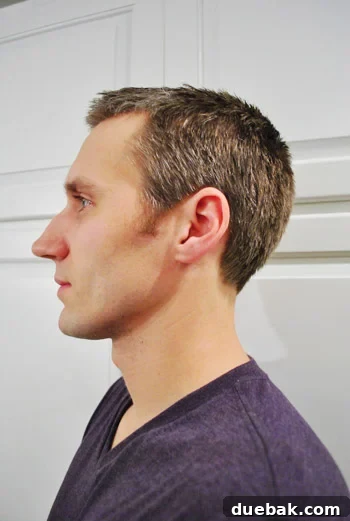
Let’s talk about DIY haircuts, shall we?
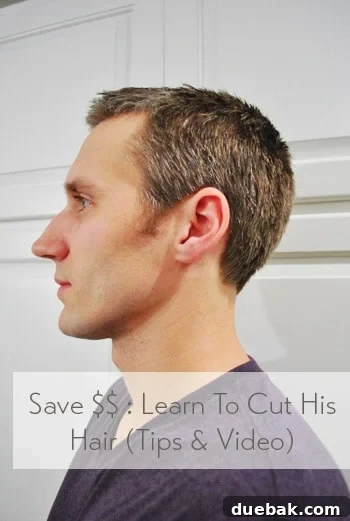
This post isn’t about home projects, but it came up so often that I decided to share: how I cut my husband’s hair at home. I never trained as a stylist—my experience began in high school and continued through college, where I practiced on friends and family. I’m not claiming to be professional, just someone who learned to trim hair well enough to save money and avoid salon trips.
After seven years of cutting John’s hair and offering more than fifty haircuts to others over the past decade, I’ve developed a simple routine that works for us. Consider these tips a friendly, practical guide from a non-professional who’s comfortable with a pair of scissors and a steady hand.
We also made a video to show the process visually, which is much easier to follow than a written step-by-step. In the video you can see how I position my hands, where I trim, and how I shape the haircut. If you can’t play the audio, the visuals still communicate most of the technique.
Below are concise tips I follow when cutting John’s hair. These are what have worked for us—simple, low-cost, and effective.
- Cut hair dry or only lightly misted. Wet hair often appears longer and then “shrinks” when it dries, which can result in cutting too short. Dry hair also reveals cowlicks and natural fall, making it easier to create an even result.
- Pick a quiet time. I typically cut John’s hair at night after our toddler is in bed so there aren’t distractions and we can focus on neat work.
- Skip the clipper if you can’t store one. I don’t use a buzzer; instead I trim the hair and then shave the neckline with a regular razor for a clean finish. This avoids purchasing or storing a large clipper.
- Use basic hair-cutting scissors. I keep a simple pair of scissors dedicated to hair. They don’t need to be expensive—sharpness and comfort matter more than brand.
- Measure with fingers. I use my fingers as a guide to maintain consistent length. For example, I hold the hair one finger-length from the scalp for the sides and a bit longer—two fingers—on top, so the top has some length and movement.
- Cut vertically more than horizontally. When trimming, I generally snip vertically (parallel to the spine) rather than cutting straight across. Horizontal cuts can create a blunt, blocky look. Vertical snips blend layers and create a softer, more natural silhouette.
- Trim the neckline carefully. The only area I cut horizontally is the outline around the neck to keep a tidy edge. After trimming, I shave the neck for a polished result.
- Be honest about your skill level. I’m not a trained stylist—this is just my practical approach. If you’re nervous, practice on small trims first and be conservative with length.
Here’s an after photo from the back to give you a clear idea of the finished shape and clean neckline.
If you’re trying DIY haircuts to save money, this approach can be surprisingly effective. Over seven years, cutting John’s hair at home has saved us a significant amount—likely several hundred dollars—compared to regular salon visits. Add in the times we’ve trimmed each other’s hair or done quick touch-ups, and those savings really add up.
Hope these tips help anyone considering at-home haircuts. If you try it, go slow, be conservative with length, and focus on clean lines. A calm, steady approach yields the best results.