

Mastering the Art of Grouting and Sealing Tiles: A Comprehensive DIY Guide
After the exhilarating (and admittedly extensive) process of laying tiles, the final steps of grouting and sealing might seem like minor details. Yet, for many DIY enthusiasts, myself included, the thought of tackling grout can bring a surprising wave of apprehension. From experienced renovators dubbing it “the pits” to online mentors confessing it’s the most challenging part of any tiling project, the reputation of grouting precedes itself, often hinting at an unpleasant experience. It made me wonder: couldn’t we just leave our beautiful new tiles as they were?
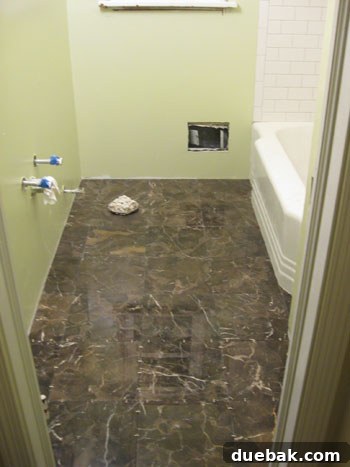
Unfortunately, for both aesthetics and durability, grouting is an essential step that simply cannot be skipped. It protects your tiles, creates a unified look, and prevents moisture from seeping underneath. My own journey into grouting began with a few unexpected detours. My first attempt was thwarted by a rookie mistake – misreading the water-to-grout ratio (3 cups/1.4 Liters somehow became “3 Liters” in my mind – a significant difference!), followed by a timely snowstorm that prevented a quick trip for more supplies. The very next day, a minor traffic incident (train + SUV = major delays, thankfully no injuries) kept me from getting home in time to start. At the moment, these delays felt frustrating, but in hindsight, they proved to be incredibly fortuitous.
Choosing the Right Grout: Why Specialty Matters
Long before our bathroom demolition even began, we had already purchased our initial grout: standard nonsanded Polyblend grout from a major home improvement store. We chose nonsanded grout for both the shower walls and floor because it’s ideal for our narrow 1/16-inch grout lines and, crucially, because sanded grout can scratch delicate marble surfaces like ours. We had “bright white” ready for the shower and “nutmeg” for the floor, even though the nutmeg shade was a bit redder than our preference.
The delays offered a crucial window. During a holiday break, we received invaluable advice: consider a specialty tile store, such as The Tile Shop, for superior quality grout. The benefits promised were substantial: enhanced durability, better resistance to mildew and mold, and a much wider color palette. It was a revelation – why hadn’t we thought of that before?
While only time will truly tell regarding its long-term durability and mold resistance (as stated on the label), our tipster was absolutely right about the color selection. Specialty stores often feature comprehensive color guides, allowing you to hold your actual tile samples against real grout swatches, rather than just relying on printed labels. This critical step ensures a perfect color match, harmonizing seamlessly with your chosen tiles.

Thanks to this discovery, we upgraded our choices significantly. We found “standard white” for the shower, a much more subtle hue that perfectly complemented our actual tile color, unlike the stark “bright white” from the generic store. For the floor, “mocha” proved to be an ideal, rich brown, free of the garish red undertones that plagued our initial “nutmeg” selection. The best part? The price was comparable to the big-box store’s offerings. We later felt immense gratitude for those initial mishaps, realizing how close we came to having shower lines that looked like over-whitened teeth and floor lines resembling bad auburn streaks. With superior grout in hand, and allowing the newly laid tiles at least two full days to set, there was no more postponing the task.
Essential Grouting Tools and Materials
Before diving into the process, gather your arsenal of tools. Many of these I inherited from my dad’s previous bathroom projects (many of which, coincidentally, were purchased at The Tile Shop). Having the right equipment makes a significant difference in achieving a professional finish:
- Grout Float: This rubber-faced tool is essential for pressing grout into joints and scraping away excess. It’s your primary applicator.
- Sponges: Opt for large, dense grout sponges. You’ll need several, or be prepared to rinse frequently.
- Buckets: At least two are crucial – one for mixing grout and one for clean water for sponging. A third for dirty water is even better.
- Paper Towels & Rags: For immediate clean-up and final buffing.
- Flexible Grout Admixture: Instead of water, this liquid enhances grout performance, reducing shrinkage and cracking.
- Grout Release: A pre-application treatment, especially for porous or textured tiles, to prevent grout from sticking.
- Marble Sealer: Used for pre-sealing porous natural stone like marble, and often doubles as a final grout sealer.
- Mixing Tool: A simple paint stir stick works for small batches, but a drill attachment for mixing larger quantities is highly recommended.
- Utility Knife: Handy for scraping off any stray dried grout or debris.
- Safety Gear: Gloves, kneepads (essential!), and safety glasses are always a good idea.
Preparing Your Tiled Surfaces for Grouting
Proper preparation is key to a smooth grouting process and an easy cleanup. The first step involves applying the Grout Release and Marble Sealer.
Think of Grout Release as a protective layer, akin to using cooking spray in a baking pan. Applied to the tile surfaces before grouting, it creates a barrier that makes cleaning off excess grout significantly easier. This is particularly important for textured, porous, or matte tiles where grout can easily become embedded. Simply wipe it on according to the manufacturer’s instructions, allowing it to dry.
For our marble floors, we used Marble Sealer. This product penetrates the stone, making it less porous and preventing grout (and later, spills) from staining it. A fantastic multitasker, this is the same product we would eventually use to seal the grout itself, offering double protection. Apply it evenly, allow it to penetrate, and wipe off any excess before it dries on the surface, following the product’s specific guidelines for application and drying time.
Mastering Grout Mixing: Consistency is Key
Once your surfaces are prepped, it’s time to mix the grout. This stage is critical, and this time, I was determined to follow the instructions meticulously. In my previous, failed attempt, I learned the hard way that getting the liquid-to-powder ratio wrong can quickly lead to disaster.
For this project, we opted for a Flexible Grout Admixture instead of plain water. This was a recommendation from the tile specialists at The Tile Shop, and we happened to have some leftover from my dad’s projects. Admixtures offer numerous advantages: they improve the grout’s elasticity, reduce shrinkage and cracking over time, enhance water resistance, and minimize discoloration. These benefits contribute significantly to the longevity and appearance of your grout lines.
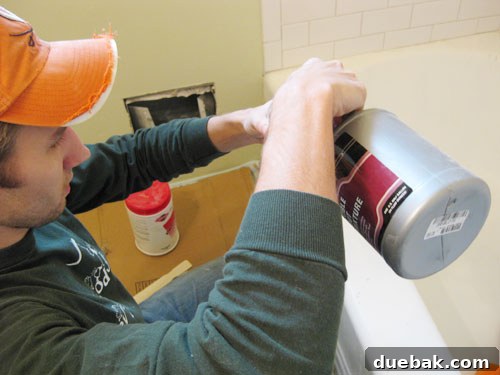
Many people warned me that mixing grout, especially by hand, can be tedious. Since I was working with relatively small batches and didn’t want to invest in a specialized mixer, I opted for a sturdy paint stir stick. The trick is to measure out only as much grout as you can comfortably use within a 20-25 minute window, as it starts to set quickly. Add the corresponding amount of admixture gradually, mixing thoroughly.
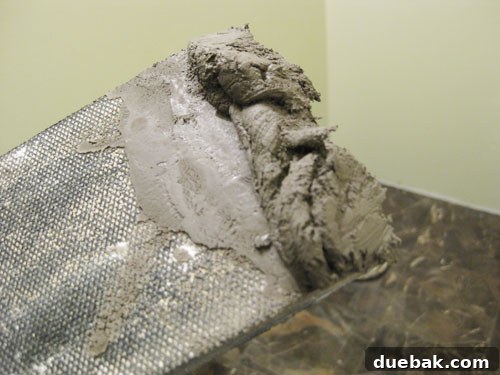
The goal is a smooth, lump-free consistency. Imagine something similar to thick toothpaste, cream cheese, or cake batter – firm enough to hold its shape but spreadable. It took a bit of arm power (and yes, one broken stir stick!) to achieve this, but the effort was well worth it. Avoid anything too watery and drippy, or too dry and crumbly. After the initial mix, let the grout “slake” or rest in the pail for about ten minutes as instructed. This allows the chemicals to fully activate. Give it one more good mix before you begin application. Below, you can see the perfect “mocha” floor grout, ready for action.
Applying Grout Like a Pro: The Grout Float Technique
With perfectly mixed grout and your trusty grout float – which I like to call the notched trowel’s friendlier cousin – it’s time for application. Despite all the pre-project anxiety, this step proved surprisingly straightforward.
Start by scooping a small amount of grout onto your float. Hold the float at a nearly flat angle (around 15-30 degrees) against the tile surface. Spread the grout diagonally across the tile joints, ensuring all cracks are generously filled. Apply firm, consistent pressure to really pack the grout into the lines, leaving no voids. For our small 1/16-inch grout lines, this step was quick and efficient.
Once an area is covered, adjust the float to a steeper 45-degree angle. Use this angle to scrape away excess grout from the tile faces, pulling diagonally across the joints. This technique removes the bulk of the grout from the tile surface, leaving it primarily within the grout lines. Don’t worry if some residue remains – that’s what the next step is for. I started to think, “Is this really it? Am I doing it wrong because it’s not awful?”
The Crucial Cleaning Phase: Sponging for Smooth Lines
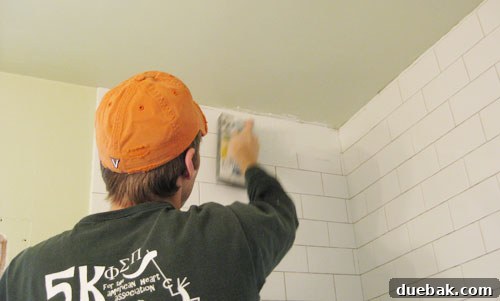
Even after using the grout float to remove excess, a thin film of grout will inevitably remain on the tile surfaces. This is where your damp sponge comes into play. Timing is essential here: begin sponging roughly 8-10 minutes after applying the grout, but certainly no longer than 15 minutes. If you wait too long, the grout will begin to set, making it much harder to remove.
Fill one of your buckets with clean water. Lightly dampen a large yellow sponge – and “lightly” is the operative word here. A sponge that’s too wet will pull grout out of the joints and smear it around. With gentle, light passes, wipe across the tiles diagonally. This action serves a dual purpose: it lifts most of the remaining grout film from the tile faces and, simultaneously, smooths and shapes the grout lines, giving them a professional, concave finish.
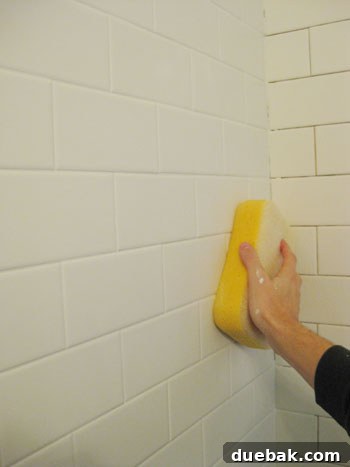
The effectiveness of this step genuinely surprised me. The key to success is keeping your sponge clean. Rinse it thoroughly and frequently in your water bucket, changing the water often to avoid smearing dirty grout back onto your clean tiles. The Grout Release we applied beforehand likely played a significant role in making this process so manageable. This project, which I had dreaded so much, was proving to be far less miserable than anticipated.
The Reveal: From Chaos to Cohesion
While the process itself wasn’t excruciating, I won’t pretend it was a walk in the park. Grouting an entire shower can be physically tiring and a bit monotonous, requiring occasional breaks to clean buckets and mix fresh batches of grout (I ended up using about 3 pounds of a 5-pound container for the tub/shower surround). However, the transformation was nothing short of amazing. The dark, negative spaces between the tiles were now filled with clean, crisp white grout, shifting the visual emphasis away from the lines and back to the beauty of the tiles themselves. Our shower finally looked like a proper, functional space!
After admiring my handiwork on the subway tiles, I turned my attention to the floor. Mixing the “mocha” grout was a bit more challenging due to the darker pigment requiring more careful attention to color consistency. However, the application process for the floor was noticeably faster. With only 1/16-inch wide grout lines and larger tiles, there were fewer lines to cover, requiring only about 1.5 pounds of grout. The difference was once again incredible.
Tackling Grout Haze: The Final Polish
No matter how meticulous your sponging technique, some degree of grout film – known as “grout haze” – is almost inevitable. This thin, often chalky residue may only become truly visible as the grout begins to dry.

This is where the previously applied Marble Sealer was supposed to simplify cleanup. I initially tried wiping away the haze with a damp sponge a few more times. While it helped, it mostly just moved the haze around rather than completely removing it. It was a frustrating cycle.
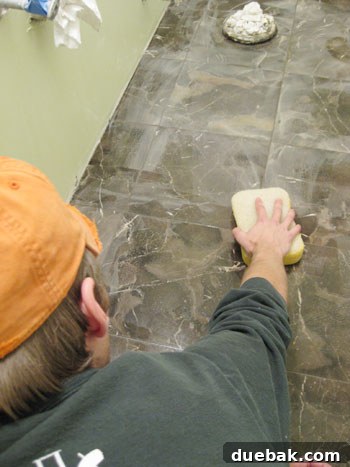
Although we had a bottle of specialized haze remover (borrowed from my dad), I was hesitant to introduce another chemical to our new marble floors. Instead, I experimented with a dry paper towel. And voilà! With a bit of elbow grease and repeated buffing, the dry towel technique proved incredibly effective on both the floor and wall tiles. It successfully removed the stubborn, subtle haze that remained after multiple sponging attempts. Both surfaces easily passed the “white glove test” – no residue left on my bare finger after dragging it across the tiles. Victory at last!
Sealing for Longevity: Protecting Your Investment
The final crucial step, after allowing the grout to cure for at least 48 hours, is sealing. For us, this turned into 72 hours due to a minor “water incident” – a momentary lapse where a curious posterior brushed against the sink’s water valve, sending a jet of water to the ceiling and onto our newly grouted floor. We decided an extra day of curing couldn’t hurt after that unexpected shower!
The sealing process itself is remarkably straightforward and simple. It’s an investment in the long-term beauty and durability of your tiled surfaces. We applied a few generous coats of sealer to both the floor and shower wall. Sealing prevents moisture penetration, helps repel stains, and significantly reduces the likelihood of mold and mildew growth. We used the same Marble Sealer for the floor grout and a product called SurfaceGard for the tub/shower surround, opting for penetrating sealers that soak into the grout lines without altering their texture. We also plan to re-seal every few years to maintain optimal protection.
Note: After sealing, the grout subtly deepened in color, blending even more seamlessly with the mocha tones in our floor tiles – a perfect finish!
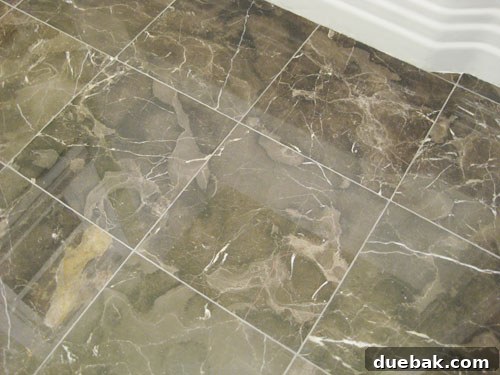
The Finish Line: A Shower-Ready Sanctuary
Reflecting on the entire process, I found myself wondering why grouting had such a formidable reputation. Perhaps working with super thin grout lines in a smaller room made our experience more manageable, or maybe it was the culmination of careful preparation and the right materials. Regardless, applying the grout sealer was the final flourish, bringing our bathroom renovation close to completion. With fixtures yet to be installed and some edges still needing caulk, the room is almost ready to be called a showerable space again. Hello, light at the end of the tunnel – it’s wonderful to see you.
Psst- Eager to catch up on the previous chapters of our bathroom makeover journey? Dive into Chapter One, Chapter Two, Chapter Three, enjoy a little teaser post, and revisit Chapter Four right here.