
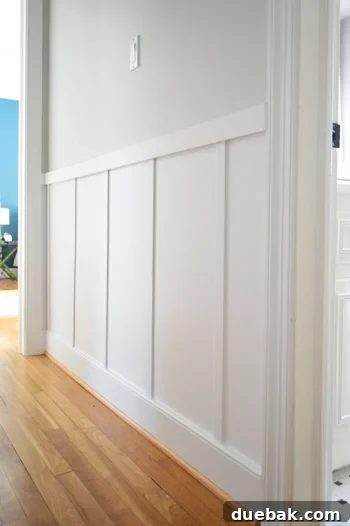
Yesterday we shared the reveal of our board-and-batten hallway project for the Pinterest Challenge, and today we’re posting the full step-by-step tutorial. It’s long—around 2,000 words—but it’s packed with practical, budget-friendly guidance for anyone wanting a high-impact upgrade without a huge price tag. This project cost about $57 in materials (we did buy a tool separately) and was completed in a few short sessions spread across about six days, including paint-dry time. If you work nights and weekends, you could easily spread this out over a week.
We’d been thinking about adding molding details to the hallway for a while and now wish we’d done it sooner. The result feels cohesive and substantial, and once painted it looks like continuous paneling even though we used the existing drywall as the background.
Planning Our Board & Batten
We pulled ideas from several tutorials and blended the techniques that fit our space best. There’s no single “right” way to do board-and-batten—choices come down to personal preference, wall texture, and your home’s style. A few decisions we made early on:
- No additional flat “board” panels: Our drywall is smooth, so we used the wall itself as the background and applied vertical battens directly to it. When painted, it reads like a paneled wall. If you have textured walls, consider adding flat boards first.
- Kept the existing baseboards: We chose battens thin enough to sit flush with our baseboards so we didn’t have to remove or replace trim. If you prefer chunkier boards, you may need to replace baseboards for a cohesive look.
We also created two short videos—one covering construction and one covering finishing touches—so if you prefer visual guidance, those are handy to watch. Below is a thorough breakdown of the process, including tips for keeping rails and battens level, spacing them consistently, and preventing bowing away from the wall.
And the finishing video with caulking, filling nail holes, and paint tips:
If you can’t watch the videos right away, the text and photos below cover every step clearly. Watching later can make the whole process feel less intimidating.
Measuring & Shopping For Materials
First, measure your wall and sketch a plan. A graph-paper sketch helped us tally how many linear feet of molding we needed for the top rail and how many vertical battens to buy. We shopped for the few items we didn’t already own—mainly lattice, a couple of pine boards for the rail, and a nail gun (the nail gun was a birthday gift; you can also rent one if you prefer).
Tools & Supplies Needed
Here’s the supplies list we used:
- Pneumatic or airless brad nail gun (or rent one)
- Pre-primed lattice strips (we used 12 ft pieces cut down)
- 1 x 3″ pine board for the top rail
- 1 x 2″ pine boards if you want a top ledge (optional)
- Measuring tape
- Laser level (optional) or standard level
- Stud finder
- Miter saw or have wood pre-cut in-store
- Spackle or joint compound for nail holes
- Paintable white caulk and caulk gun
- Sandpaper or palm sander
- Primer
- White paint (we used durable satin cabinet-type paint)
- Paint brush, roller, and other painting supplies
*Tip: Buy your wood about a week early and let it acclimate in your home to reduce movement after installation.
Installing The Top Rail
We used 1 x 3″ pine boards for the top rail and cut them to length with a miter saw. Home improvement stores will cut boards for you if you don’t have a saw. Next, decide the height of the top rail. We initially held the rail high but found it visually lowered our eight-foot ceilings, so we settled on a traditional height of 40″ off the floor.
Use a laser or standard level to mark the 40″ line in a few spots along the wall to guide rail placement. Mark stud locations so you can fasten the rail into studs where possible. We nailed the rails in using a brad nail gun, which made the process quick and secure. We avoided gluing the rails to avoid damaging drywall if we ever remove them later.
Measured, cut, and nailed, the rails went up quickly once we were comfortable using the nail gun—without it, expect the assembly phase to take several times longer.
Adding The Vertical Battens
For the vertical battens we used pre-primed lattice strips. Lattice is inexpensive and thin enough to sit flush with our baseboards. If you prefer thicker battens, use 1 x 2″ boards but plan for how they’ll interact with baseboards and door trim.
We spaced our battens 16″ on center to match typical stud spacing, which allowed many of the battens to be fastened into studs. To keep spacing consistent, we made a spacer from a scrap 1 x 3″ board that measured 14.5″ (so battens were 16″ center-to-center). We temporarily taped each batten to the wall, used a level to ensure vertical alignment, then nailed them in place.
The lattice is lightweight, so tape holds long enough to level and secure it. If you can’t line every batten with a stud, prioritize a balanced, even visual layout over hitting every stud—thin battens are light and will hold fine with nails and caulk.
We considered adding a thin top ledge but decided it narrowed the hallway and created awkward corners, so we skipped it.
Prepare For Painting
Next we filled nail holes and caulked gaps. We used spackle (joint compound works too) for nail holes because it’s easy to apply and sands nicely. Paintable white caulk filled gaps where the boards didn’t sit perfectly flush with the wall—mainly along the top rail and a few battens. Caulking and spackling added about an hour of work each.
After the filler dried we sanded smooth with a palm sander to remove excess and create a clean surface for primer.
Prime & Paint
We primed the wood with a stain-blocking primer to prevent bleed-through and create an even surface for paint. Even pre-primed lattice got a quick coat.
Once the primer dried, we painted the battens and rails with Benjamin Moore Advance in a satin finish (a durable paint designed for cabinetry and trim). After allowing the molding paint to cure, we painted the walls above in a light neutral (Moonshine by Benjamin Moore) to complement the adjacent hall and keep the narrow hallway feeling open.
Sherry cut in around the molding by hand to avoid using tape on fresh trim paint; she’s got a neat edging technique that worked well, and then we rolled the wall coats for a smooth finish.
Total Project Cost
We spent very little out of pocket because we already had paint, spackle, and caulk. The items we purchased were:
- Four 12′ pieces of lattice – $32
- Two 8′ pieces and two 6′ pieces of 1 x 3″ pine – $25
If we’d already owned the nail gun, the total would’ve been about $57. Time-wise, the project spanned roughly five days (six including the shopping trip), but with focused work it can be done in three days: construction and spackling one day, sanding/priming/painting the molding the next, and painting the wall on the third day. Nailing by hand will extend the timeline unless you rent a nail gun.
We’re thrilled with how the hallway turned out—what felt bland before now has character and presence. We’re planning what to hang above the molding and considering future trim projects like crown molding. UPDATE: We repeated this treatment in our new house with a slightly fancier take on the classic look.
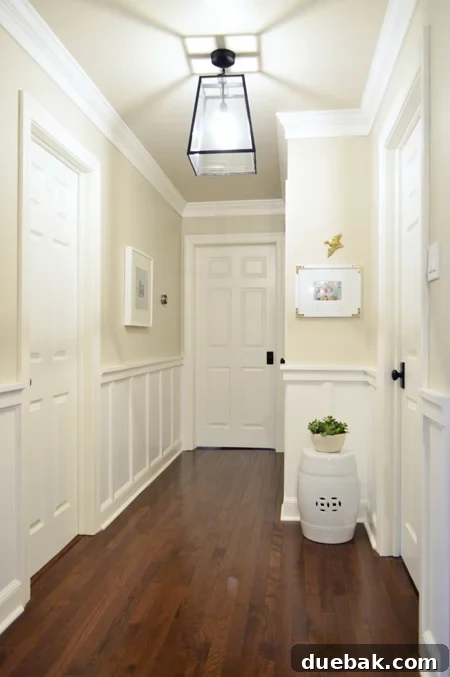
Update – Want to know the paint colors or sources for items we used in our house? We created a shop page with those details.
