
Transforming your home with a DIY project that is both affordable and high-impact can seem like a daunting task. However, few projects offer the blend of simplicity and dramatic results quite like a board and batten wall treatment. This timeless architectural detail, once primarily seen on exteriors, has become a beloved interior design feature, adding character and sophistication to any room. We’ve mastered the art of installing board and batten across three different homes, discovering a clever technique that makes this popular wainscoting style faster, easier, and significantly less expensive than traditional methods. Prepare to be amazed by how simple it is to elevate your space!

For our recent beach house guest bedroom project, we opted for a higher board and batten installation, creating a stunning foundation for peel-and-stick wallpaper above. This combination perfectly captured the traditional yet colorful aesthetic we envisioned, proving that classic design elements can beautifully blend with modern, vibrant touches.
Table of Contents
Understanding Board & Batten Design
Board and batten is a distinctive style of paneling that originated centuries ago as exterior siding for barns and homes, designed for durability and weather protection. Today, it has transitioned seamlessly into interior design, becoming a popular choice for homeowners and designers seeking to add architectural interest and texture to walls. The technique involves placing thin strips of molding, known as “battens,” over the seams between wider, flat boards. This creates a visually appealing pattern of raised and recessed panels. While traditionally featuring actual boards, our method simplifies this by using your existing drywall as the “boards,” installing battens directly onto it for a similar sophisticated effect without the added complexity and cost.
The versatility of board and batten is one of its greatest assets. It can be installed as a classic wainscoting that extends partway up a wall, or dramatically from floor to ceiling, enveloping a room in texture. Battens can be arranged in simple vertical lines, complex horizontal patterns, or even intricate box configurations, each offering a unique aesthetic. From evoking a charming cottage feel to exuding traditional luxury or even a clean, modern vibe, board and batten adapts beautifully to various interior styles. Its ability to transform a plain wall into a focal point makes it an enduring favorite for enhancing entryways, hallways, bedrooms, and dining areas.
Budgeting Your Board & Batten Project
One of the most appealing aspects of a DIY board and batten project is its flexible cost, which can range anywhere from $50 to $650 or more, depending significantly on the scale of your space and your material choices. We’ve personally completed installations on both ends of this spectrum, proving that you can achieve stunning results without breaking the bank. Our most budget-friendly project, costing only $57, involved reusing existing baseboards and opting for simple lattice strips as battens. This smart approach allowed us to create a beautiful impact with minimal material investment.
Conversely, for a grander and more traditional look in a longer hallway, we layered on additional moldings, bringing the cost closer to $300. This demonstrates how material upgrades and increased scope can influence the budget. Our most extensive molding project was a floor-to-ceiling, box-style board and batten in a bathroom, which, due to the sheer volume of molding required for its intricate design, approached $650. While this was a higher investment, it perfectly suited the high-end, luxurious aesthetic we desired for that space.

The key takeaway is that board and batten can be tailored to almost any budget. For the specific project we’re detailing today, the cost came in at approximately $195. Factors like room size and the chosen height of your wainscoting will affect your final spend. Keeping the installation lower on the wall, for instance, naturally reduces material needs and thus, costs. Our innovative technique of applying battens directly to drywall, rather than installing separate “boards,” is a cornerstone of our cost-saving strategy, eliminating the need for extra materials and labor while still achieving that sought-after, polished look.

Essential Tools & Materials for DIY Board & Batten
Our “secret” to achieving stunning board and batten without the hefty price tag lies in a simple, yet brilliant modification: we skip installing the traditional “board” section. Instead, we directly install the battens onto your existing drywall and then paint the entire treatment to match. This ingenious approach drastically cuts down on materials, labor, and time, offering a beautiful, seamless finish that looks every bit as custom and high-end as more conventional methods. The results are indistinguishable, providing an elegant wall treatment with significant savings.

Here’s a comprehensive list of the tools and materials you’ll need to embark on your board and batten journey:
- 1″ x 4″ x 8′ primed boards (These will serve as your sturdy top rail, defining the upper boundary of your wainscoting.)
- 1″ x 3″ x 8′ primed boards (These are your vertical battens, creating the distinctive pattern. Pre-primed wood saves you a critical step!)
- 1″ x 2″ x 8′ primed boards (Used for the top lip, this adds a subtle ledge, enhancing the finished look.)
- Primer (Essential for sealing porous surfaces like spackle and ensuring an even, lasting paint finish.)
- Paint (We used our existing trim paint, SW Pure White in semi-gloss, for a cohesive and bright look. A semi-gloss finish is durable and easy to clean.)
- Spackle or wood filler (We highly recommend this convenient 4-in-1 tool for filling nail holes with ease.)
- Caulk (Our new favorite is Extreme Stretch caulk, known for its flexibility and resistance to cracking.) and a caulk gun (A sturdy caulk gun ensures smooth, controlled application.)
- Nail Gun (An airless nail gun dramatically speeds up the installation process and creates secure fastenings.)
- Miter Saw (Crucial for making precise, clean cuts to your boards, ensuring tight joints. A compound miter saw is ideal.)
- 48″ Long Level (A longer level is invaluable for ensuring your horizontal pieces are perfectly straight across wider expanses.)
- Tape Measure (For accurate measurements of all boards and batten spacing.)
- Stud Finder (A reliable stud finder is essential for locating wall studs, ensuring your top rail is securely anchored.)
- Spackle Knife or Painter’s Tool (For smoothing spackle and scraping any unwanted caulk or debris.)
- High-grit sanding block (To achieve a perfectly smooth finish after spackling.)
- Painter’s Tape (Indispensable for mocking up designs and protecting adjacent surfaces during painting.)
- Pen or Pencil (For marking cuts and stud locations.)
While the actual installation of our board and batten took us only half a day, the entire project spanned two days due to the necessary drying times for caulk, spackle, primer, and paint. Despite this, it’s not overly time-intensive, amounting to roughly six solid hours of focused work. This efficient timeline makes board and batten an excellent weekend project for any DIY enthusiast. Now, let’s dive into the basic steps to achieve this stunning wall treatment.
Step-by-Step Guide to Installing Board & Batten
Step 1: Planning Your Board & Batten Layout and Spacing
Careful planning is the foundation of a successful board and batten installation. The first crucial decision is determining the optimal height for your top rail and the consistent spacing of your vertical battens. For comprehensive planning strategies, refer to this detailed post. We advocate for a visual approach: use a tape measure and blue painter’s tape to mock up several different layouts directly on your wall. This allows you to visually assess what looks most pleasing and balanced in your unique space before making any permanent cuts.

For our beach house bedroom, we chose a wider 18-inch spacing for the battens and positioned our top rail approximately 20 inches down from the ceiling. This specific height was strategically selected to minimize the amount of wallpaper needed above the wainscoting, optimizing material usage. Equally important was considering how the top rail intersected with existing architectural features like doors and windows. We intentionally positioned it to appear slightly lower than these elements, ensuring the final installation looked purposeful and integrated rather than awkwardly aligned. Remember, the goal is harmonious visual flow that enhances the room’s character.
Step 2: Locating and Marking Wall Studs
Securing your board and batten firmly to the wall is paramount for its longevity and stability, and this begins with accurately locating your wall studs. Utilizing a reliable stud finder, systematically scan all walls where you plan to install the top rail. We’ve found this magnetic Stud Buddy to be exceptionally trustworthy due to its strong magnet that snaps onto the nails within your studs. The beauty of a magnetic stud finder is its ability to stay in place, freeing your hands to mark the stud location. Mark your findings with a pencil or, as we did, use pieces of painter’s tape, placing one high and one low to ensure precise alignment for your future battens and top rail.

Accurately marking these studs is critical because the top horizontal rail of your board and batten should ideally be nailed directly into them. This provides the strongest possible anchor, preventing sagging or detachment over time. While not every vertical batten will align with a stud, securing the main horizontal components to studs ensures the overall structural integrity of your wall treatment. This careful preliminary step is a small investment of time that pays dividends in the durability and professional finish of your DIY board and batten.
Step 3: Preparing Your Baseboards
The preparation of your existing baseboards is a pivotal step that largely depends on their current profile. In our guest bedroom, the existing baseboards were a substantial 1×6-inch board topped with a small, decorative trim piece. This 1×6-inch board proved to be the ideal bottom rail for our board and batten, providing a perfect ledge for our vertical battens to sit against. Our task was simply to remove the smaller decorative trim piece, ensuring a flush surface for the battens.

To remove the trim effectively and minimize damage to your drywall, first score the top edge where the trim meets the wall using a utility knife, the sharp corner of a spackle knife, or a painter’s tool. This scoring action breaks the caulk and paint seal, making it easier to gently pry off the decorative piece with a pry bar without tearing large chunks of drywall. Once the trim is removed, you may find some cleanup necessary. Scrape off any remaining caulk, adhesive, or paint residue, and use spackle to patch any nail holes or minor damage, aiming for the smoothest possible surface for your new wall treatment.
If your current baseboards are too thin or unsuitable, you might consider replacing them entirely with a 1×6-inch board to create that perfect bottom edge. In some of our previous hallway projects, we utilized thinner lattice strips as battens, which worked well with narrower baseboards. However, having experimented with both approaches, we’ve come to prefer the more substantial look achieved with thicker battens and a robust baseboard, as demonstrated in this tutorial. This creates a more impactful and traditional wainscoting appearance, enhancing the overall elegance of the room.
Step 4: Installing the Horizontal Top Rail
With your planning complete and baseboards prepped, it’s time to install the first major component of your board and batten: the top rail. This 1×4-inch board will run horizontally around the room, serving as the upper boundary for your battens. Since you’ve already determined its height and marked your studs in Step 2, this phase should proceed smoothly. An efficient airless nail gun will significantly expedite this process, securely fastening the board to the wall.
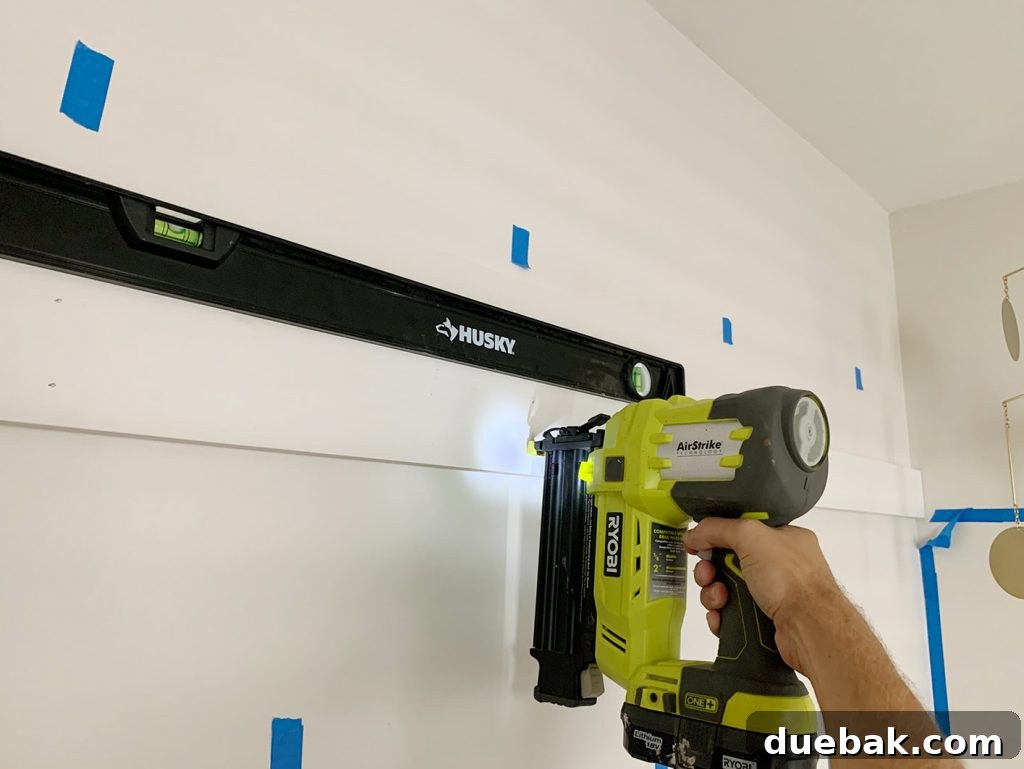
As you install, keep a long level constantly at hand. Older homes, like our 115-year-old beach house, often feature charmingly “wonky” walls, floors, and ceilings that are rarely perfectly straight. In such cases, it’s often more visually pleasing to align your top rail with the slight slope of the ceiling rather than adhering rigidly to a true level. This creates an optical illusion that makes the installation appear perfectly parallel to the most prominent architectural line, making your final work look the most “level” to the human eye. We use our miter saw for precise cuts, but hand cutting with a miter box or even having your lumberyard make the cuts can work too.

For most installations, straight cuts where boards meet in corners are perfectly acceptable and simplify the process. The only instance where we incorporated an angled cut was on a particularly long wall that required two board pieces to span its entire length. A slight angle at the joint helps to visually camouflage the seam more effectively than a blunt straight cut, creating a smoother transition. However, this is largely an aesthetic preference and not strictly necessary for functionality. Focus on hitting those marked studs for maximum stability.
Step 5: Attaching the Vertical Battens with Precision
With the top rail firmly in place, it’s time for the “main event”: installing your vertical battens. While this step isn’t rocket science, the repetitive nature of measuring, cutting, and nailing requires patience and precision. A key recommendation is to measure each individual batten piece before cutting it. Walls, especially in older homes, are rarely uniform in height, and even slight discrepancies can lead to unsightly gaps if you pre-cut all your pieces. Measuring individually ensures each batten fits as snugly as possible between your baseboard and the top rail.

To guarantee consistent spacing, a crucial tip is to create a “spacer” out of scrap wood. As seen in the photo above, this simple tool (positioned between the two middle battens) eliminates the need for constant tape measure checks. For our 2.5-inch wide battens, spaced 18 inches apart from center-to-center, our spacer was cut to 15.5 inches wide. This allows for quick and accurate placement of each subsequent batten. Some DIYers opt to apply construction adhesive behind their battens for extra hold, especially since not every batten will align with a stud. However, we generally avoid adhesive to prevent extra drywall damage should we ever decide to remove the wall treatment. We’ve found that a few well-placed nails up and down the board, combined with caulked edges and the final paint layers, provide ample security. Just remember to ensure any batten intended for hanging heavy items (like coat hooks) is securely nailed into a wall stud.
Step 6: Expert Tips for Seamless Corners
While your initial planning likely addressed general batten spacing, navigating corners can present unique challenges to maintain a polished, consistent look. Our standard approach involves centering one batten on the wall and then installing subsequent battens at our chosen 18-inch interval until we approach a corner, door, or window. Sometimes, this means the last batten might be slightly “cut off” in the corner, and that’s perfectly acceptable for a practical installation.

However, through trial and error, we discovered that corners achieve the most aesthetically pleasing result when two “full” battens meet without overlapping. By “full,” we mean that each batten should maintain its original width right up to the corner, without one appearing slimmer due to partial overlap. To achieve this, as shown in the photo below, our corner battens don’t butt fully into the corner. Instead, they are floated ever so slightly off the corner, allowing both battens to appear their full size and avoid any visual distortion where they meet. This subtle adjustment prevents one batten from seemingly shrinking at the expense of the other, ensuring a harmonious and professional finish around every turn.

Step 7: Adding the Decorative Top Ledge
While our very first board and batten project omitted a top ledge, we’ve since concluded that the added effort is undeniably worthwhile. The inclusion of a flat ledge significantly enhances the substantiality and finished appearance of the wainscoting. More than just an aesthetic upgrade, it provides a functional surface perfect for leaning artwork, displaying small decorative items, or even holding a drink. To create this elegant feature, we simply used a 1×2-inch board, securely nailing it along the top edge of the horizontal top rail.

For most decorative purposes, nails provide sufficient hold for the top ledge. However, if your intention is to place particularly heavy objects on the ledge, or if it will be frequently handled, we highly recommend reinforcing the attachment. In such cases, consider using wood screws in addition to, or instead of, nails. Screws offer a stronger, more secure fastening, providing peace of mind that your ledge can safely support whatever you choose to display. This thoughtful addition elevates your board and batten from a simple wall treatment to a refined, functional architectural element.
Step 8: Finishing Touches: Spackle & Sand Nail Holes
Before you even think about grabbing your paintbrush, the crucial step of filling and sanding all nail holes must be completed. This meticulous attention to detail is what separates a good DIY job from a professional-looking finish. Many of our podcast listeners raved about this 4-in-1 spackle tool for exactly this kind of task, and they were absolutely right! While any standard spackle knife would suffice, this tool significantly streamlines the process.

To use it, simply squeeze a small dot of spackle directly into each nail hole from the tube. Then, flip the tool around and use its flat edge to smoothly scrape off any excess, leaving a perfectly filled and flush surface. Although the tool’s cap includes a small sanding pad, we found it more efficient and ergonomic to use a larger, regular sanding block for this step. Once the spackle is completely dry (check the product’s recommended drying time), gently sand each filled area until it is perfectly smooth and indistinguishable from the surrounding wood. This creates an invisible repair, ensuring a flawless base for painting. After sanding, be sure to thoroughly dust off all sanded areas with a microfiber cloth or paper towel. This removes any fine sanding dust that could interfere with paint adhesion and create an uneven finish.

Step 9: Sealing and Smoothing: Caulk Your Seams
Caulking is the secret weapon for achieving that seamless, built-in look for your board and batten. This step involves applying caulk to every seam where your boards meet the wall and where they meet each other. Not only does caulk fill any small gaps, but it also effectively disguises minor bows or imperfections in your wall, making the entire board and batten treatment appear as if it’s an integral part of the wall, rather than just an addition nailed onto it. This creates a refined, professional finish that elevates the entire project.

We’re particularly fond of Extreme Stretch caulk because of its superior flexibility, which helps prevent cracking and separation as your home’s temperature and humidity fluctuate. If that’s unavailable, this fast-dry alternative is also an excellent choice, especially if you’re eager to get to the painting stage. For this project, you’ll likely need only a thin line of caulk, so be cautious not to cut too large an opening at the tip of your caulk tube. Cutting it at a slight angle and keeping the opening small will give you more control, make the application faster, and result in a cleaner finish. You can always cut off more if a thicker bead is needed.

For efficiency, we found it fastest to apply a thin bead of caulk along all four sides of a particular “box” or panel before smoothing. Instead of stopping to smooth each side individually, tackling a whole section at once creates a more continuous and even finish. A pro tip for smoothing caulk is to dip your finger in a cup of warm water first. This prevents the caulk from sticking to your finger, allowing you to achieve a perfectly smooth, clean line with minimal effort. Allow the caulk to dry completely according to the manufacturer’s instructions before proceeding to the next step.
Step 10: Prime & Paint for a Flawless Finish
You might be tempted to skip priming, especially if you’ve used pre-primed boards. However, we’ve learned through experience that it’s always the safest bet to apply at least one coat of primer over any areas where you’ve used caulk or spackle. This crucial step prevents what’s known as “flashing,” which occurs when the final paint job shows a discernible change in sheen or color from certain angles, particularly where fillers or caulk have been applied. We’ve had more than a few projects spoiled by these shiny, inconsistent spots appearing *after* the final coat of paint, so believe us when we say: it’s better to be safe than sorry (or flashing!).

The image above, taken after everything was primed, might look a little blotchy, but that’s exactly what primer is for! Thanks to that “just in case” coat of primer, we only needed one single coat of paint to achieve a perfectly smooth and even finish. We chose to use our existing trim color, Sherwin-Williams Pure White in a Semi-Gloss finish, to maintain a bright, cohesive, and classic beachy aesthetic. However, the beauty of board and batten is its adaptability; it looks fantastic in a myriad of colors, from bold, dramatic hues to subtle, tone-on-tone looks achieved by simply using a glossier sheen of your existing wall color. Consider your room’s overall palette and desired mood when selecting your final paint color.

Reveal: The Finished Board & Batten Accent Wall
As glimpsed at the very beginning of this guide, our board and batten installation was beautifully complemented by the addition of wallpaper above it. This combination created a captivating and personalized aesthetic that brought our vision for the guest bedroom to life. If you’re inspired to take your wall treatment even further, you can learn how to effortlessly hang peel & stick wallpaper yourself – it’s another beginner-friendly DIY project! For a complete look at the final bedroom makeover, including all product sources and design details, explore our dedicated post. This DIY board and batten tutorial provides a robust foundation for anyone looking to add timeless elegance and character to their home. We hope this comprehensive guide empowers you to tackle this rewarding project with confidence, transforming your space with architectural charm and a touch of personal flair!

Board & Batten FAQs

Is board & batten an outdated style?
Absolutely not! Board and batten is a classic, timeless design element that remains incredibly popular in contemporary interior design. Its versatility allows it to seamlessly adapt to various aesthetics, from modern farmhouse to coastal chic or traditional elegance. To ensure your board and batten feels fresh and current, opt for crisp, clean paint colors – we highly recommend Sherwin-Williams Pure White – or choose an on-trend color that complements your home’s decor. Its enduring appeal lies in its ability to add texture, dimension, and architectural interest without ever truly going out of style.
What kind of wood can you use for board & batten?
You have several excellent options for materials when creating the board and batten look. For the battens themselves, we frequently use pre-primed pine boards or lattice strips, as they save a significant amount of time during the priming stage. If you opt for the more traditional method of installing “boards” over your drywall before adding battens, MDF (medium-density fiberboard) panels are an excellent choice for a smooth, flawless finish that surpasses plywood in consistency. However, avoid using MDF in high-moisture areas like bathrooms or kitchens, as it can swell and warp. For outdoor installations, always choose pressure-treated wood or cedar, which are specially designed to withstand the elements and resist rot and insects.
Where does board & batten look best?
There are no strict rules for where to incorporate board and batten; its adaptability makes it suitable for almost any space! It’s especially popular in high-traffic areas like hallways, entryways, and mudrooms, where it adds durability and visual appeal. Bedrooms and dining rooms also benefit greatly from this treatment, creating a cozy and sophisticated atmosphere. For optimal visual impact, we generally recommend installing board and batten on walls that can accommodate at least three vertical panels. This repetition creates the rhythmic pattern necessary for the style to make a cohesive and impactful statement.
How high should board & batten be?
The ideal height for board and batten typically falls between one-half and two-thirds of the way up your wall. However, it can also extend dramatically all the way to the ceiling for a bold, enveloping effect. We strongly recommend using painter’s tape to mock up different heights in your specific space. This allows you to visualize the best proportion in relation to your ceiling height, doorways, windows, and any artwork you plan to display. As a general rule of thumb, when aiming for a “halfway” look, it’s often better to err on the side of slightly higher rather than lower. A true halfway measurement can sometimes appear squat or too low, so cheating it up a few inches can make a significant difference in achieving a more elegant and balanced visual.
How far apart should board & batten be?
The spacing of your vertical battens plays a crucial role in the overall aesthetic of your board and batten installation. We typically recommend spacing them between 12 and 20 inches apart, measured from the center of one batten to the center of the next. Generally, larger rooms can accommodate wider spacing, while smaller rooms might benefit from a slightly tighter pattern. Just like determining height, using painter’s tape to visualize different spacing options on your wall is invaluable. It’s also important to remember that different walls within the same room may require slight adjustments to spacing to avoid awkward small or “cut-off” sections, particularly in corners or around architectural features. Prioritize visual balance and a consistent look rather than strict adherence to a single measurement.
Can you install board & batten on textured walls?
Yes, you can absolutely install board and batten on textured walls, but it requires a slightly different approach than the method detailed in this tutorial. If your walls have a significant texture, you won’t be able to use your existing drywall as the “boards” (the flat sections) because the texture would show through. Instead, you’ll need to first install thin, smooth panels over your textured drywall. We suggest using thin MDF (medium-density fiberboard) panels, securely screwed into your wall studs, to create a smooth surface. Once these panels are in place, you can then proceed with adding your battens on top, following the remaining steps of this guide to achieve a beautiful, smooth board and batten finish.
Explore More DIY Wall Treatment Ideas

Seeking further inspiration to add captivating architectural interest and unique personality to your walls? Beyond this detailed board and batten tutorial, we’ve explored a variety of DIY-friendly wall treatment projects that can dramatically transform any space. From budget-conscious wainscoting alternatives to intricate decorative moldings and textured planked walls, there’s a project to suit every style and skill level. Dive into these other popular DIY endeavors, including different iterations of the board and batten style:
- Our $57 Board & Batten Tutorial (Discover how we achieved a stunning look for less than the cost of dinner!)
- A “Fancy” Version Of Board & Batten (Elevate the classic look with layered moldings for added sophistication.)
- Decorative Box Molding In Our Bathroom (Learn to create elegant box-style molding for a high-end feel.)
- A Colorful Wood Wall Treatment (Infuse vibrant personality with a unique planked wall.)
- Installing $31 “Shiplap” Kitchen Backsplash (Achieve the popular shiplap look affordably in your kitchen.)
- Quick Bathroom Shiplap Backsplash (A fast and easy way to add character to your bathroom without extensive demolition.)
- Adding Crown Molding Yourself (Master the art of installing crown molding for a regal finish.)
- How To Add A Removable Wallpaper Mural (Easily update your walls with the transformative power of removable wallpaper.)
*This post contains affiliate links*