

Transforming your bedroom into a sanctuary of style and comfort is simpler than you might imagine. One of the most impactful and surprisingly easy upgrades you can undertake is adding a beautiful headboard to your bed. A DIY upholstered headboard not only introduces an immediate sense of polish and coziness but also offers unparalleled opportunities for personalization. Forget about compromising on fabric, size, or design; with a custom-made headboard, you can achieve the exact aesthetic you’ve envisioned for your personal space. What’s more, this project is remarkably affordable, often costing significantly less than ready-made alternatives. We’ve successfully tackled numerous headboard projects over the years, constantly refining our methods to bring you the best and most straightforward approach.
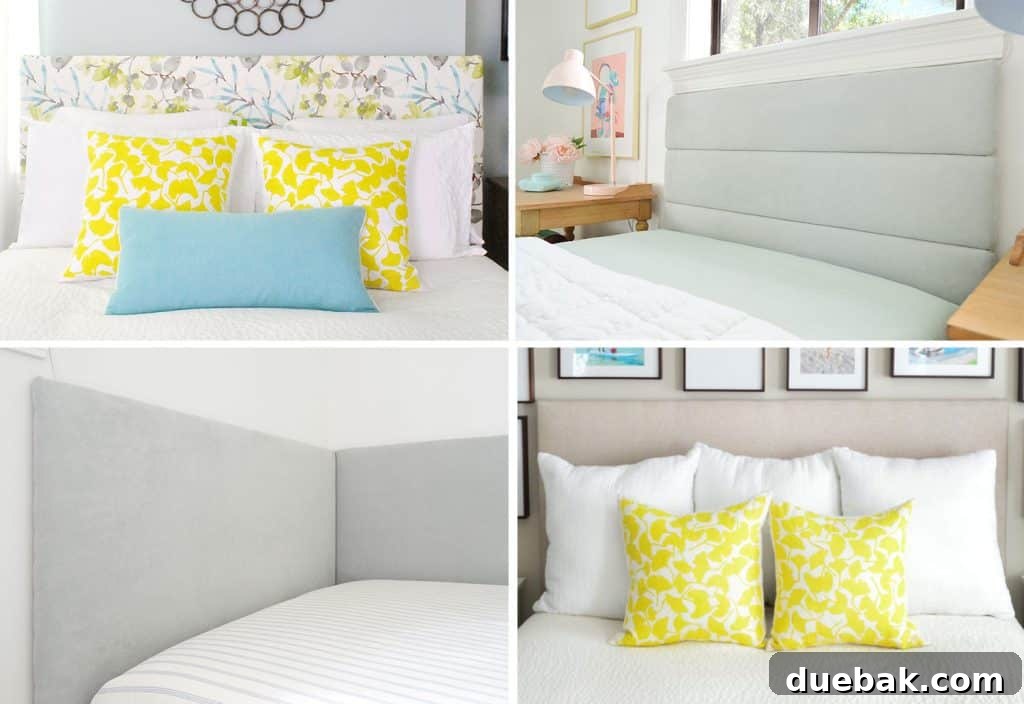
In this comprehensive guide, we’ll walk you through the step-by-step process of creating a classic upholstered headboard, mirroring the timeless design featured in the top-left corner of the image above. This particular tutorial is our go-to for its elegance and straightforward execution, making it perfect for both beginners and experienced DIY enthusiasts. However, for those seeking alternative designs or more advanced techniques, we’ve also curated additional inspiring headboard ideas:
- How to make a channel-tufted headboard (top right) – A sophisticated option for adding texture and depth.
- How to make a daybed-style headboard (bottom left) – Ideal for multi-functional spaces or children’s rooms.
- How to make a wall cleat to hang a headboard (bottom right) – A robust and clean hanging solution for any headboard style.
Table of Contents
Why Choose A DIY Upholstered Headboard?
The decision to add a headboard, especially an upholstered one, brings a multitude of benefits to any bedroom. Initially, our motivation stemmed from a desire to replace a less-than-ideal existing headboard, aiming for something far cozier and more supportive. We had previously transformed our four-poster bed by removing the posts, realizing we craved a softer, more inviting backrest for evening relaxation. The short wooden headboard we had simply didn’t provide the plush comfort we sought.

Elevate Your Bedroom Aesthetics and Comfort
Beyond personal comfort, upholstered headboards are powerful design elements. A bedroom without a proper headboard can often feel incomplete or utilitarian, sometimes evoking the starkness of a college dorm room or a first apartment. Adding an upholstered headboard is a sophisticated upgrade that instantly anchors your bed, transforming it into the focal point of the room. It’s not just about filling a void; it’s about adding architectural interest and a sense of luxury.
Unmatched Customization and Personalization
One of the most compelling reasons to DIY an upholstered headboard is the sheer freedom of customization. You get to select the fabric, dictating the mood and style of your space. Whether you desire a bold splash of color and an intricate pattern to energize the room or a subtle, neutral texture to contribute to a serene, zen-like atmosphere, the choice is entirely yours. This level of control is rarely found with off-the-shelf options, allowing you to truly imbue your personality into your decor. From plush velvets to crisp linens, vibrant florals to minimalist solids, the fabric becomes a canvas for your personal style.
Significant Cost Savings
As we’ll demonstrate with our budget breakdown, crafting your own upholstered headboard can lead to substantial savings compared to purchasing a pre-made one. Designer headboards, especially those offering custom fabric choices, can cost hundreds, if not thousands, of dollars. Our project, for instance, came in at a fraction of that price. This affordability makes a custom, high-end look accessible, proving that luxury doesn’t always have to come with a hefty price tag.
Materials & Tools for Your Headboard Project

While specific items may vary slightly based on your chosen design and bed size, the following list provides a comprehensive overview of the materials and tools you’ll generally need to construct your own stylish upholstered headboard:
- Fabric of your choosing: The star of your headboard! We typically use around 2-3 yards for a queen-size headboard, but always measure your frame with some overhang in mind. Consider durability, cleaning, and how the pattern will repeat.
- Extra loft batting: For plushness and a smooth finish. We recommend 4 yards for a double-layer effect, ensuring ample padding. Upholstery foam is an alternative for thicker cushioning.
- 5/8″ plywood or MDF: This forms the rigid backbone of your headboard. Plywood is generally lighter and more warp-resistant, while MDF offers a very smooth surface.
- Two or three 1×3″ whitewood boards: Essential for structural support, especially if you’re joining pieces of plywood or adding unique design elements like winged sides.
- Miter, table, or circular saw: Needed for precisely cutting your wood pieces. Many home improvement stores offer cutting services if you don’t own these tools.
- Heavy-duty staple gun & staples: A crucial tool for securing both batting and fabric. Invest in a good quality one that can handle consistent use.
- Screwdriver and screws: For assembling your wood frame and attaching the headboard to your bed or wall.
- Optional: Kreg Jig: If you plan on using pocket holes for seamless and strong wood joinery.
- Optional: Wood glue and nails: Alternative or supplementary methods for assembling your wood frame.
- Iron and ironing board: To ensure your fabric is smooth and wrinkle-free before upholstery.
Step 1: Constructing Your Sturdy Wood Frame
The foundation of your upholstered headboard lies in a well-constructed wood frame. While there are various approaches to building this base, including incredibly lightweight options, for this project, we opted for a robust plywood frame. If you’re aiming for a straightforward rectangular design, this step can be as simple as cutting a sheet of plywood to your desired dimensions. Many home improvement stores offer convenient cutting services, saving you time and effort.
Determining Dimensions and Design
For our queen-size bed, we settled on a headboard measuring 65 inches wide and 31 inches tall. However, these dimensions are entirely customizable to fit your specific bed size, ceiling height, and personal preference. Consider the overall scale of your room and how much of the wall you want the headboard to occupy. A wider headboard can make a room feel more expansive, while a taller one adds drama.
Our frame, however, required a slightly more intricate design, which we’ll explain in detail.

Incorporating Unique Features: Wrap-Around or Winged Designs
Our specific plan was to design the DIY headboard to seamlessly wrap around the existing headboard posts of our Ikea Edland bed. We initially mocked this concept in Photoshop to visualize the final look. This wrap-around technique is also perfectly adaptable if you’re aiming for the popular “winged” headboard aesthetic, which adds a luxurious, enveloping feel to your bed.

To achieve these small side pieces, we attached two 1×3 inch whitewood boards to each edge of the main plywood panel. We utilized screws drilled into pocket holes, created with our trusty Kreg Jig, for a strong and concealed joint. Alternatively, these pieces could be securely fastened using a combination of wood glue and nails, ensuring a durable connection.

Addressing Practical Challenges: Joining Plywood Sections
Another reason our frame construction was slightly more involved than a single plywood sheet was a practical one: fitting it into our car! Due to its large size, we had the plywood ripped in half at Home Depot. Back home, we seamlessly reconnected the two halves using scrap pieces of whitewood boards, reinforcing the seam from the backside. This clever solution proves that you don’t always need specialized equipment to overcome logistical hurdles in DIY projects.

Pre-Upholstery Fit Test
Before proceeding with any upholstery, it’s absolutely crucial to perform a dry-fit. We brought our newly constructed frame indoors to ensure it perfectly fit around our existing bed frame as planned. This step is vital to catch any sizing errors or alignment issues early on, preventing frustrating setbacks later in the process. Thankfully, our frame fit precisely!
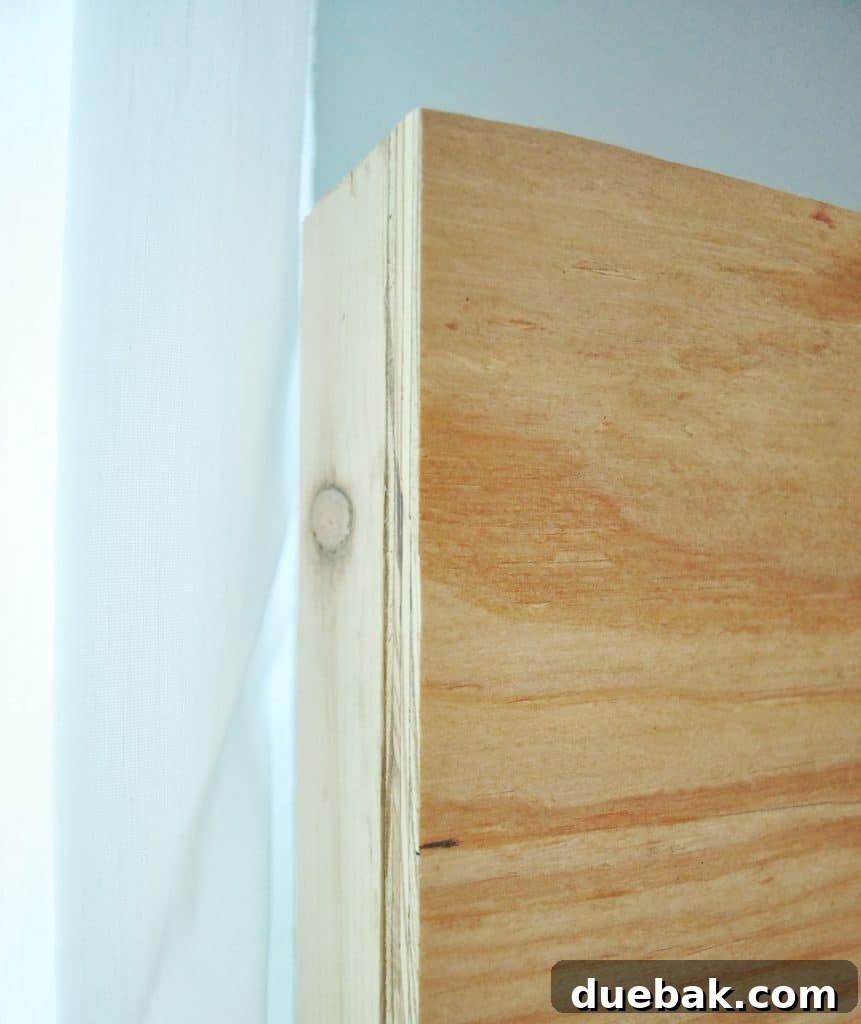
At this stage, you can also clearly visualize how the wrap-around side pieces effectively conceal the existing bedposts, creating a clean and integrated look. Since these raw edges will soon be covered by fabric and batting, their unfinished appearance at this point is completely acceptable.
Step 2: Creating a Plush Foundation with Batting
If the thought of upholstery feels daunting, remember this simple mantra: if you can wrap a present, you can upholster a headboard! The process is very similar, focusing on tautness and neat corners.
Choosing Your Padding: Batting vs. Foam
Before applying the decorative fabric, adding a layer of padding is essential for both comfort and a professional finish. We opted for extra loft batting. To achieve ample plushness without compromising the headboard’s shape, we decided on two layers. Batting is forgiving and easy to work with, especially around curves and edges.
Alternatively, you could use upholstery foam, which offers a thicker, firmer cushion. If using foam, you typically attach it to the plywood with spray adhesive. While foam can be faster for a very thick result, batting is often easier to wrap smoothly around all edges. If you desire extreme thickness with batting, be mindful that too many layers might make stapling into the wood challenging.
Applying the First Layer of Batting
To begin, lay your chosen batting flat on a clean floor. For our headboard, Sherry carefully trimmed a 2-yard section using regular scissors, ensuring about a 2-3 inch overhang on all sides of the frame. This overhang is crucial for securely wrapping the batting around the back of the plywood. Once trimmed, center your wooden headboard frame on top of the batting.
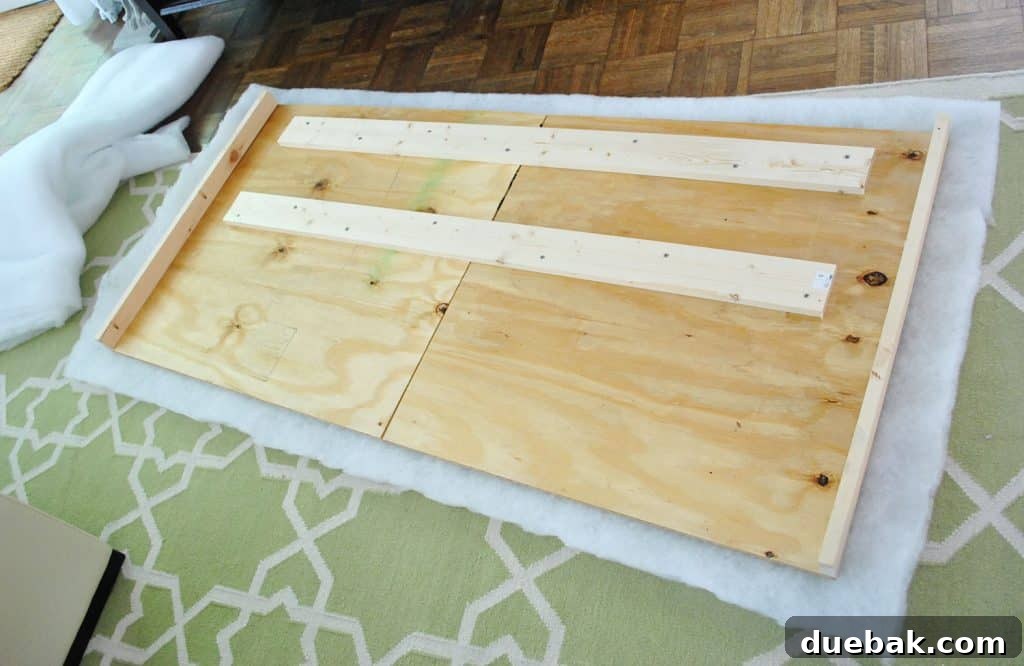
Using your heavy-duty staple gun, start attaching the batting to the back of the frame. Begin by pulling the batting tightly around the edge of the plywood and stapling it every few inches. Work your way around the perimeter, ensuring consistent tension to prevent any looseness or sagging on the front.
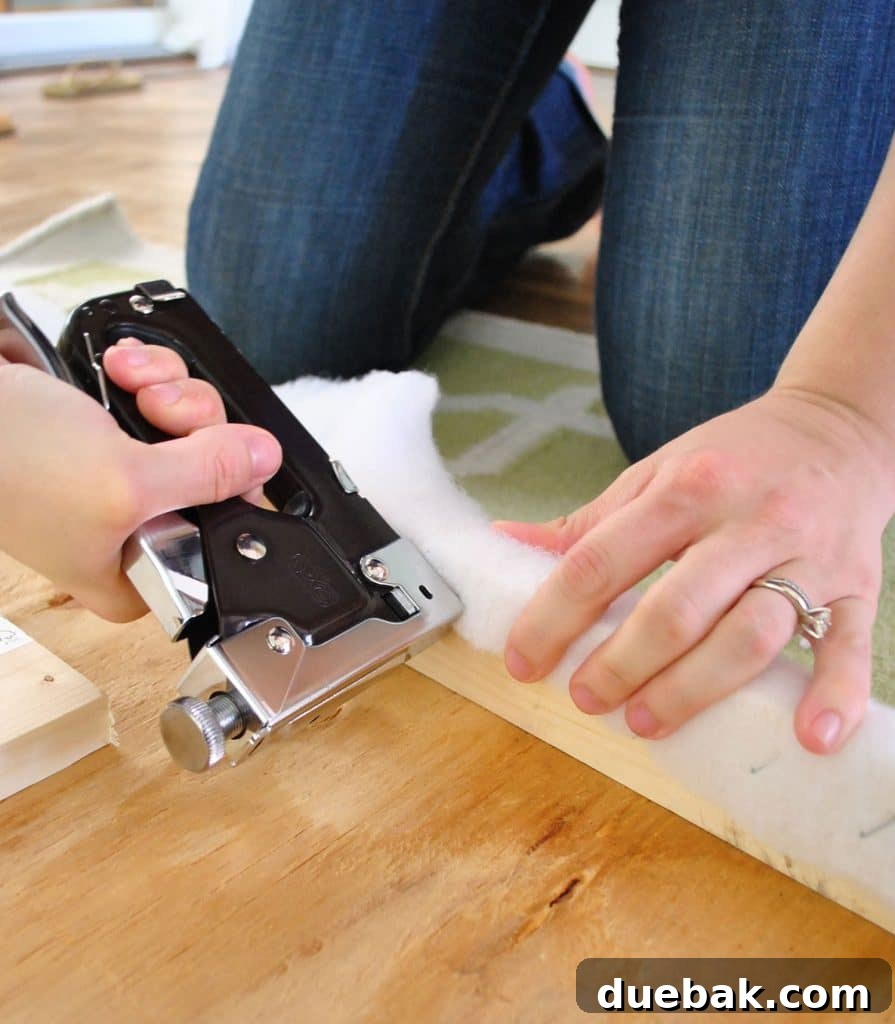
Mastering the Corners
When you reach the corners, treat them just like you would when wrapping a gift. Smoothly fold the excess batting back, creating a clean, tight corner. Staple it securely, ensuring the front remains perfectly smooth and free of bulk. The goal is to minimize excess material at the corners to maintain a sleek profile. This attention to detail will significantly impact the professional appearance of your finished headboard.
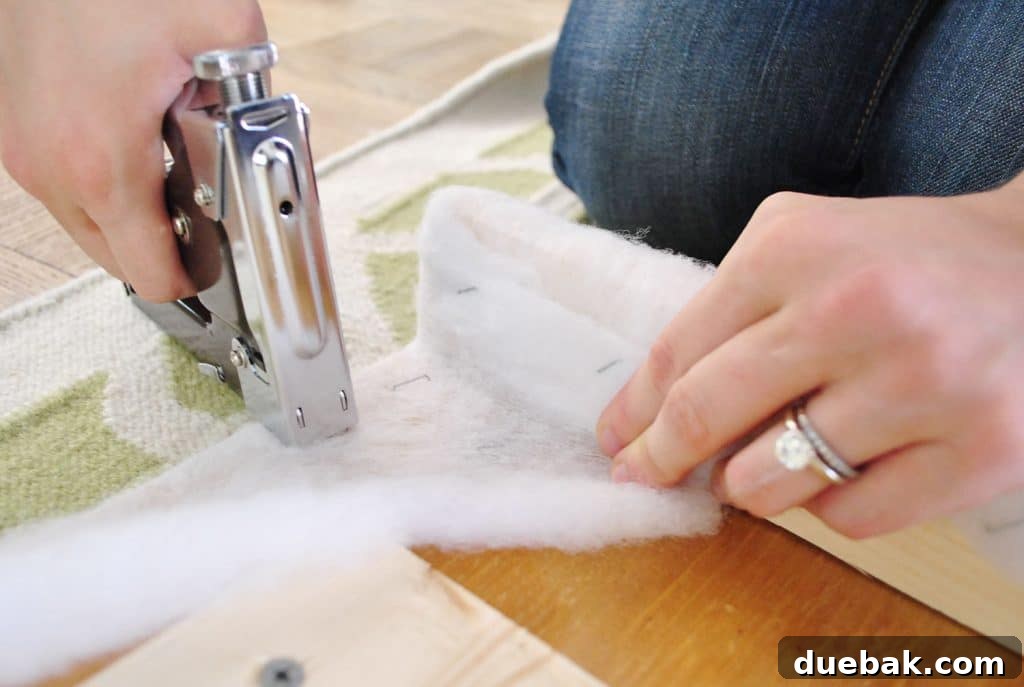
Continue working your way around the entire back of the headboard, consistently pulling the batting taut and stapling every few inches. It’s a rhythmic process, and before you know it, the first layer will be securely in place. (John even managed to capture an “action shot” of this focused effort!)

Once the entire first layer is stapled down, you’ll have a beautifully padded base. Ensure all edges are uniformly covered and securely fastened.
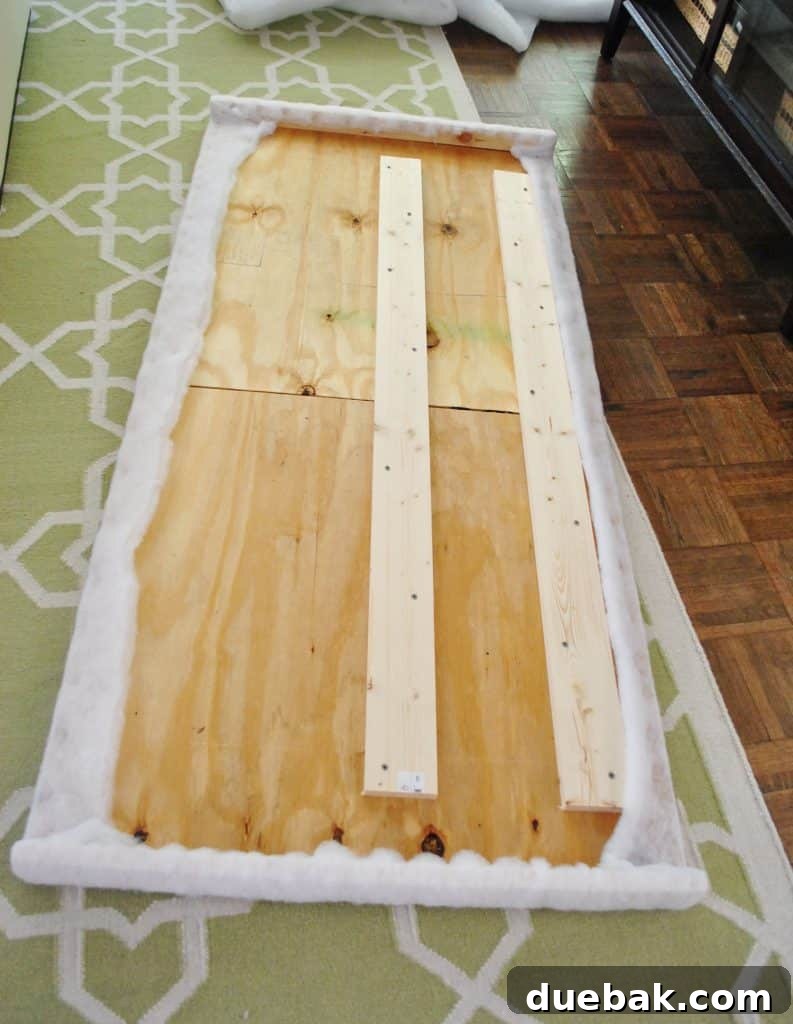
Adding the Second Layer for Extra Plushness
For an even more luxurious and plush feel, we decided to add a second layer of batting. Simply repeat the entire process: lay out another section of batting, place your now single-layer-padded frame on top, pull taut, and staple around the perimeter, paying close attention to clean corners. This double layer creates a wonderfully soft yet firm surface, perfect for leaning against.

Step 3: Upholstering with Your Chosen Fabric
This is where your vision truly comes to life! Upholstering with your chosen fabric is the most rewarding part of the process, transforming your padded frame into a stylish centerpiece. Before you begin, give your fabric a thorough ironing to eliminate any creases or wrinkles. A smooth starting point ensures a flawless finish.
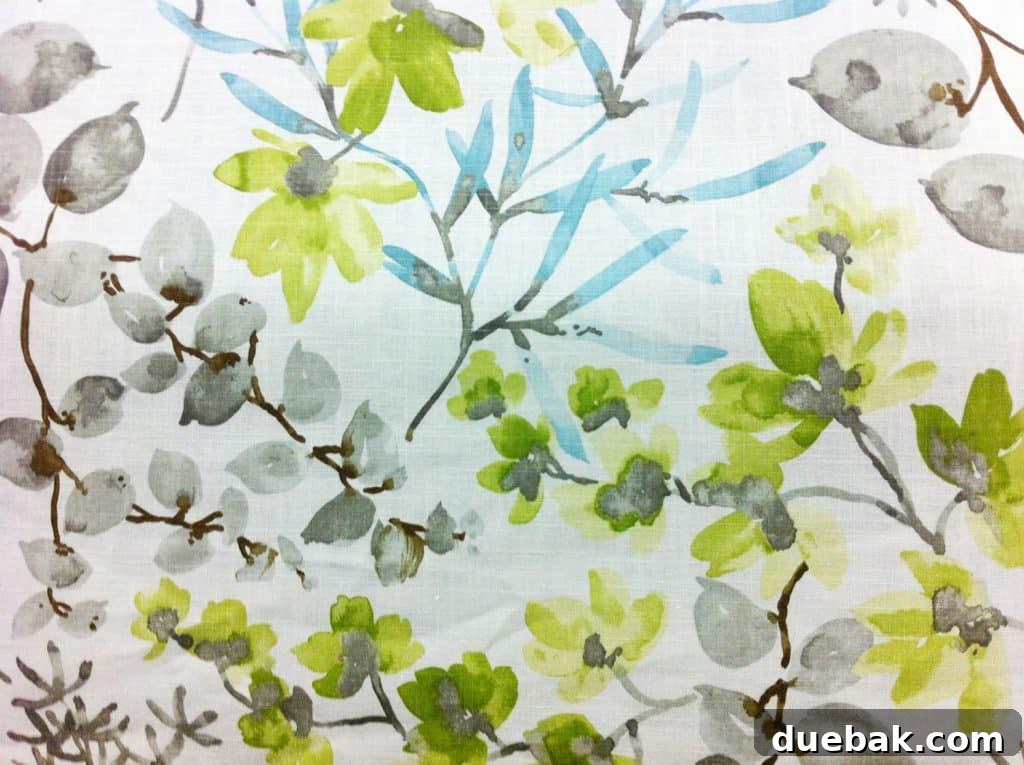
Preparing and Positioning Your Fabric
Just as you did with the batting, lay your ironed fabric flat on a clean floor. Carefully place your (now batting-covered) headboard frame on top of the fabric. It’s crucial to ensure the fabric is perfectly centered and positioned, especially if it has a pattern you want to align. Pull the fabric taut underneath the frame, checking from the front to confirm there are no wrinkles or distortions. Next, trim off the excess fabric around the perimeter, leaving a generous few inches – typically 2-3 inches – to be wrapped and stapled around the back, mirroring the process used for the batting.
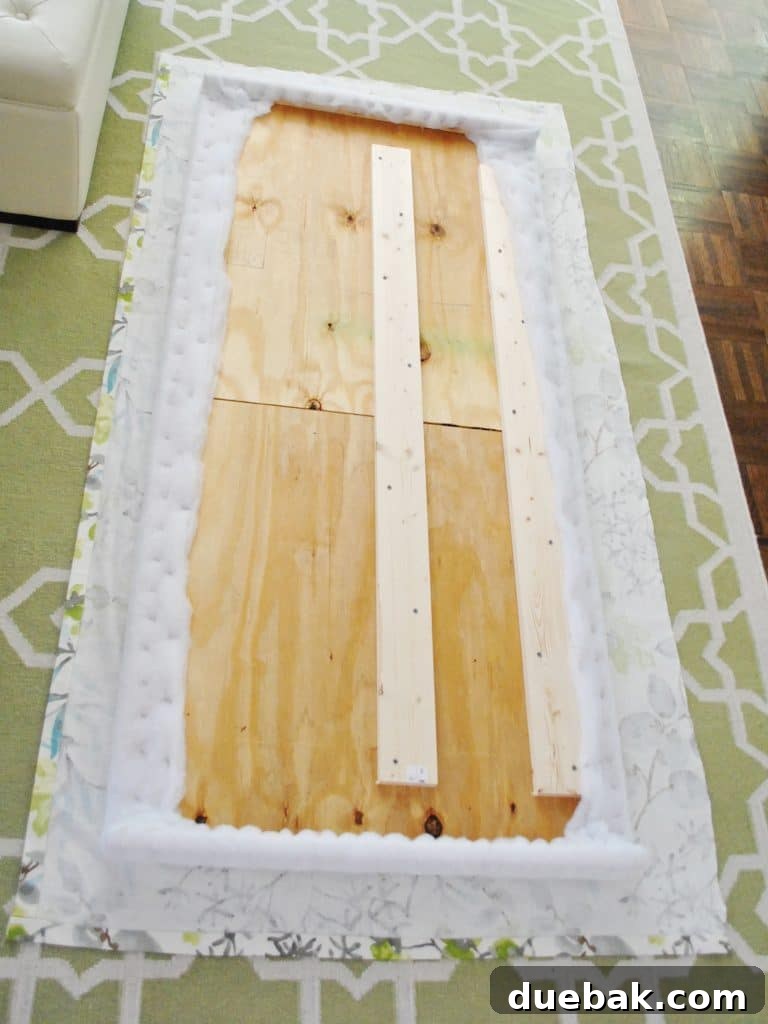
The Stapling Sequence for a Professional Finish
The key to a smooth, wrinkle-free upholstered headboard is maintaining consistent tension and following a strategic stapling sequence. Begin by securing the fabric on two opposite sides. We started with one side, pulling the fabric extremely tight, then stapled along that edge. Immediately move to the directly opposite side, pulling it equally taut, and staple it securely. This opposing tension helps distribute the fabric evenly and prevents pulling or puckering.
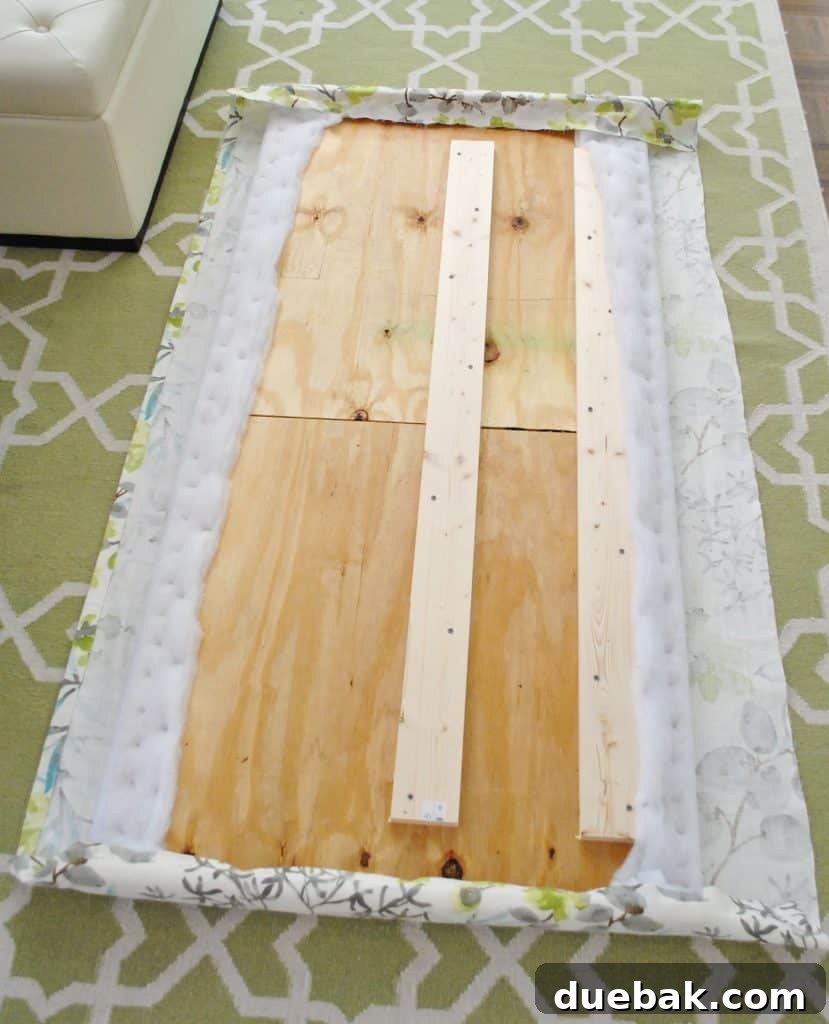
Once the fabric is secured on the horizontal (or vertical, depending on your starting orientation) sides, repeat the process for the remaining two sides. Pull the fabric tightly along the top edge, staple it, and then do the same for the bottom edge. This method ensures that the fabric is stretched evenly across the entire surface, creating a drum-tight finish that will resist sagging over time. Pay close attention to the corners, folding the fabric neatly as you did with the batting, to minimize bulk and create a crisp edge.
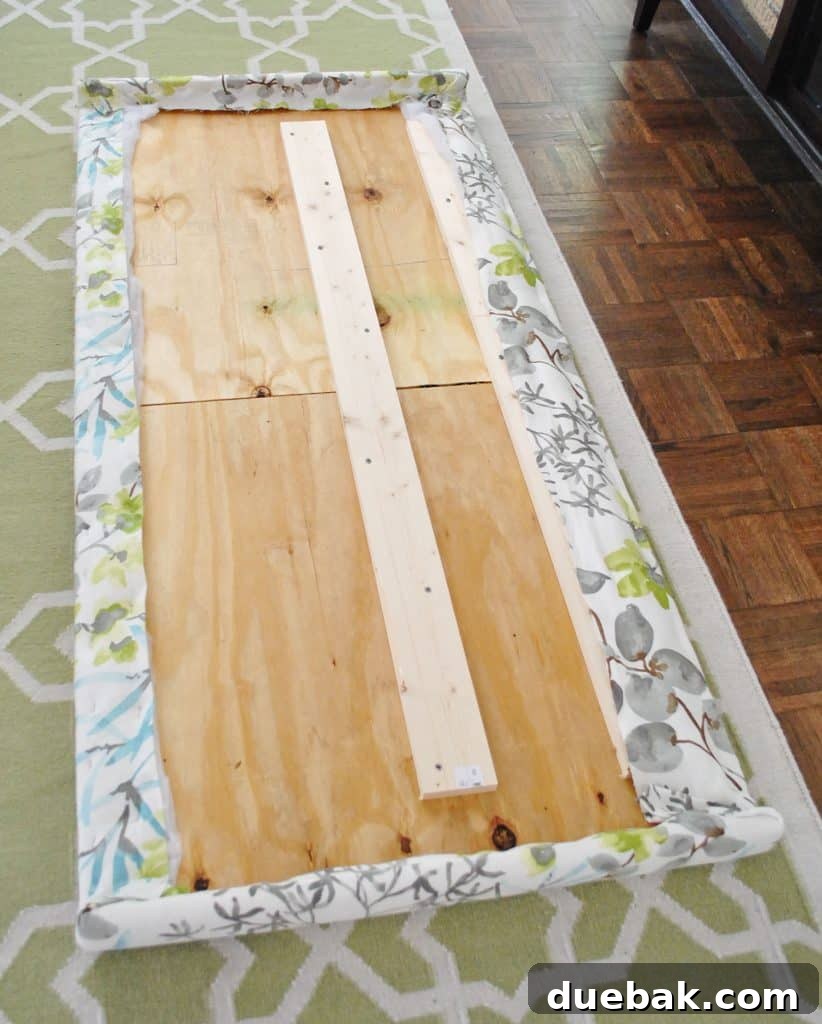
With all four sides securely stapled, flip your headboard over to admire your handiwork. The entire upholstery process, from laying the fabric to the final staple, can often be completed in less than forty-five minutes. The transformation is incredibly satisfying, delivering a plush, tightly upholstered surface that looks professionally done. We absolutely adore the pattern we chose; it truly brings the headboard to life.
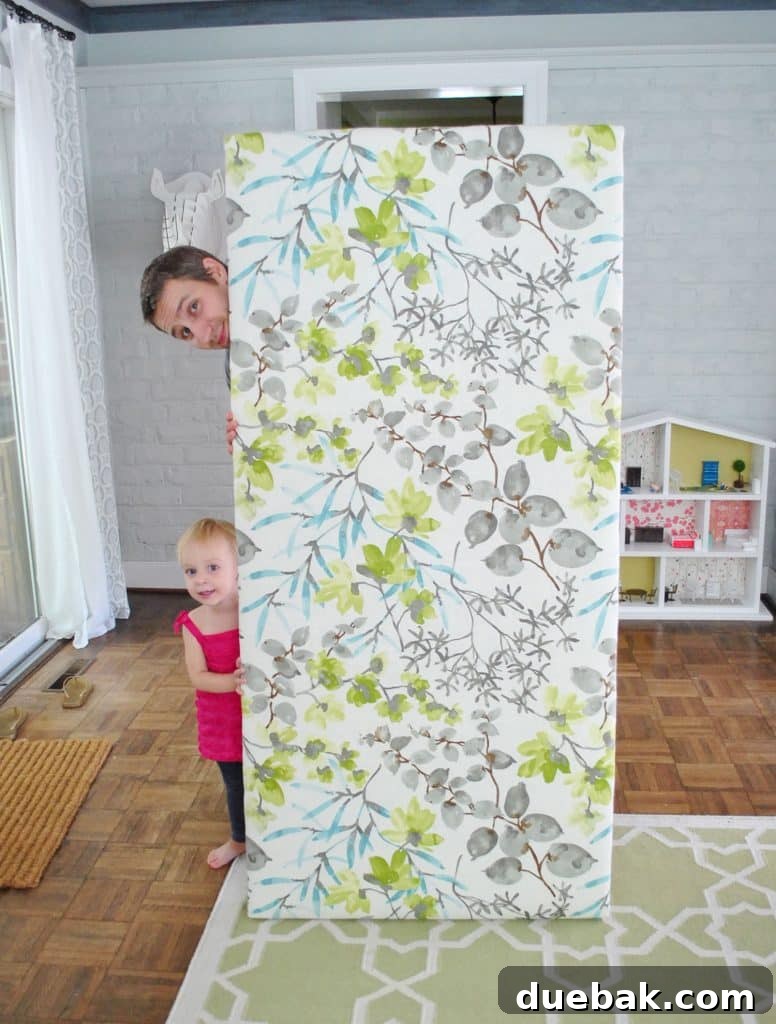
While difficult to convey in a flat image, from this angle, you can truly appreciate the plushness of the double-layer batting. It’s soft and inviting, yet impeccably tight, ensuring it will withstand daily lounging without becoming baggy or losing its elegant form.
Step 4: Securely Hanging Your New Headboard
Once your beautiful upholstered headboard is complete, the final step is to securely attach it to your bed or wall. The method you choose will largely depend on your existing bed frame and personal preference for stability.
Wall-Mounted Headboards: French Cleats for Superior Stability
We generally prefer to install headboards directly onto the wall, as this often provides a sturdier and more integrated feel than attaching it solely to the bed frame. For wall mounting, a French cleat system is an excellent and highly recommended option. A French cleat consists of two pieces of wood, typically 2x4s, cut at opposing 45-degree angles. One piece is securely mounted to the wall (into studs), and the other is attached to the back of your headboard. The angled edges interlock, creating a strong, secure, and virtually invisible hanging mechanism. We provide a detailed tutorial on how to DIY a French cleat in a separate post, which is an invaluable resource for this method.

Interestingly, the headboard pictured above is the very same one from this tutorial, simply updated years later for a new home with fresh fabric and a modified top piece (just as we added the side pieces in this guide). You can clearly see the French cleat on the back, illustrating how effectively this system works. For those who prefer a ready-made solution, pre-made metal cleats are also available for a minimal cost.
PRO TIP: When hanging your headboard, aim to position its top edge, or slightly below, the top edge of your mattress. This ensures there’s no unsightly gap between the headboard and your bed, creating a cohesive and polished look.

Attaching to an Existing Bed Frame
In the specific scenario of our “postless-four-poster” bed, we chose a different attachment method. We carefully screwed the new fabric headboard directly into the old wooden headboard that was part of the existing bed frame. This required careful selection of screw length to ensure they were long enough for a secure hold but short enough not to poke through the front of the newly upholstered surface.
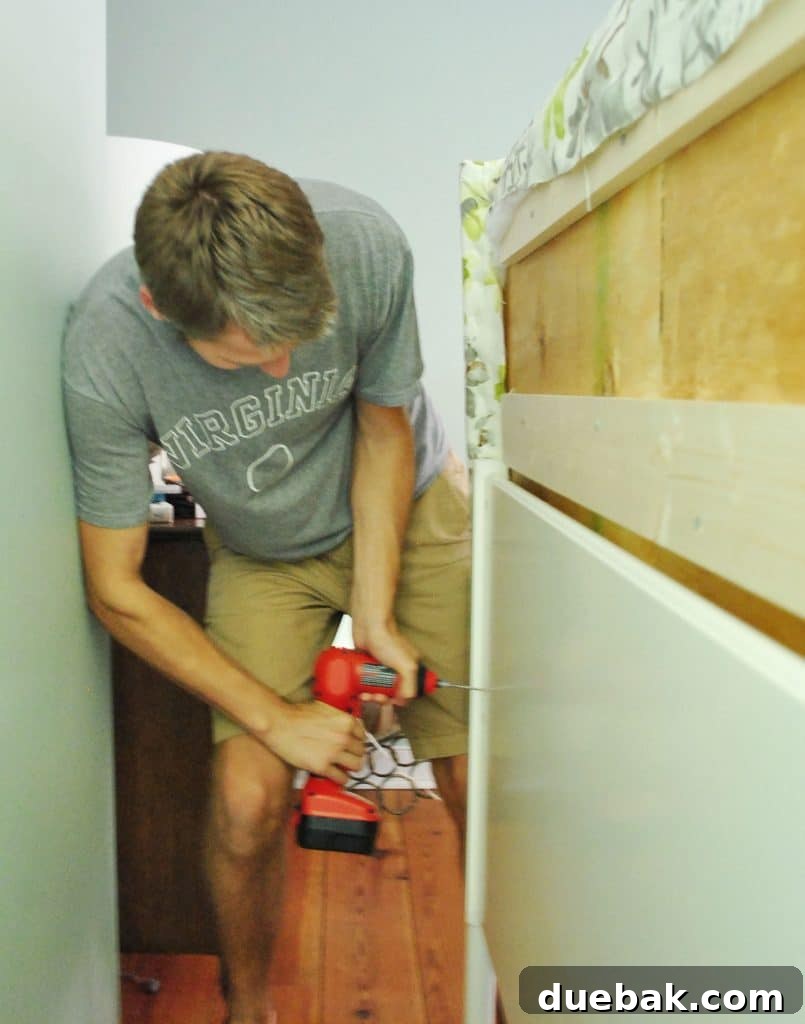
Here, John applies the final screws from the backside, pressing the new fabric headboard snugly against the bed frame. This ensures a tight, wobble-free fit, providing both stability and an integrated appearance.
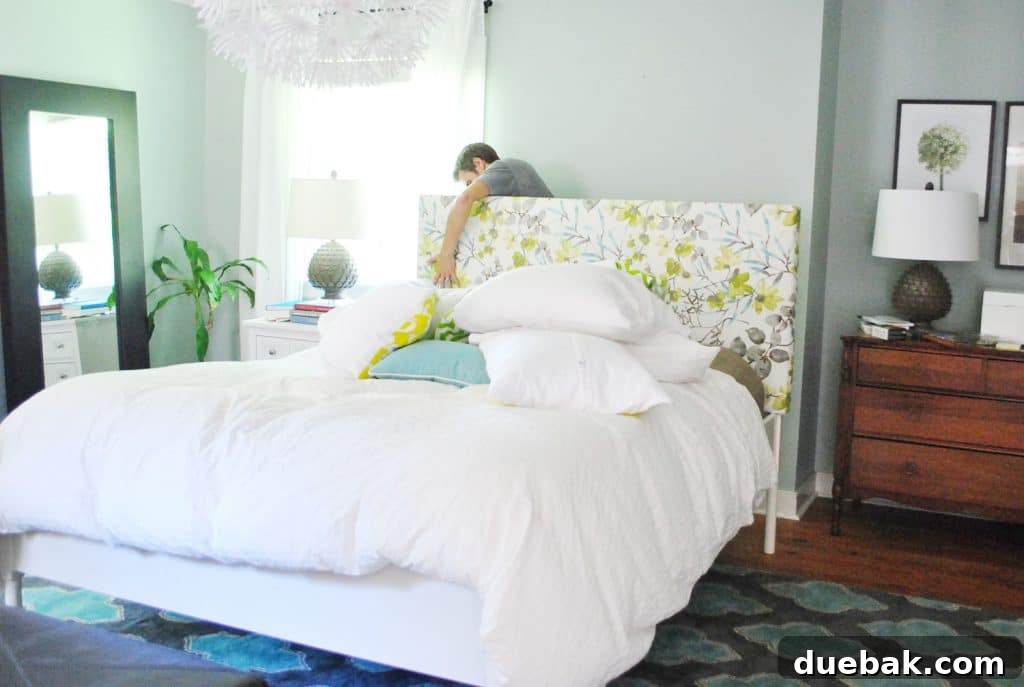
Step 5: Styling and Enjoying Your Handiwork
With your new upholstered headboard securely in place, it’s time to step back and admire your accomplishment. We immediately pushed the bed back into its position and couldn’t help but beam at the transformation. If only it had been bedtime already, so we could instantly sink into its plush comfort!
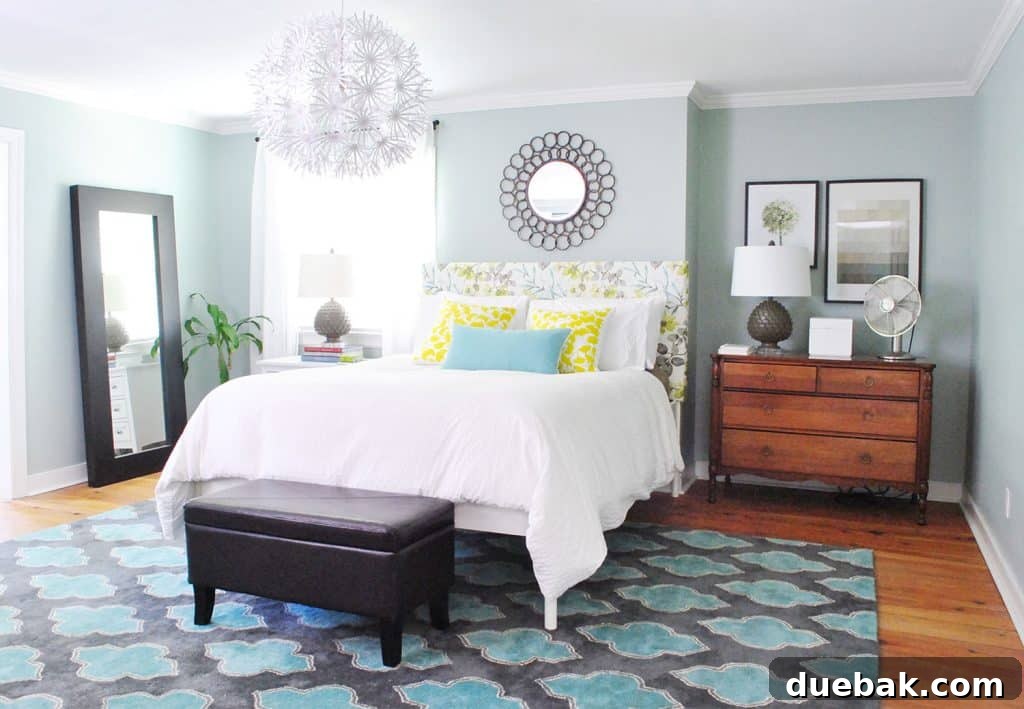
Integrating with Existing Decor
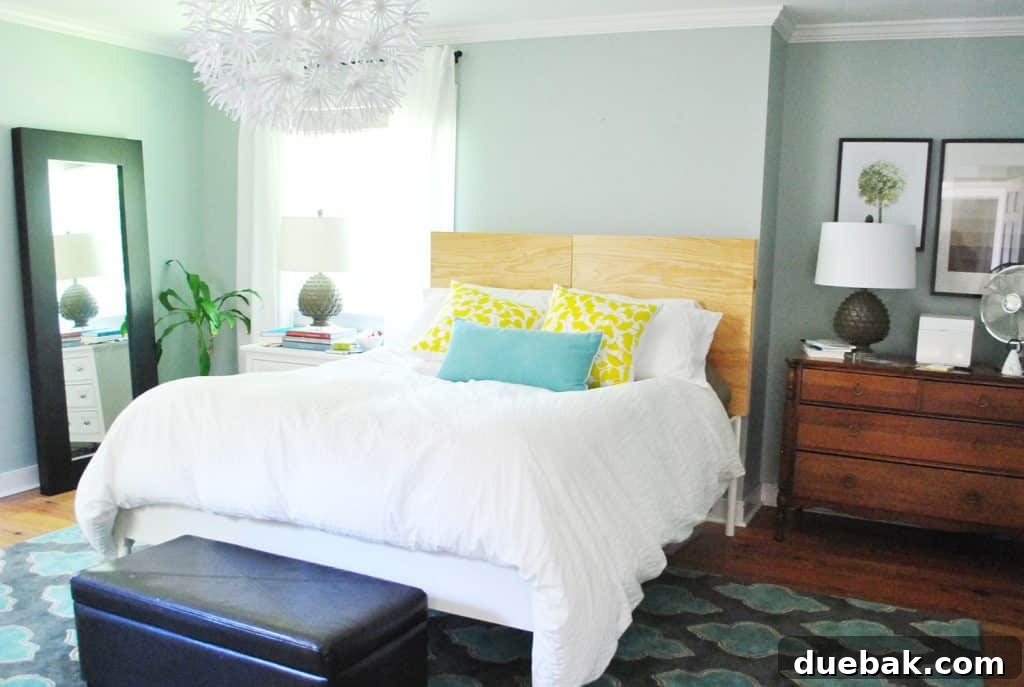
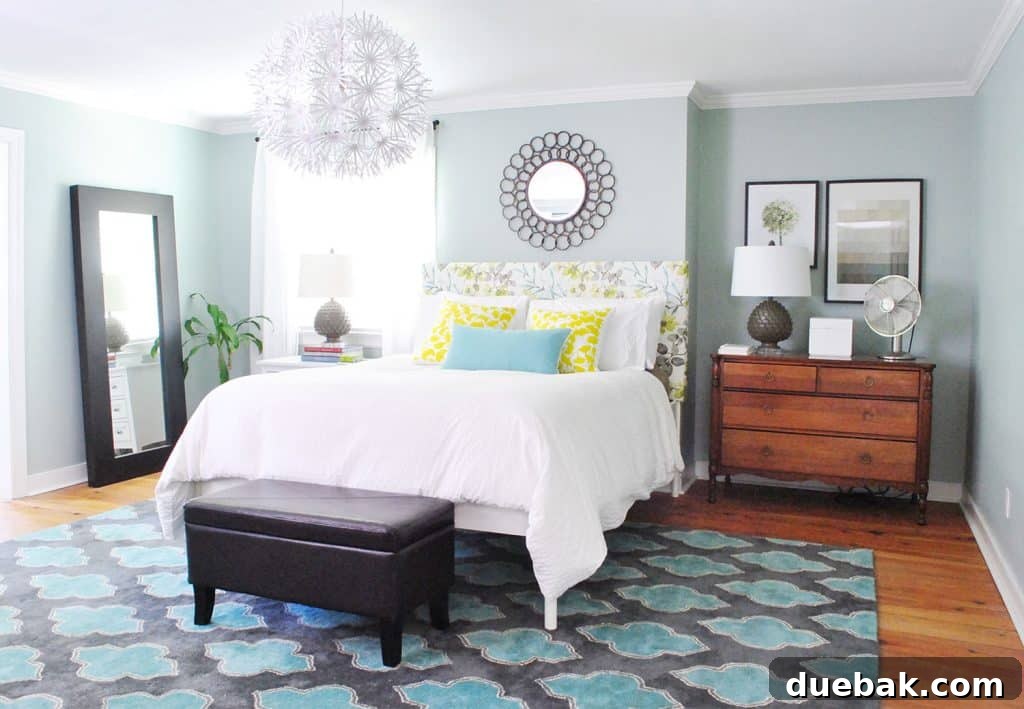
The beauty of a custom headboard lies in its ability to seamlessly tie together various elements of your bedroom decor. We particularly loved how our chosen floral fabric acted as a perfect bridge between the vibrant yellow ginkgo pillows (with their subtle green-yellow tones) and the serene turquoise of the rug (echoed by the delicate leafy sprigs in the headboard fabric). This thoughtful integration of colors and patterns creates a cohesive and harmonious space.
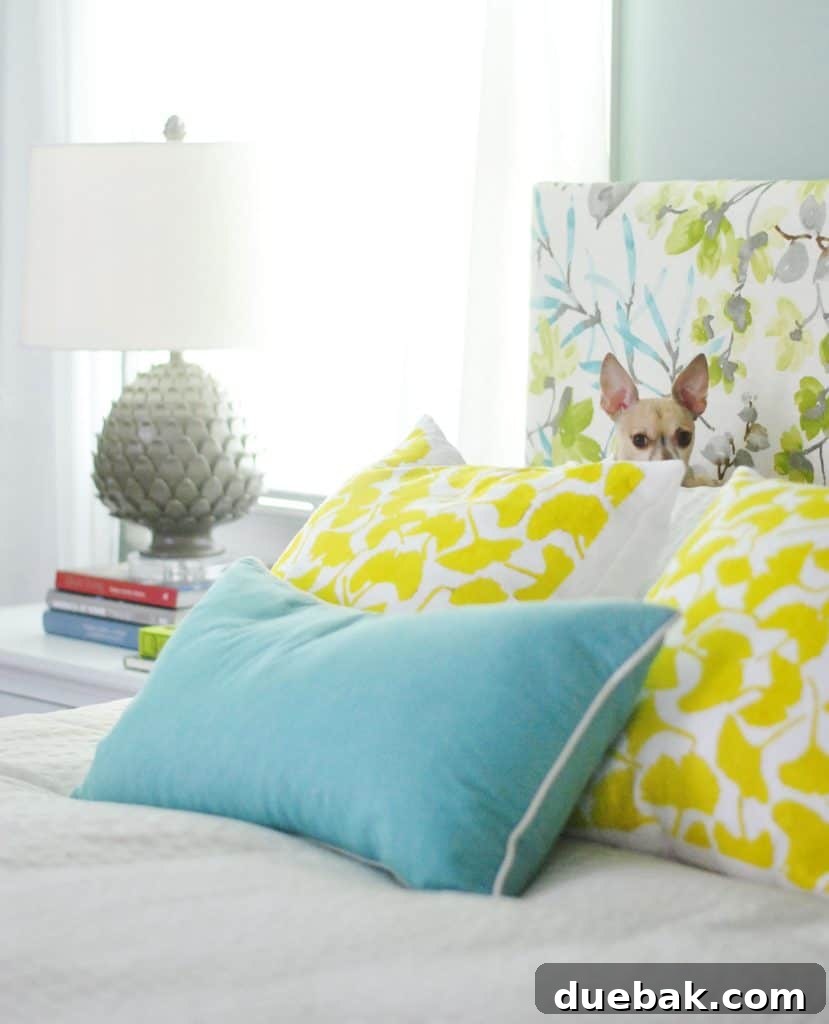
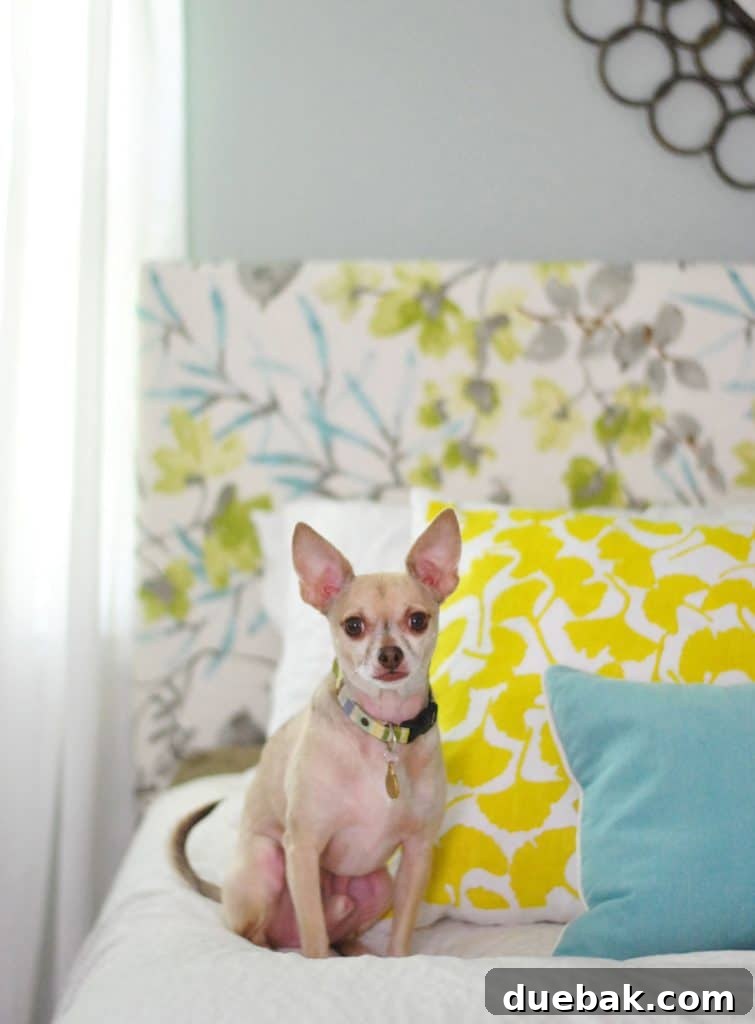
Even our furry friend, Burger, seems to appreciate the stylish new backdrop, looking especially dapper against the colorful print.
A DIY upholstered headboard is more than just a piece of furniture; it’s a statement of personal style, a commitment to comfort, and a testament to your DIY capabilities. We encourage you to embark on this project and experience the joy of creating something truly unique for your home.
DIY Upholstered Headboard Cost Breakdown
One of the most appealing aspects of creating your own upholstered headboard is the remarkable cost savings. Here’s a detailed breakdown of what we spent on our project, demonstrating just how affordable a custom, high-quality headboard can be:
- Wood frame (plywood and bracing boards from Home Depot): $22
- Two layers of extra loft batting (from JoAnn with a 50% off coupon): $4
- Discount designer fabric (from a local fabric outlet called U-Fab): Already owned – but it was originally priced at $20/yard, making the 2 yards used $40 total.
- Total estimated cost: $66 (This includes the full value of the fabric, even though we had it on hand from a previous project).
Spending sixty-six dollars might not be pocket change, but when compared to the retail prices of upholstered headboards, it represents substantial savings. Even the most basic upholstered headboards found at retailers like Overstock can easily cost $100-$200 more. When you consider high-end stores such as Ballard Designs, which charge anywhere from $400-$700 for custom headboards where you get to select the fabric, our DIY project offers incredible value. The ability to choose your exact fabric and craft a bespoke piece for such an affordable price is truly an unmatched advantage of the DIY approach.
*This post contains affiliate links, meaning we may earn a small commission when you make a purchase through links on our site at no additional cost to you. These commissions help us continue to provide valuable content and DIY tutorials.