

Elevating Home Style: Our DIY Journey to Perfect Door Knobs
Every home renovation project, no matter how small it may seem, holds the potential for a significant transformation. Sometimes, it’s the little details that make the biggest impact, subtly enhancing both the aesthetic and functionality of your living space. For us, this journey recently revolved around a seemingly simple yet profoundly impactful upgrade: installing new doorknobs throughout our upstairs.
Just last week, we poured over a plethora of doorknob options, meticulously selecting the perfect hardware to complement our home’s evolving style. The anticipation grew with each passing day as we awaited the arrival of our chosen set. Why the urgency? Because, quite literally, we couldn’t close any of our upstairs doors! The missing hardware left our rooms exposed, devoid of privacy, and frankly, looking rather unfinished. So, when that much-anticipated box finally landed on our porch, we wasted no time in diving straight into the installation process.
The Unpredictable Path of DIY: Embracing the Challenges
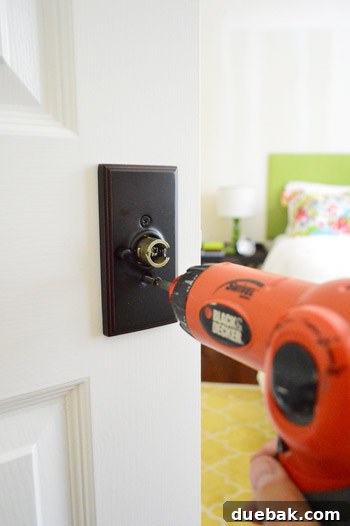
Like many do-it-yourself endeavors, what initially appeared to be a straightforward task of swapping out old hardware for new quickly revealed its own set of complexities. Our first hurdle emerged when we realized the latch assembly of our new doorknobs was slightly larger than the existing holes in our doors. This meant a bit of carving was in order to widen them appropriately. While the knob instructions suggested using a file, a brief attempt quickly proved it to be a tedious and time-consuming method. Resourcefulness kicked in, and I opted for a drill, finding that its spinning bit made quick work of chipping away at the wood, making it my preferred and more efficient approach.

This modification wasn’t a one-off; it had to be performed on every single one of our eleven upstairs doors. The repetitive nature of the task undoubtedly extended the project’s timeline and contributed to a growing pile of sawdust. But the challenges didn’t stop there. On five of the doors, I also discovered that the latch wasn’t extending far enough into the strike plate hole in the door frame. This required me to carefully chisel out the mortise (the recessed area where the latch sits) a bit deeper, ensuring proper alignment and smooth operation of the latch mechanism.

What I had optimistically estimated as an hour’s worth of work blossomed into a four-hour marathon of drilling and chiseling. Oh, DIY, you truly are an unpredictable beast! Yet, despite the unexpected effort, every minute spent was ultimately worthwhile. The satisfaction of overcoming these hurdles and seeing the project through to completion far outweighed the initial frustrations. These minor setbacks are often part and parcel of home improvement, teaching us patience, problem-solving, and the sheer joy of transforming a space with our own hands.
From Unfinished to Functional: The Transformative Power of Hardware

It’s remarkable how much impact such a seemingly minor detail as a doorknob can have on the overall ambiance and functionality of a space. Prior to their installation, the upstairs hallway felt undeniably unfinished, with the “naked” doors revealing empty knob holes. It was a constant visual reminder of a project left undone. While I’m sure our daughter, Clara, will miss her playful peeking through those open holes and making funny faces, the new doorknobs have brought a newfound sense of completion and polish to the entire area.

Capturing a single shot of all the doors in our hallway was a challenge in itself (our master bedroom, seen above, is just behind the camera). This photograph marked a significant milestone: it was the first time since we moved into our home that we’ve been able to close all the doors simultaneously. This seemingly small achievement has brought immense practical benefits. For Clara’s room, it means no more propping the door shut with a floor pillow during nap times, ensuring a more peaceful and dark environment for her rest. And for the bathroom, well, the reasons for wanting a fully functional, closable door are quite obvious!

Thoughtful Design Choices: Back Plates and Subtle Distinctions
We are absolutely thrilled with our decision to choose doorknobs featuring a generous back plate. These aren’t just functional pieces; they add a wonderful traditional touch without appearing overly ornate or fussy. As Sherry aptly put it, they act like little exclamation points on every door, a rather accurate description, I think. They quietly make a statement, adding a refined architectural detail that enhances the overall aesthetic without being overly dramatic or competing with other design elements in the space. This subtle elegance contributes significantly to the sophisticated feel of our renovated hallway.

As we detailed in our previous post, our decision-making extended to balancing aesthetics with practicality and budget. For closets and secondary areas, we opted for versions without the back plate, which offered a modest saving of about $10 per knob. However, we made a conscious choice to install a plated version on the hall bathroom door. This decision was purely for visual continuity, ensuring it blended seamlessly with the other plated doorways in the hallway when viewed from the top of the stairs. Consequently, the plate-less version found its home on the attic door, tucked away beyond the laundry area where its simpler design made perfect sense.
The hallway also features a two-doored linen closet (a glimpse of which can be caught in the fourth picture). We felt that having two plated doorknobs in such close proximity would be visually overwhelming. Therefore, this closet, along with all the other storage closets, received the more basic, plate-less doorknobs. This creates a subtle yet effective visual cue for navigating our home: doors adorned with back plates signify an actual room, while those with regular knobs denote a closet or a storage area, like the attic. The consistent finish across all hardware ensures everything blends harmoniously, providing a cohesive and thoughtful design language throughout the upstairs.

Security, Safety, and Smart Storage Solutions
Last week, some readers inquired about the locking mechanisms of these new doors. We’re happy to share the details with these close-up images. On the inside, there’s a small, discreet button conveniently located behind the knob. A simple push of this button engages the lock, providing instant privacy. To unlock it from the inside, a mere turn of the doorknob is all it takes – a user-friendly design for everyday use. We believe it’s important for Clara to be exposed to locks and understand their function, hoping it will teach her about boundaries and safety, preventing situations like accidentally locking herself into a friend’s room or a hotel bathroom.
Crucially, for added peace of mind, each doorknob features a subtle keyhole on the exterior side. In the event that Clara (or anyone) were to accidentally lock themselves in, a flat silver key (see that small hole in the photo on the right below?) quickly pops the lock open. These emergency keys are now stashed in our junk drawer for easy access, should the need arise. So far, after a few days of living with the new doorknobs, Clara has been remarkably good at heeding our “please don’t touch that part” requests, which is a huge relief!

Update regarding key storage: We received some excellent tips from readers suggesting we place the keys on top of each door frame. This was a common practice in our childhood homes! However, these particular keys are larger and flat, more akin to a hinge, which unfortunately prevents them from balancing securely on the door frame. We’re currently exploring other clever, yet accessible, storage solutions that keep them out of reach of little hands but readily available for adults.
Beyond the Knobs: The Ongoing Adventure of Home
We’re certainly glad to no longer have a hallway full of “holey” doors giving us the stink eye. The new doorknobs have made a significant difference, adding both function and charm. However, this project is just one step in our ongoing home transformation journey. When it comes to furniture placement, selecting the perfect window treatments, tackling closet organization, and choosing paint colors for the walls… let’s just say that while we’ve lived here for two weeks, it still looks very much like we moved in two weeks ago. There are still chairs and boxes in unexpected places, bare walls yearning for artwork, and mostly bare windows awaiting their coverings. A whole lot remains to be done, but that’s the exciting part!
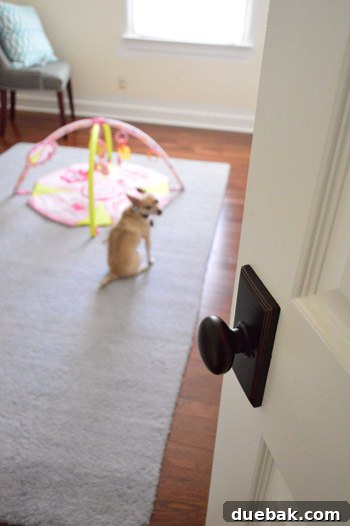
The planning and brainstorming phase is our favorite. We often find ourselves engrossed in discussions late into the night, envisioning our dream spaces, until one of us falls silent, and we realize the other has drifted off to sleep. And yes, it’s good to have those doors closed now. We recently caught our sneaky chihuahua, Burger, getting into a bit of funny business, playing with Clara’s old play mat behind a closed door! It just goes to show, you never know what surprises await you in a newly renovated home.
*This post contains an affiliate link*