
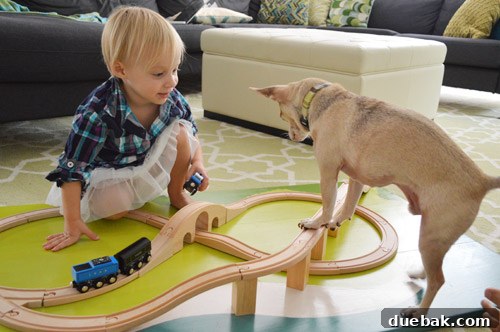
All aboard! (Can I get a choo-choo?)
As promised in our Instagram and Facebook sneak peek, here’s the story of how we built a train board for Clara. Why a train board? Clara is absolutely obsessed with the one at Barnes & Noble: a large track secured to a pedestal board that kids swarm to in the store. If we pull into the parking lot that leads to that mall, Clara will shout from the car, “We’re getting to play with the trains!” before we even turn off the engine.
When John suggested making our own version using a train set Clara received for her second birthday, I remembered a DIY train board I’d seen on a blog and searched for a few more for inspiration. We had a few clear objectives for our build:
- Use the Melissa & Doug train pieces we already owned to create a nice, big track.
- Build the board from solid wood to avoid off-gassing issues with MDF or plywood; whitewood is lightweight and affordable.
- Paint a playful background on the surface to spark imagination—beach, forest, water, and more.
- Use low-VOC paint and sealer, and attach the tracks with screws from underneath to avoid smelly glue.
We completed the board for about $28: nine dollars in sample paint and a single 12″ whitewood plank for $19. First, John bought a twelve-foot long 10″ x 1″ board of whitewood and had it cut into three equal 10″ x 1″ x 47″ boards at the store. He joined them with his Kreg Jig—alternatively, you could use flat bracing pieces of wood or metal along the back—and added felt pads to prevent floor scratches. He sanded everything smooth so the board wouldn’t feel rough or splintery; the seams turned out nearly invisible.
Next, we arranged the train tracks in numerous configurations before settling on a layout that includes hills, an elevated section, a bridge, a tunnel, and a spot where the train rolls down an incline and off the board—Clara’s favorite imagined trick.
We sketched a background plan on paper first: light green for grass, blue for ocean, a sand stripe, and dark green for forest. Then I transferred those lines to the board with pencil, marking where water, beach, and forest would meet.
We picked up three $2.95 sample pots of Behr Ultra in Japanese Fern, Mirage Lake, and Shamrock—low-VOC choices. Before painting, we photographed the track configuration so we could rebuild it after painting. I painted the water area first, then the grass; since those two areas don’t touch, drying time wasn’t a concern. I didn’t prime the board because we liked the look of painted wood with a few knots showing through. If you prefer a solid finish, a stain-blocking primer helps hide knots.
After letting the first coats dry, I painted the forest area and then added the sand with leftover no-VOC white paint. Once the paint cured, I applied several thin, even coats of an eco-friendly poly sealer (Acrylacq by Safecoat). I brushed it on lightly and quickly to avoid gummy spots, letting each coat dry before applying the next. Acrylacq is low-VOC and essentially non-toxic—an excellent choice for children’s toys and furniture.
We decided to temporarily fasten the track to the board for a few reasons:
- At Clara’s current age, assembling the tracks herself often led to frustration and tantrums.
- We’d noticed at Barnes & Noble that a fixed track encourages creative, independent play—train stops, tunnels, imagined breakdowns, and destinations—without the stress of rebuilding.
- If Clara later wants to build her own track, we can remove the screws from the underside to free the pieces, keeping the board flexible for future play.
After the poly cured for 48 hours, we laid out the track on the sealed board and attached each track section with screws driven up from the underside. John removed each track, drilled a pilot hole from the top through to the bottom, then reassembled the track and fastened it from below so there are no visible screws on the playing surface. We used countersunk screws so the hardware sits flush in the back and won’t scratch floors, and we added felt pads for extra protection.
For the elevated sections, we attached support blocks the same way—pilot holes from above and screws driven up from the back into the blocks so no hardware shows. To secure the track to the top of each block, we tapped a small finish nail into the track groove and into the block; that proved sturdy without being obvious.
To make one section of track appear to lead off the board, John traced the board’s edge onto the underside of that track piece, cut along the line, sanded it smooth, and then reinstalled it by drilling and fastening from below.
The final upside-down test confirmed everything was secure—Clara has even kicked the elevated portion and it held up. When we turned it over and set it up, Clara immediately loved it. She chatters about riders traveling to the beach, exploring the forest, and racing over hills. Surprisingly, her favorite feature is sending trains down the middle hill into a big pile-up. Sometimes she invites us to join the chugga-chugga fun.
We’re glad we chose a fixed track for now. Adding a painted environment and features like a train that can roll off the board has made playtime more imaginative and exciting. And the board’s flat design is a huge bonus: it slides neatly under the sofa for storage, which helps keep it special—Clara loves toys we bring out and put away instead of things that are always available.
So that’s the full $28 train board rundown. What have you been building, painting, or sanding lately? Any fun kids’ projects in progress?