
Transform Your Bathroom: A DIY Guide to Installing Trim and Baseboards
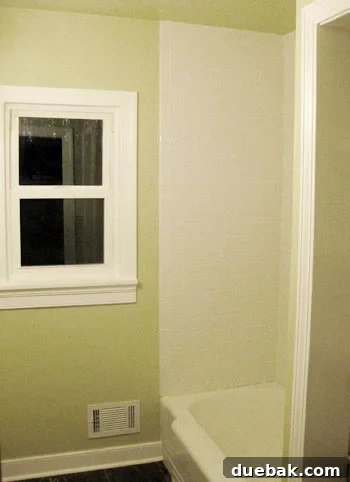
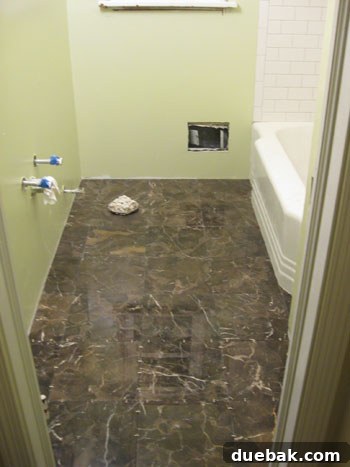
After weeks of dedicated effort—setting, grouting, and meticulously sealing our shower/tub and floor tiles—our bathroom renovation felt incredibly close to completion. Yet, one significant element remained missing, casting a lingering shadow of “under construction” over the space: the installation of baseboards and trim. These crucial finishing touches are what truly unite a room, providing crisp, professional transitions between walls and floors, and elegantly framing windows and doors. Below, you can see the tiled floor, patiently awaiting its defining border:
The Initial Dilemma: Salvage or Replace?
During the demolition phase, I approached the project with the optimistic, albeit somewhat naive, notion of salvaging the existing trim around the window and doors, including both the main bathroom entrance and the linen closet. The idea of reusing materials appealed to me, promising both cost savings and a nod to sustainability. However, this hopeful vision quickly evaporated as I began the actual removal. Many pieces of the old trim were brittle, splintered, broken, or simply too compromised from years of wear and tear, compounded by the stresses of the renovation process. Attempting to repair and reinstall them would have required an exorbitant amount of time and yielded questionable results, far outweighing the benefits of starting fresh.
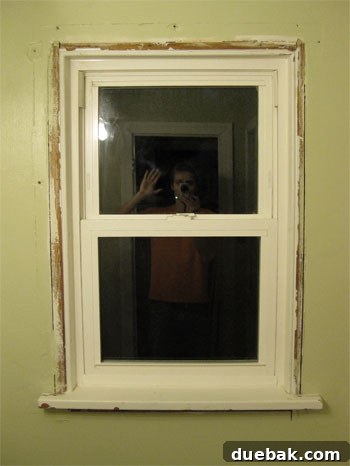
Furthermore, new baseboards around the floor were an absolute necessity, regardless of the trim situation. The original bathroom featured a tiled border where the walls met the floor, which was removed during demo. Thanks to the diligent efforts of my trusty crowbar and hammer, all the old trim was successfully removed, revealing bare, unfinished areas like the one around the window shown here:
Preparation and Tools: Kicking Off the Trim Project
Once the grout had fully set for 24 hours and received its final seal, re-installing the trim became my top priority. Fortuitously, I had borrowed my dad’s miter saw for this task—a recurring theme in my DIY endeavors, and one for which I’m eternally grateful! Having the right power tools significantly simplifies complex jobs, and I must admit, the prospect of operating another power saw was a major source of excitement. Beyond the machinery, I also found a peculiar satisfaction in the precise measuring and mathematical calculations involved; yes, I embrace my inner nerd!
Meticulous Measuring and Material Procurement
The first critical step was meticulous measurement. I painstakingly recorded the length of each wall section, every side of the door frames, and all segments surrounding the window. Armed with these precise figures and samples of our old trim, we ventured to a home improvement store. Our objective was to find new trim that closely matched the style found throughout the rest of our house. We ultimately chose a slightly wider version of the same classic profile, aiming for a more substantial and impactful presence in the renovated bathroom.
Home improvement retailers typically sell trim in very long strips, often ranging from 8 to 16 feet. To facilitate transport and handling, they usually offer a convenient cutting station. I spent a good 30 minutes at this station, precisely cutting every single piece we needed into more manageable lengths. A crucial tip for any DIYer: always cut your pieces slightly longer than your exact measurement. It’s infinitely easier to trim a little more off later than to attempt to add length to a piece that’s too short. To stay organized, I diligently labeled the back of each piece with its approximate length and intended location, such as “44 inches, back wall under window” or “35 inches, spare.” This system proved invaluable during checkout, enabling me to quickly calculate the total linear feet purchased without requiring the cashier to measure dozens of individual sections.
Precision Cutting: Installing Window Trim as an Example
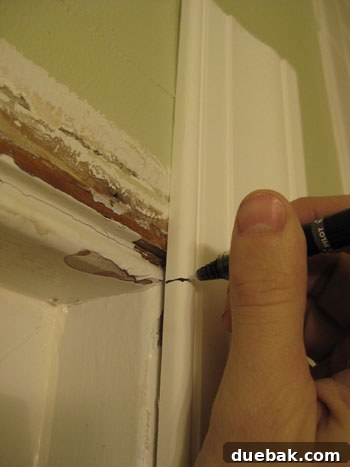
Instead of detailing the installation for all thirty-plus pieces, let’s use the window trim as a clear example of the process. My first action was to locate the sections I had roughly cut for each side of the window. I then marked the precise inside edge of my intended cut on each piece using a standard ballpoint pen. Honestly, the most challenging part of this preliminary step was balancing the camera and the pen simultaneously for a photo!
Mastering the Miter Saw for Seamless Angles
With my marks clearly defined, it was time for the frequent trek through the house, across the sunroom, over the driveway, and into the garage where my dad’s miter saw was set up. This path became quite familiar as I repeatedly cut, and sometimes re-cut, each piece of trim. The miter saw is specifically designed to make accurate angled (or mitered) cuts, which are indispensable for creating perfect corners and joints in molding and trim work. Despite being a novice with the tool, I found it remarkably user-friendly.
To achieve the correct angle, you simply swivel the saw base to your desired setting (for window trim corners, 45-degree angled cuts are standard for a 90-degree corner), lock it firmly in place, and then align the wood piece flush against the saw’s guides. Even though my dad’s saw featured a convenient laser guide, I always adopted a crucial safety and accuracy habit: before powering on, I would pull the saw blade down in power-off mode to visually confirm the exact point of contact with the trim. This quick dry run ensures perfect alignment and prevents costly miscuts before the actual operation.
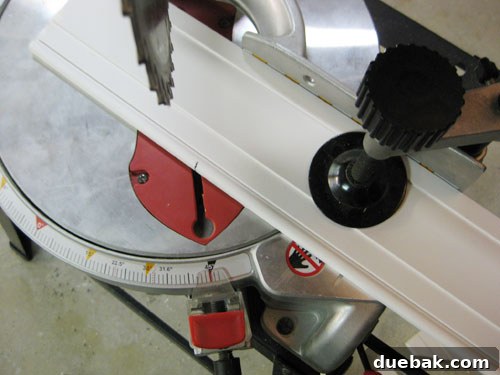
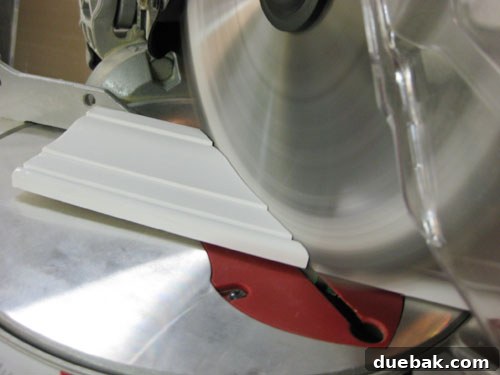
Once the saw was properly set, cutting each piece was a breeze. Much like my experience with a wet saw for tiles, I found it easy to return and fine-tune cuts if a piece turned out slightly too long upon re-entry into the bathroom. I firmly adhere to the motto: “It’s a lot easier to cut more off than to put more back on.” This philosophy often leads me to make initial cuts very conservatively, knowing I can always trim a little more. While it might not be the most time-efficient method for a seasoned professional, it’s certainly more forgiving (and significantly cheaper) than having to discard a piece and purchase new trim because of an initial over-cut.
Affixing Trim with Low-Tech Precision and Care
When the moment arrived to secure the perfectly cut trim pieces, we opted for a decidedly low-tech, yet highly effective, approach. Rather than investing in a power nail gun for what was a relatively small job, we purchased a small 10 oz hammer. This lighter, more maneuverable hammer provided superior control, a critical advantage when working in close proximity to newly installed tiles, especially around the baseboards. Additionally, we acquired a small “nail set,” a simple but ingenious tool designed to recess each finishing nail cleanly below the trim surface without the risk of marring the wood with the hammer’s broad head. This method, while not the fastest, allowed us to complete the job with zero damage to the surrounding finishes, all while staying comfortably within budget.
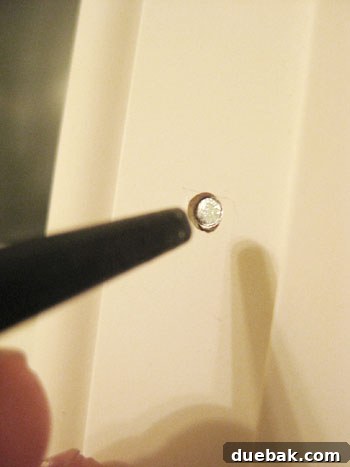
Our process involved using the small hammer to drive finishing nails most of the way into the trim, leaving approximately an eighth of an inch exposed. This initial fastening secured the trim temporarily, allowing for minor adjustments before the final seating of the nail.
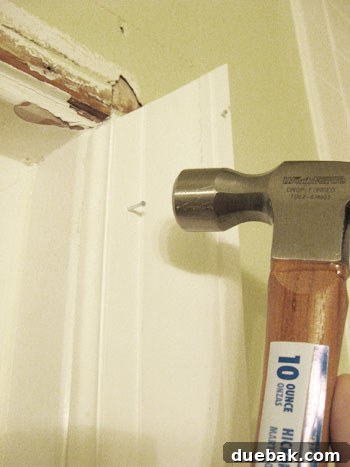
Next, the nail set came into play. This short, metal tool—conveniently sized to match the head of a finishing nail—is placed over the exposed nail head. A light tap with the hammer drives the nail completely flush with, or even slightly below, the wood surface. This technique prevents the wider hammer head from damaging the delicate trim around the nail, ensuring a clean, professional finish.
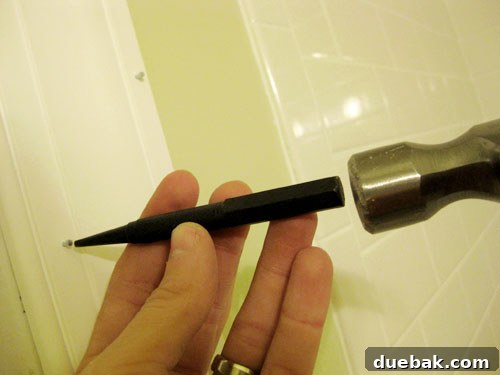
By recessing the nail heads slightly, we created small, shallow indentations that would later be effortlessly concealed with caulk and paint, contributing to an absolutely impeccable final look.
The Final Touches: Caulking and Painting for Perfection
It’s important to clarify that while the trim we purchased appeared white, it was actually just pre-primed. Some DIY enthusiasts prefer to paint their trim before installation, as this can simplify achieving full coverage without concern for getting paint on adjacent walls. However, having painted already-installed trim countless times, it has become a second nature for us. Our approach involves a single, comprehensive painting session after installation, which efficiently incorporates all necessary touch-ups, rather than splitting the process into two separate painting phases.
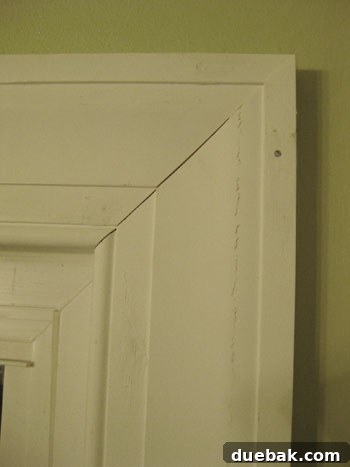
Once all the trim pieces were securely installed around the window, the result was approximately 98% perfect. While the trim naturally bore minor smudges from handling, and despite my best efforts, not every single joint was flawlessly flush, the overall fit was remarkably tight. This is precisely the stage where caulk and paint step in to elevate a “good” installation to a “great” one, concealing minor imperfections and creating a polished look.
Sealing and Smoothing with Paintable Caulk
To fill any tiny gaps, hairline cracks, and the recessed nail holes, we opted for a high-quality white paintable door, window, and trim caulk. Brands like Dap are often praised for their ease of application and reliable performance. The process involved carefully applying a generous, even strip of caulk along all seams and joints, such as the corner seam of the window frame, ensuring full coverage.
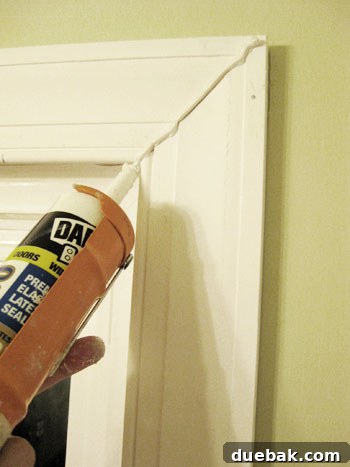
After applying the caulk, the next step is to smooth it into the seam using a finger (a damp cloth helps prevent sticking) or a specialized caulk tool, then immediately wiping away any excess with a clean, damp cloth. This technique effectively hides minor imperfections, resulting in a smooth, continuous surface that appears truly seamless and professional.
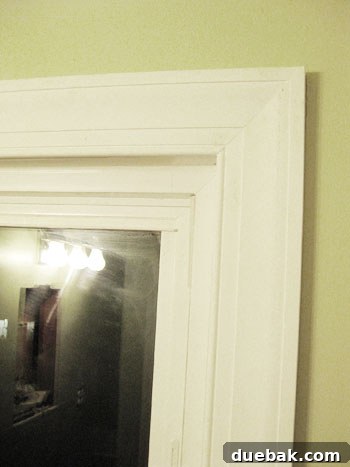
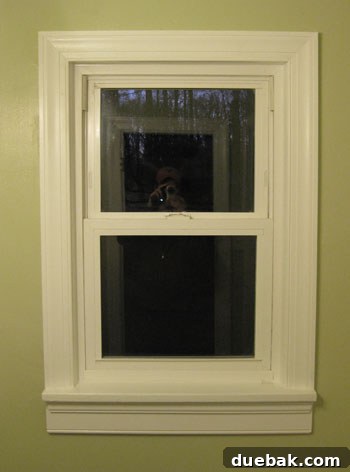
Once the caulk had completely dried in all the corners and over the nail holes, we applied two meticulous coats of No-VOC Freshaire white semi-gloss paint. The transformation was immediate and remarkable—TA-DA! The window trim now appeared utterly polished, seamlessly integrated, and impeccably finished, completing the aesthetic.
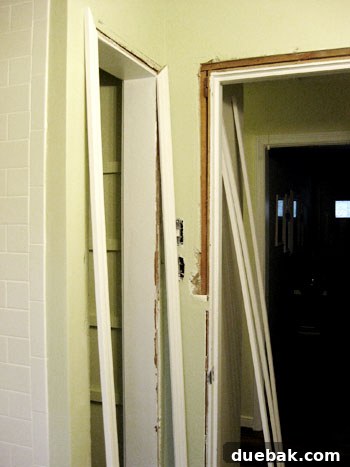
The installation of trim around the linen closet and the main bathroom door followed the exact same meticulous process. Here’s a quick before shot, complete with trim pieces strategically positioned for length checks…
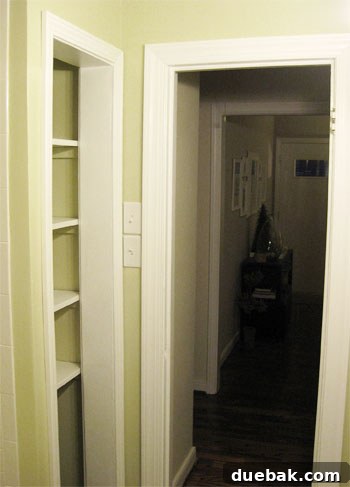
…and the incredibly satisfying after: all caulked, painted, and ready to contribute to the bathroom’s elegant aesthetic.
Baseboard Installation: The Foundation of Finish
Installing the floor baseboards presented a distinct set of challenges and opportunities. This phase involved affixing baseboard along the entire perimeter of the walls, including the interior of the linen closet, before finishing everything off with quarter-round shoe molding. This part of the project was particularly gratifying because it provided the perfect solution for neatly concealing any minor discrepancies where my tile work wasn’t perfectly flush against the wall. Additionally, it offered an excellent chance to apply the miter saw’s capability for making bevel cuts.
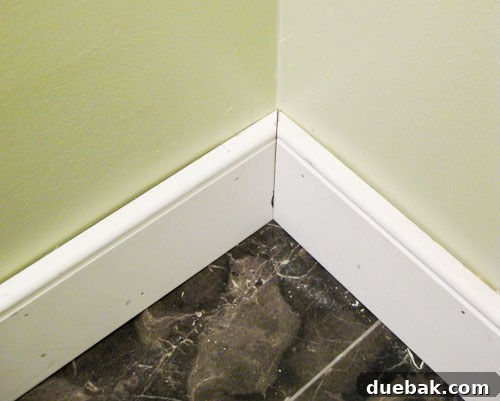
Unlike standard miter cuts (where the saw base rotates horizontally), bevel cuts are achieved by tilting the saw blade itself to the side, typically still at a 45-degree angle for interior corners. These specialized cuts allow two pieces of baseboard to meet in a seamless, professional-looking inside corner joint, creating a visually continuous line like this:
Protecting Your Investment: Nailing Baseboards Safely
While achieving perfectly mitered or beveled corners was a primary objective, I wasn’t overly anxious about minor flaws, knowing that caulk would readily disguise any small imperfections. My greatest apprehension, however, was the act of hammering so close to our newly installed, pristine floor tiles. To mitigate this risk, I implemented a simple yet highly effective safety measure: a thick towel was always strategically placed under the hammering zone. This provided a crucial buffer, offering at least a small layer of protection against any accidental hammer slips. Furthermore, I exclusively used my smaller 10 oz hammer, which offered significantly greater control compared to our usual heavier, larger mallet. Here’s a glimpse into the carefully arranged project work zone:
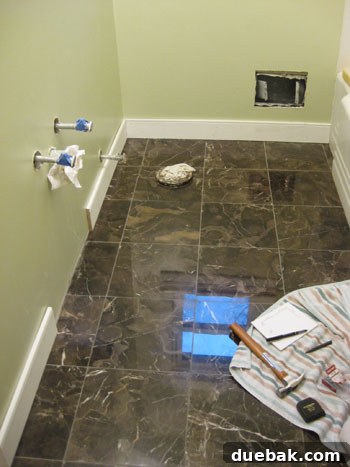
You might notice a prominent missing piece of baseboard on the longest wall. This was not an oversight! This specific gap is precisely where the bathroom vanity will be installed. To ensure the vanity sits perfectly flush against the wall, it was essential to avoid installing baseboard in that section. We had previously dry-fitted the vanity in the room to determine its exact placement (guided by both aesthetic preference and plumbing requirements). After marking the walls, we then meticulously measured and installed the baseboard accordingly, leaving the necessary recess.
Finishing with Quarter-Round Shoe Molding
After successfully installing all the baseboards, the next crucial step was to measure and cut the quarter-round shoe molding using the same careful approach. The primary difference in attaching the quarter-round was our preference for Liquid Nails, supplemented by a few actual finishing nails. Despite my desire for flush fits everywhere, I was quite hesitant (perhaps “chicken” is a more accurate term!) to manually hammer nails so close to the pristine marble floor if a viable alternative existed. We’re delighted to report that the combination of Liquid Nails and minimal mechanical fasteners worked like an absolute charm, securing the quarter-round perfectly without any risk to the floor.
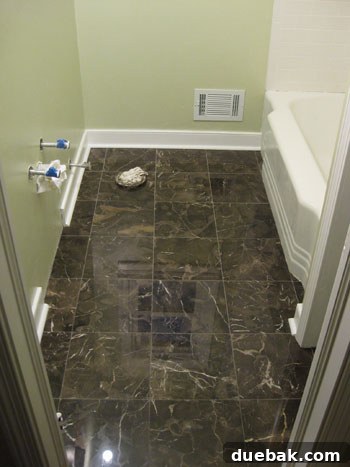
A final application of caulk to seal any remaining gaps, followed by two meticulous coats of paint, completed this transformative step. Presto-change-o! The bathroom floor now boasts a beautifully finished perimeter, adding a layer of elegance and a profound sense of completeness to the entire space.
The Transformative Impact of Finish Work
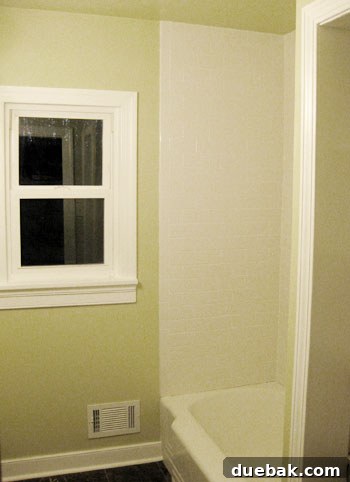
In total, the entire trim and baseboard installation process took approximately five hours, and much like the grouting phase, the visual impact of this final finish work was nothing short of astonishing. With each piece of trim and baseboard meticulously installed, the room began to shed its “under construction” guise and truly emerge as a fully realized, polished bathroom. It’s incredible how these seemingly small, intricate details contribute so profoundly to the overall aesthetic and feel of a space, making it look intentionally designed and complete.
Next on our renovation agenda are the exciting tasks of installing the toilet and building the custom vanity. With these major components in place, we’ll be practically at the finish line! Stay tuned later this week for our detailed DIY vanity play-by-play. Can you almost taste the satisfaction of completion? We certainly can, and curiously, it has a subtle hint of silicone caulk!
Join the Conversation: Share Your DIY Stories!
But enough about our renovation journey for a moment – we’d love to hear from you! What DIY projects are you tackling this week? Are there any fellow bathroom renovators out there? Perhaps you’re currently hanging trim or installing baseboards yourself? Share your experiences, challenges, and triumphs in the comments below. Let’s commiserate and celebrate our home improvement adventures together!
Psst- Want to catch up on the earlier stages of this extensive bathroom makeover? Dive into the full series here: Chapter One, Chapter Two, Chapter Three, a little teaser post, Chapter Four and Chapter Five.