
Revitalizing Our Kitchen: The Ultimate Crown Molding Transformation Guide
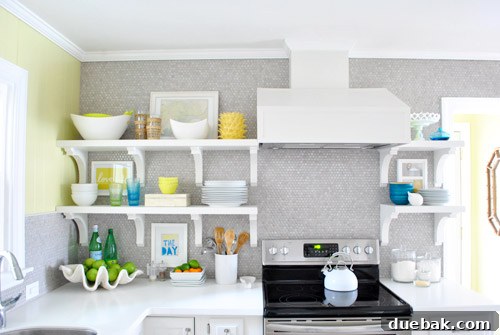
For what felt like an eternity, photographs of our kitchen always came with the caveat: “Oh, and we still need to add crown molding.” That persistent, unfinished edge where the wall or tile met the ceiling was a constant reminder of an incomplete project. But today, that chapter closes!
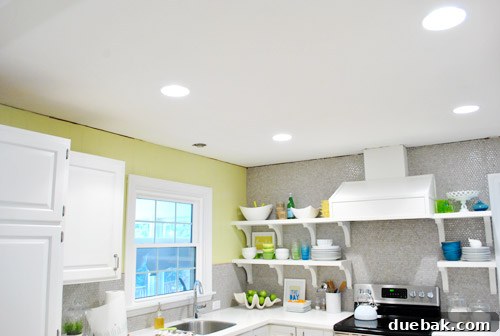
That stark, unadorned line is no more, replaced by the elegant finish of crown molding.
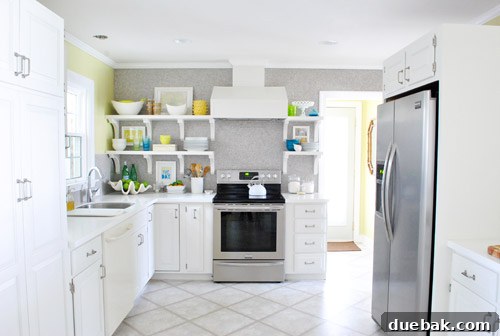
Let’s take an even closer look at the stunning transformation.
Unraveling the Mystery: Why Our Kitchen Lacked Crown Molding
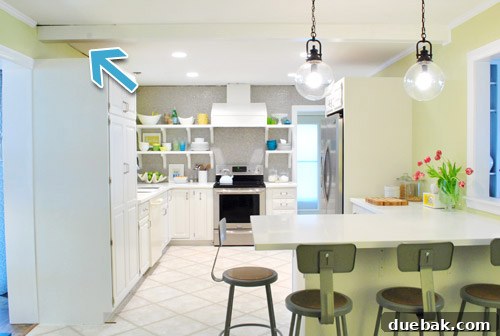
To truly appreciate the “after,” we need to rewind a bit and understand the “before.” Many of you have noticed and inquired about that peculiar dark line above our pantry. Some wondered if a beam was sagging or if there was a mysterious hole. The simple truth? It was yet another area desperately missing crown molding.
Originally, this entire side of the kitchen, including a section that wrapped around a beam, featured floor-to-ceiling cabinets. When we removed those cabinets last November, we were left with several “crownless” voids. These spaces appeared dark and somewhat craggy, lacking the essential trim that provides a polished, finished aesthetic to any room. Addressing these visual inconsistencies became a top priority in our ongoing kitchen renovation.
Pre-Installation Prep: A Crucial Hood Ventilation Fix
Before diving into the trim work, a vital, albeit quick, detour was necessary for our range hood. In my haste during a previous project, I had sealed its vents with regular duct tape. It’s called “duct tape,” after all, so it must be suitable for ducts, right? Wrong! Thankfully, insightful commenters on a previous post enlightened me about the proper material: real metal foil tape. This crucial advice saved us from potential ventilation issues down the line.
So, I paused the crown molding plans to carefully pry off the existing duct tape from within the wood hood cover.
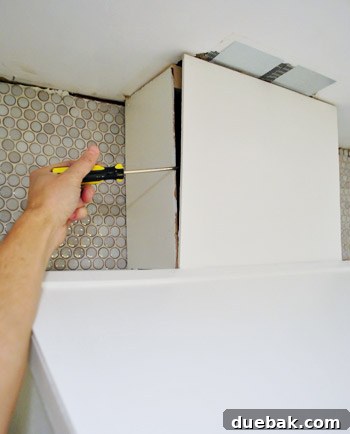
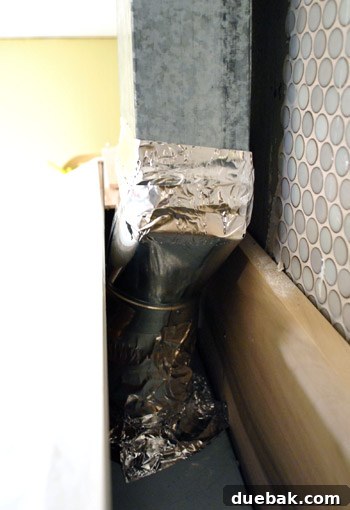
With a bit of maneuvering, I managed to reach into the enclosure, remove the inadequate duct tape, and re-wrap the vents with the correct, legitimate metal foil tape, ensuring proper and safe ventilation for our kitchen.
Navigating the Maze of Mismatched Trim: Our Crown Molding Challenge
Enough about tape; let’s talk about the main event: crown molding. This part of our kitchen renovation journey proved to be a peculiar challenge, and my less-than-stellar process photos won’t fully capture the complexity, so please bear with me as I try to explain.
Our kitchen, for some inexplicable reason, features three distinct types of crown molding. There’s traditional crown molding running along the perimeter of the room, but with a subtle catch: the molding on the fireplace side is ever-so-slightly smaller. It’s a difference imperceptible to the naked eye unless you physically hold them side-by-side. Thanks to the ceiling beams preventing them from meeting, we didn’t even notice this anomaly until we tried to fill in the missing sections and discovered the slight variation.
Adding to the complexity, the ceiling beams themselves are adorned with thin cove molding, except for one particular side of one beam which, inexplicably, has a thick crown molding running across it. This architectural inconsistency was truly baffling and a major hurdle in achieving a cohesive look.
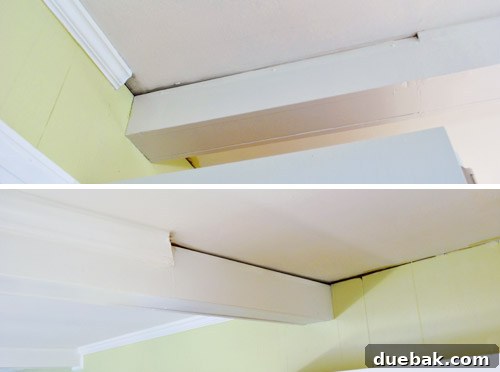
Our primary challenge was threefold: we needed to replace small segments of all three molding types, and critically, remove the overly thick, mismatched trim from that one odd beam. Undertaking a complete re-crowning of the entire room would have been an enormous and prohibitively expensive project. Given that all the beams would require trim on each side, the total material and labor would easily equate to trimming out four average-sized rooms, a cost we were determined to avoid.
Further complicating matters, none of the existing molding appeared to be standard, off-the-shelf profiles available at local hardware stores like Home Depot. This meant we couldn’t simply purchase new pieces to fill the gaps. Our saving grace from an exhaustive and costly full-room overhaul was a stroke of foresight: I had meticulously saved every single piece of crown molding we removed when the old cabinets came down. This collection of salvaged trim became our invaluable treasure trove for patching the gaps.

Preparing for Perfection: Painting and Resourcefulness
Bringing Old Trim Back to Life: Priming and Painting
Of course, these salvaged pieces, remnants of our old, “woodsy” kitchen, needed a significant refresh. To banish any flashbacks of their former orange-tinted glory, priming and painting were essential. We opted for Zinsser Smart Prime, a robust stain-blocking primer crucial for wood trim. Without it, the tannins in the wood can bleed through, ruining an otherwise perfect paint job. Following the primer, we applied several coats of Behr’s off-the-shelf white paint, a paint-and-primer-in-one formula that provided excellent coverage, especially with our stain-blocking primer beneath.
This specific white paint wasn’t arbitrary; it was the same product we used for the rest of the kitchen trim when we painted the paneling. It delivers a beautifully crisp white finish that harmonizes perfectly with our white Corian countertops, contributing to the bright and clean aesthetic we aimed for.
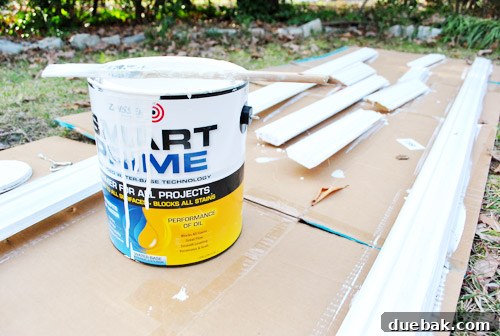
A Stroke of Luck: Solving the Missing Piece Puzzle
Despite my careful hoarding of old trim, I faced a minor setback: I was short a few pieces. My supply of the larger crown molding wasn’t quite enough to fill all the gaps on that side of the room. Just as frustration began to set in, I had a flash of brilliance – or perhaps, just applied some good old common sense. I realized that the oversized, mismatched thick trim on one side of that peculiar beam was precisely the right size for the job! This meant I could “steal” that piece, replacing it with a store-bought smaller trim that either perfectly matched or was very close to the cove molding already on the other beams.
This clever swap meant the entire room would finally have trim that made sense, and I wouldn’t be short on material to complete the project. Talk about a lucky break! That odd, mis-matched beam, which had initially been a source of frustration, unexpectedly saved us from the daunting task of re-crowning the entire kitchen. It was an unexpected, but very welcome, turn of events.
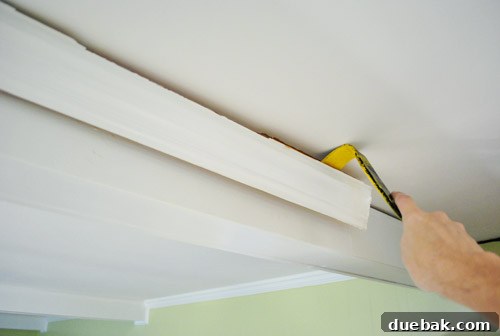
So, the good news was that I now had another long, substantial piece of crown molding to use for all the areas needing attention. The slightly less glamorous news was that, at this stage, the kitchen actually looked a good deal uglier, with pieces removed and gaps exposed, a testament to the work in progress.
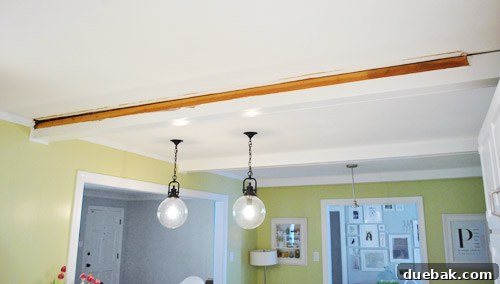
Mastering the Art of Installation: A First-Timer’s Guide
Now, this is where my photographic documentation starts to decline. My mind, I confess, was elsewhere – deep in a post-book photoshoot haze. So, please forgive me that this isn’t a comprehensive “how-to install crown molding” tutorial, but rather a collection of fleeting moments and glimpses of the finished product. We do plan to install crown molding in Clara’s room and the other two bedrooms on that side of the house in the future, and I promise to be a better documentarian then, providing a step-by-step breakdown. In the meantime, as a first-timer myself, I found these online tutorials incredibly helpful: Popular Mechanics, One Project Closer, DIY Network, and This Old House.
The Tricky Business of Cutting Crown Molding
Cutting crown molding is, to say the least, an interesting challenge. Unlike typical trim, you must cut it at the same angle it will sit against the ceiling, not flat on the saw table. One tutorial suggested temporarily gluing a guide piece of wood to the saw table to maintain the correct angle. I attempted this technique, even snapping a picture of my initial setup, but it didn’t quite work for me. I was reluctant to use heavy-duty glue that might damage my saw, and the lighter-duty adhesive I had wouldn’t cure properly due to the cold temperatures in my workspace.

Perfecting Corners with a Coping Saw
Even after I figured out how to make the angled cuts by hand-holding the pieces, the cutting wasn’t over. For inside corners, I still needed a coping saw to remove the extra overhang that would prevent my corners from sitting flush. This technique, known as coping, creates a joint where one piece of molding is cut to fit the exact profile of the other. The tutorials unanimously recommended marking the edge with a darker marker to ensure I was cutting as close to the profile as possible. I suppose it offered some guidance!
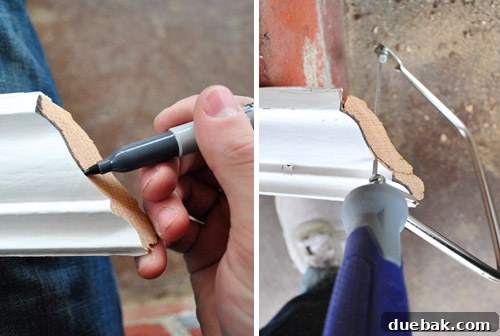

Initial Placement: Seeing the Vision Come Together
As my first time tackling crown molding, things went reasonably well, though I’ll readily admit my cuts weren’t always perfect. Adding to the challenge was the inherent unevenness of our older home’s ceiling – a common joy of historic properties! However, everything fit sufficiently enough that a little caulk and paint, applied later, would beautifully disguise any minor imperfections, creating a truly finished look. Here are my first few pieces in place, prior to the crucial caulking and painting steps.
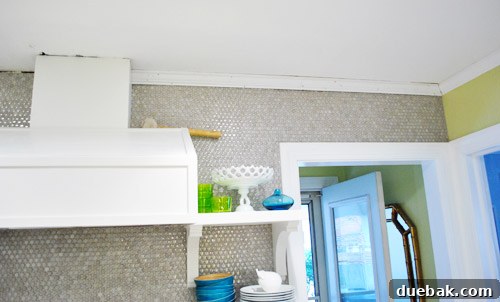
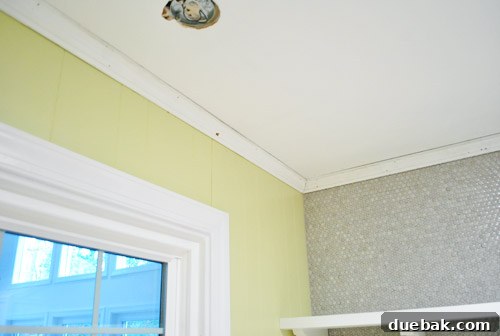
From Rough Edges to Seamless Finish: Caulking and Painting
Post-Installation Touch-Ups: Hiding Imperfections
Despite having painstakingly primed and painted all the molding pieces beforehand, the inevitable “banging around” that occurs during the cutting, coping, and hammering process left them looking quite beat up. Minor scuffs, dings, and nail holes were unavoidable.
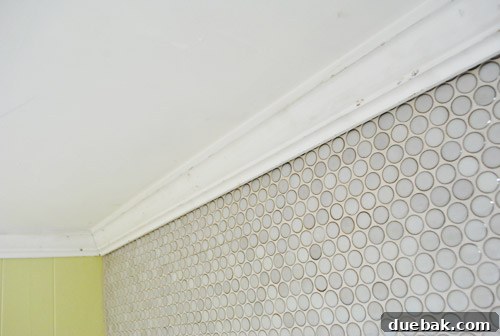
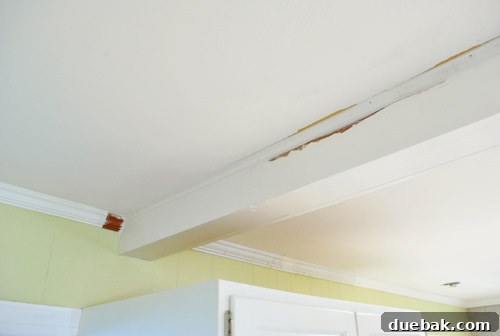
This wasn’t a major concern, as I knew we’d need to break out the paint again anyway. The final coat was essential for covering nail holes, filling in more obvious nicks, and especially for areas where we replaced the thick crown on that one beam with smaller cove molding, ensuring a smooth, uniform appearance throughout.
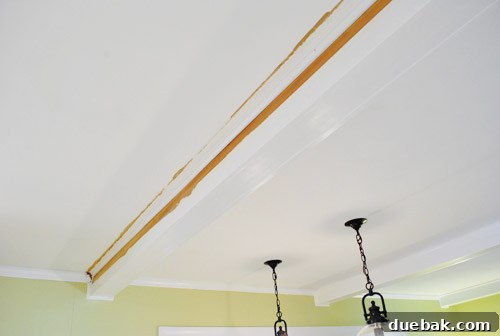
Another Twist: The Cove Molding Conundrum
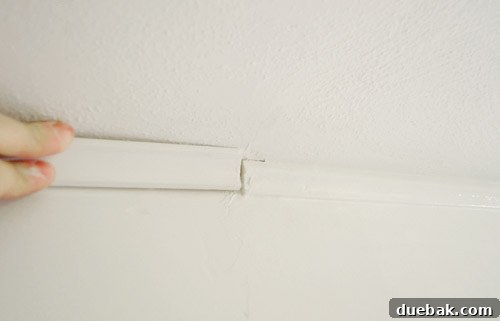
Speaking of cove molding, recall that small missing section on the other side of that beam? I had optimistically hoped the new, store-bought cove molding would be a perfect match, but alas, I wasn’t that lucky. Our existing cove molding turned out to be a non-standard size. This meant that the entire side of that beam ultimately needed to be replaced with a slightly larger, readily available profile.
Thankfully, since each side of the beam transitions into the thicker crown molding around the room’s perimeter (and doesn’t meet other beam trim), the subtle difference in profile is completely undetectable. It’s one of those “you-can’t-tell-unless-they’re-side-by-side” situations. While replacing one side of a beam for a small missing piece of non-standard cove trim might sound annoying, it was an infinitely better solution than having to replace six sides of beams and ten perimeter pieces between each beam and around the rest of the room. In short, it could have been far, far worse!
A Basement Treasure: The Final Piece of the Puzzle
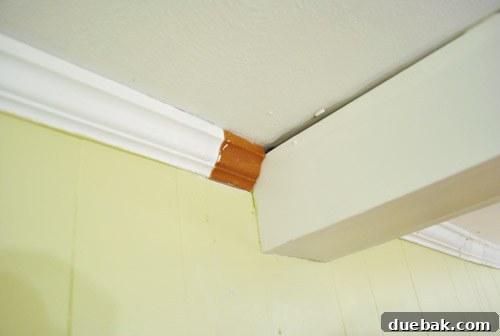
I did, however, get incredibly lucky with the small section of missing crown molding on that side – remember how it’s slightly smaller than the rest of the crown in the room? In a last-ditch effort to avoid having to replace all the crown on this half of the room, I stumbled upon a single, perfectly matching piece of molding in a trash bucket in our basement. I have never been so thrilled to find old, orange-toned trim in my life! It was the final, critical piece to complete our mismatched molding puzzle.
The Seamless Look: Caulking and Final Paint
Here are those final pieces, installed and meticulously caulked. The shot below illustrates how the thinner trim along the beams seamlessly meets the thicker crown molding around the room, hopefully making the complex interplay of moldings clearer. And yes, this is the only picture I managed to snag of the entire caulking and painting process, which Sherry and I diligently tackled over several hours. Our method was straightforward: we used white, paintable Dap caulk and a caulk gun to apply beads wherever gaps needed filling, smoothed them with our fingers, allowed them to dry, and then painted over them to ensure a flawless, seamless finish throughout the kitchen.
The Transformed Kitchen: A Grand Reveal!
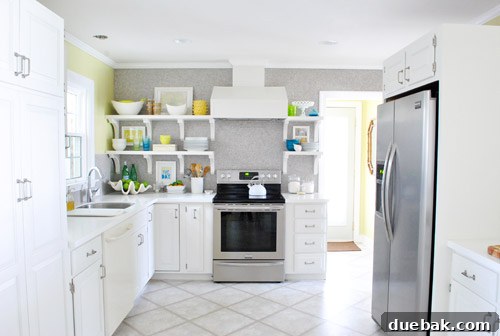
So, without further ado, let’s fast forward to the stunning “after” shots, shall we? The transformation is truly remarkable.
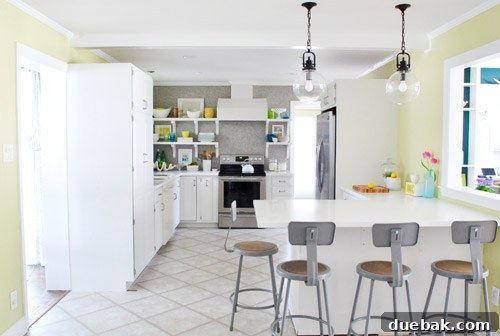
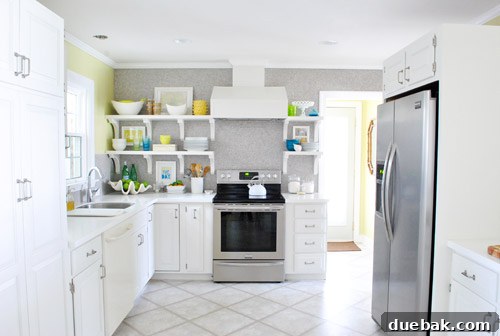
While installing crown molding might seem like a small detail, it makes a dramatically noticeable difference in our opinion. Apart from the empty fixture hole in the ceiling above the sink and our mismatched dishwasher, one could almost be tricked into believing this room is completely finished now. However, the real game-changer that will truly make this kitchen feel “done-zo” will undoubtedly be those cork floors, which we’re more anxious than ever to get installed. Slowly but surely, our kitchen vision is coming to life.
Styling the Shelves: A Personal Touch
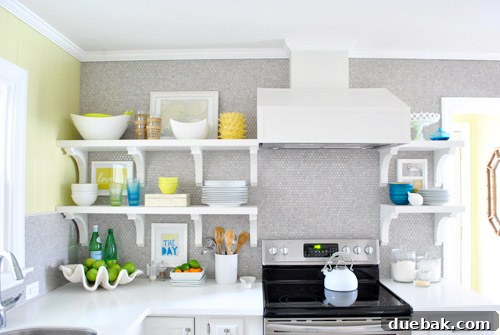
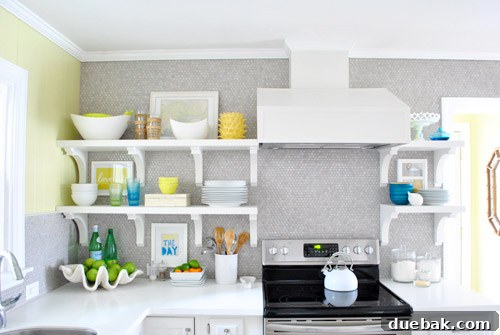
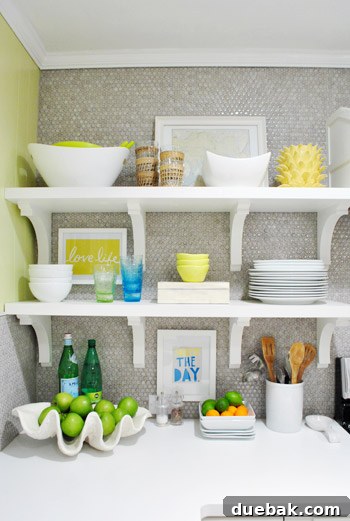
Oh yes, and since everything had to come off the open shelves when the trim went up, naturally, it didn’t all go back in the same way. Sherry had an absolute grand time styling! This involved adding two new frames, thoughtfully eliminating items we realized we weren’t using often, and generally playing around because, for her, it’s a delightful way to spend time. For the frames that are actually hung, we opted for 3M removable picture hanging strips. This clever choice meant no holes in our beautiful tile backsplash and the flexibility to easily rearrange or remove them whenever we desire.
Achieving Balance: The Window’s New Look
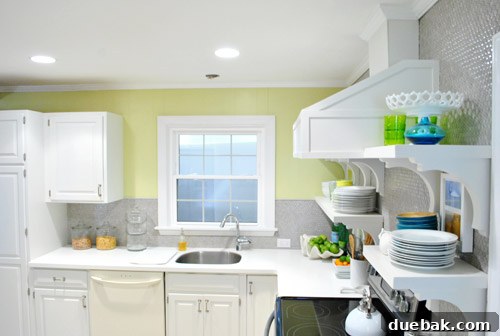
And for those who specifically requested it, here’s a photo of the window, showing the much-desired “breathing room” on each side that finally makes it appear balanced. Once we install a gleaming pendant light to hang in front of it, this spot should be utterly charming. It’s a lovely, airy space, especially considering the wall of shelves is such a significant focal point. Not filling every square inch of every other wall feels like the right design choice for us. We’re also toying with the idea of adding something to the window itself, perhaps a Roman shade or a blind, so we’ll be sure to keep you updated on that decision.
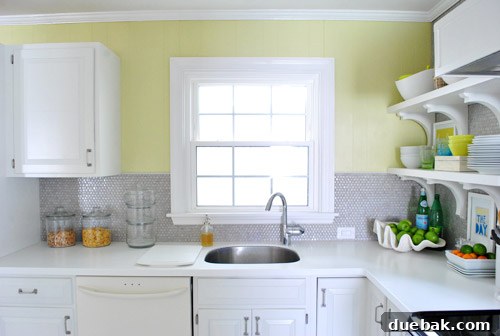
We are incredibly thankful that this balanced arrangement is a far cry from the wildly off-centered situation we endured for a while before the tile and shelves were installed to restore proper visual harmony.
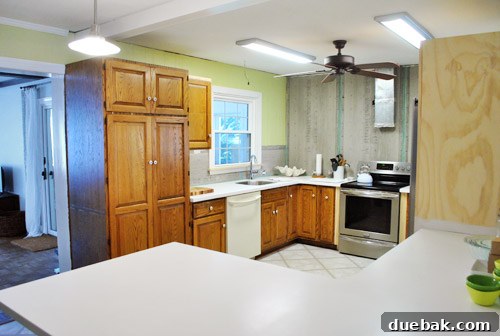
Here’s another shot from a similar angle, allowing you to appreciate more of the newly installed crown molding.
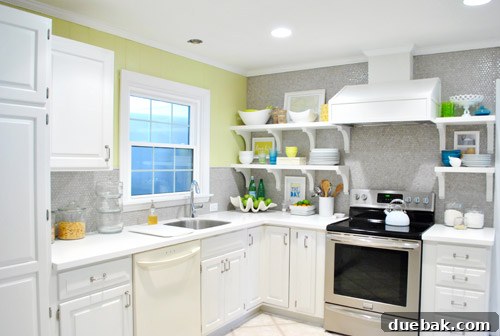
And one more perspective:
Our Journey Continues: Next Steps in the Kitchen Renovation
So, that brings us up to date on our kitchen’s progress. What’s next on our extensive to-do list? We’re focused on finding and hanging a pendant light over the sink, meticulously finishing the peninsula with some decorative wood molding, finally installing the dishwasher, and then, the moment we’ve been dreaming of: adding those cork floors. Once those are in, we can officially declare this 3.5-month marathon renovation complete!
Oh, and yes, addressing the side of the pantry and potentially altering the stools are at the very tail end of the list. We’re not sure how the cork floors will influence those design decisions, so we prefer not to jump the gun on either of those elements just yet. The finishing line is in sight!
Your DIY Weekend: Share Your Home Improvement Adventures!
What home improvement projects did you tackle this past weekend? Any trim hunting, cutting, or hanging adventures? Perhaps some open-shelf tweaking or, dare I ask, some metal-foil-tape using? Share your stories in the comments below!