

Get ready for an exciting journey into the heart of a transformative bathroom renovation!

Embarking on a major home improvement project, especially one as intricate as a bathroom remodel, often feels like stepping into the unknown. It’s a blend of excitement, anticipation, and a fair share of nervous energy. Before diving into the nitty-gritty of tile installation, I must share a brief anecdote that perfectly encapsulated my initial sentiments.
I have a fondness for Jones Soda, not just for its unique flavors, but also for the whimsical fortunes tucked beneath each cap. The other day, I uncapped a bottle and found this message:

“Tasks where skill is essential may be accomplished.” My immediate thought was, “Sounds exactly like a bathroom remodel!” But then, that word “may” echoed in my mind. May? Only may? That’s hardly the confidence boost one hopes for when facing a project of this magnitude. Thankfully, our efforts have moved far beyond mere possibility, proving that with dedication and a willingness to learn, even complex DIY tasks can be successfully conquered.
Mastering the Art of Tile Installation: A First-Timer’s Journey
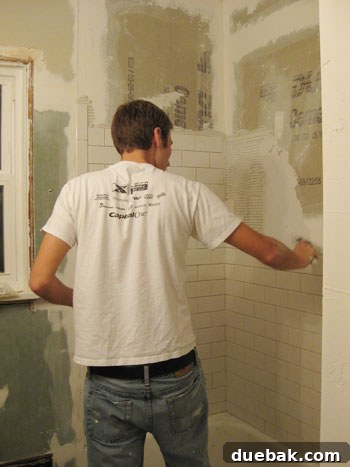
Tiling, for instance, has been a significant part of our bathroom overhaul. While you might have caught a glimpse of our developing tile work recently, I’m thrilled to provide the full, official update on our progress, as promised. You may recall from Chapter Three of our comprehensive bathroom renovation that my dad and I dedicated an intense four-day weekend to installing drywall and cement backerboard. This crucial preparation laid the foundation for re-tiling both our shower surround and the bathroom floor. Despite encountering a few unexpected “challenges” during that weekend, I barely managed to begin tiling the shower by the time my dad departed on Monday evening. In fact, I was deep into the initial stages when this farewell photo was captured.

I continued working for another couple of hours after he left, but by the end of that day, I had only managed to lay a mere two rows of tile. It was a rather deflating realization. This project, like many before it, was proving to be neither as fast nor as straightforward as I had initially envisioned. But what exactly made it so challenging?
The Unforeseen Obstacle: An Unlevel Tub
The primary culprit behind my slow progress was an unexpected issue: our bathtub wasn’t perfectly level. This seemingly minor detail completely derailed my original plan of using the tub’s edge as a reliable guide for the first row of subway tiles. After some deliberation, we conceded that even slightly unlevel tile lines would look noticeably “off” and continuously bug us. More critically, it would risk the tiles not aligning correctly at the corners, leading to a visibly unprofessional finish. While some DIY guides suggest finding the center point of your wall and starting there, with such small subway tiles, it was more critical for us to avoid ending up with tiny slivers of tile along the edge of the tub or the ceiling. Our goal was to achieve a planned, balanced aesthetic with as many full tiles as possible in these visible areas.
Consequently, I spent the majority of that first evening meticulously using a wet saw to shave off varying, precise slivers of ceramic from the bottom edge of each subway tile intended for the tub line. This painstaking process was essential to create a perfectly level base from which all subsequent rows could be built. It was a solid three or four hours of what I affectionately call “tedious trial-and-error-ish fun,” but the effort paid off handsomely. Achieving that perfectly level first row, despite the initial setback, was incredibly satisfying and set the stage for all the tiling that followed.

I genuinely mean “fun” when I describe that initial phase. It was precisely the kind of home improvement project I relish – one that demands more mental concentration and problem-solving than sheer physical strength. After all, I’d already had my fill of heavy lifting and intense labor earlier in this renovation. The immediate, tangible change brought by each perfectly laid tile was incredibly rewarding. Plus, it offered a fantastic opportunity to experiment with new tools and acquire valuable new skills. As this was my inaugural tiling experience, I’ll walk you through my personal play-by-play rather than offering an official “how-to” guide, as numerous methods exist, each effective depending on individual preferences and project specifics. For truly expert tutorials, I highly recommend consulting some of the professional resources I frequently referenced during my tenure as “Mr. Tile.” (You’ll find links to these invaluable sites at the bottom of this post.)
Essential Tools for a Successful Tile Project
Now, let’s delve into the crucial tiling details, starting with my arsenal of chosen tools – the “weapons” that made this transformation possible:
- Wet Saw: (Generously borrowed from my dad) – Indispensable for precision cuts and shaping tiles.
- Tile Cutter: (Purchased jointly with my dad) – Ideal for clean, straight cuts on ceramic and porcelain tiles.
- Thinset Mortar Adhesive: A couple of large buckets of high-quality thinset mortar adhesive, the crucial bonding agent for our tiles.
- Margin Trowel: (Another borrowed tool) – Used for applying and smoothing thinset in tighter spaces and for initial spreading.
- Notched Trowel: (Also borrowed) – Essential for creating uniform ridges in the thinset, ensuring proper adhesion and coverage.
- 1/16th” Spacers: (Used for the floor tiles; the subway tiles conveniently featured built-in spacers that naturally created a 1/16th” gap) – For consistent grout lines.
- Tape Measure: (Already owned) – For accurate measurements.
- Level: (Already owned) – To ensure every tile is perfectly horizontal and vertical.
- Pencil and Sharpie: Used for marking cut lines on tiles (a Sharpie was necessary for the darker marble, as pencil marks were invisible).
- Paper Towels and a Bucket of Water: Essential for keeping the workspace clean and managing the inevitable mess.

The Cutting Edge: Wet Saw vs. Tile Cutter
The wet saw and tile cutter were my dynamic duo for achieving perfectly sized tiles. The wet saw operates much like a circular table saw, but with a robust masonry bit and a crucial integrated water tray. This water circulation keeps the blade cool, prevents premature wear, and significantly reduces dust – though it does create a rather pleasant “mud” that requires periodic cleanup. The wet saw proved invaluable for making small, precise trims (like those slivers needed for the unlevel tub line) and intricate non-straight cuts, such as notching semi-circles to accommodate pipes. For one particular tile, I even had to employ my dad’s hole saw drill bit to create a central opening. While it can handle straight cuts and comes equipped with an adjustable guide, I found it less precise for perfect straight lines than desired. Despite its messiness, using the wet saw was enjoyable. I strategically placed it in the bathtub while tiling the shower surround (conveniently at my feet) and later in a heavily drop-clothed area of the hallway for the floor tiling. Had it not been the dead of winter, I would have certainly worked outside to minimize indoor mess.

In stark contrast, the tile cutter offered a completely mess-free and remarkably straightforward cutting experience. Its utility, however, is limited to straight cuts – perfect for when I needed to halve tiles to achieve the staggered, running brick pattern in the shower. After marking my cut line with a pencil, I aligned the tile against the flat guide surface and ran the tiny scoring wheel a few times across the tile’s surface. I always knew I was doing it right when I heard that distinct “nails-on-a-chalkboard” scraping sound. Then, with just a gentle press, the angled pad allowed me to snap the tile cleanly. The only downside was its inability to cut our thick marble floor tiles, which meant I had to rely solely on the wet saw for the floor. Fortunately, by that point, having completed the tub/shower surround first, I was considerably more adept with the wet saw.

Precision in Adhesion: Applying Thinset Mortar
While cutting tiles proved to be the slow, meticulous, and mathematically demanding aspect of the entire process, setting the tiles was, by comparison, remarkably speedy and virtually painless. The primary challenge during this phase was consistently applying the correct amount of thinset mortar. It was a delicate balance: enough to ensure robust adhesion, but not so much that tiles would sit unevenly or cause excess thinset to squish out between the grout lines (spoiler alert: I wasn’t always perfect at this). The method involved several crucial steps.
First, I’d apply a generous dollop of thinset to the wall, spreading it roughly with the flat back of the margin trowel. Once the area was adequately covered, I switched to the notched trowel. This clever tool features two straight edges and two notched edges. Initially, I used one of the straight edges to even out the thinset, drawing it across the wall at a 45-degree angle with enough pressure to leave a thin, consistent coat. Following this, I’d revisit the same area with the notched edge, again at a 45-degree angle but with slightly more pressure, to create distinct, long grooves in the thinset. These grooves are vital for proper tile adhesion, allowing air to escape and creating suction. With the thinset perfectly prepared, I was ready to press each tile firmly into place, ensuring it was level with its neighbors – a crucial check easily performed with a spirit level.
Learning from Mistakes: The Importance of Thinset Cleanup
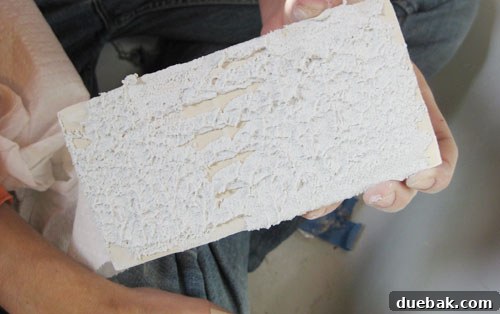
A valuable tip I picked up along the way was how to verify if I was using enough thinset: immediately after setting a tile, gently pry it up and inspect its back. If the entire surface is covered with thinset, your application is sufficient. If not, you need more. This is where I made things harder for myself. I likely overcompensated in some areas, leading to an excessive amount of thinset squeezing up between my tile grout lines. This isn’t a catastrophic error – if you’re diligent about cleaning it all out before it dries. I highly recommend a combination of your finger, a paper towel, or even an old toothbrush for this wet cleanup. I learned this lesson the hard way, spending a considerable chunk of a Saturday painstakingly chipping dried thinset out of the cracks with a razor blade – a task infinitely more challenging than removing it when wet. After all, you need to leave adequate space for the grout, right?
From Shower to Walls: Progress and Minor Setbacks
After that initial, painstaking evening of meticulously tiling the bottom row, the pace picked up significantly. Most of the subsequent tiles were full-sized, requiring less custom cutting (except for edges and corners). I managed to complete the remainder of the shower tiling in two five-hour sessions after work on Tuesday and Wednesday of that week. Victory was mine! In fact, we would have had the entire shower grouted the very next weekend, were it not for two unforeseen errors on my part. First, the aforementioned messy grout line cleanup, which demanded extra time and effort at the project’s tail end. Second, a simple misreading of the label led me to ruin an entire batch of grout by mixing in twice the required amount of water. More on that particular mishap later in the week, but suffice to say, a snowstorm that same weekend prevented us from driving out for more supplies, putting our tiling progress on a temporary “pause.” Undeterred, we shifted our attention to the bathroom walls.
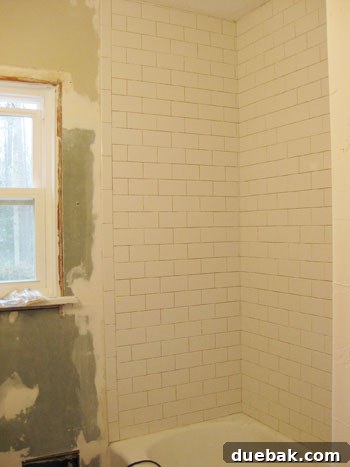
We diligently primed the walls with a specialized Valspar drywall primer. For our wall color, we settled on Benjamin Moore’s “Dune Grass,” a subtle muddy green-taupe hue that perfectly complements the tiles. While we chose a Benjamin Moore swatch, we opted to have it color-matched at Lowe’s to their no-VOC Olympic Premium semi-gloss bathroom paint. We learned that while the base is no-VOC, adding color tint makes it low-VOC, which was still an incredibly mild and low-odor option. This painting interlude turned out to be a happy accident – getting most of the painting done before laying the marble floor meant we didn’t have to worry as much about paint drips or accidental splatters on our brand new, pristine floor. Hooray for serendipitous delays that shift focus from complex tiling to the comparatively simpler task of painting! Painting felt like first-grade arithmetic compared to the advanced algebra challenges of tiling.
Preparing for the Pristine Marble Floor
With the walls painted, it was time to return our full attention to the floor. I began by completing the prep work my dad and I had initiated: installing the cement backerboard. He had kindly cut and set aside the pieces before his departure the previous weekend. We meticulously laid the backerboard over the plywood subfloor. Here’s a crucial tip: we used extra-long screws to ensure they penetrated not only the backerboard but also the 3/4-inch plywood underneath and deep into the diagonal subfloor. This created a super-strong and uncompromising hold, essential for a stable tile base. Once the four puzzle pieces were securely set and generously screwed into place, we used mesh tape and thinset mud to fill all seams and any remaining gaps. After allowing this to dry for a full day, we sanded off any excess and performed a thorough sweeping, ensuring the backerboard was 100% free of dust or cement crumbs that could potentially compromise the adhesion of our new marble tiles.
Strategic Layout: Planning for Perfection
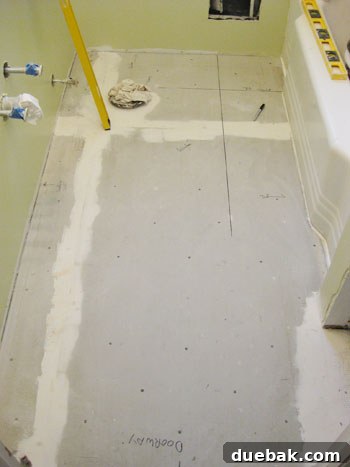
As eager as I was to unleash my wet-sawing skills once more, we first embarked on a crucial step: planning our tile placement strategy. This was vital not only for achieving an aesthetically pleasing layout but also for ensuring the smartest approach to tile cutting. Our goal was to maximize the number of full tiles in the most visible areas, and since we had to navigate around the curved tub and the linen closet entrance, we absolutely wanted to avoid awkward, tiny tile slivers in corners or high-traffic zones. While some experts advocate starting tiling from the center of the room and working outwards, for our small bathroom, we felt our criteria – prioritizing large, full tiles in prominent areas and eliminating dreaded slivers – was more important. So, we conducted a “dry run,” arranging several configurations with our actual 12″ x 12″ marble tiles (complete with spacers!). This exercise helped us settle on a layout that called for relatively simple cuts and allowed us to lay full tiles for nearly the entire length of the bathroom. Here’s a snapshot of the guidelines I drew to kick off the precise installation:
Floor Tiling: Back Buttering and Clever Tricks
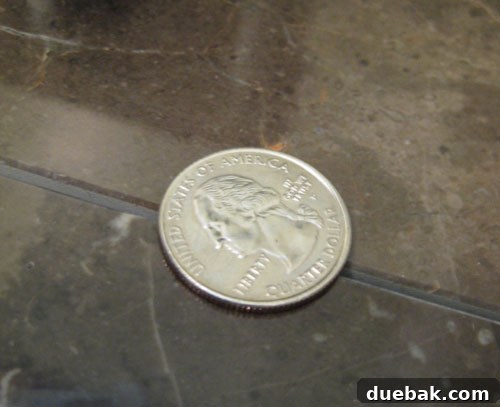
I won’t bore you by repeating the entire process of laying the floor tiles, as it was largely similar to installing the wall tiles. However, there was an added challenge: despite our best efforts, our bathroom floor still had a very slight slope to it. To compensate for this, and to ensure maximum stability for our natural stone, we opted to “back butter” our tiles. This technique is also highly recommended by many experts for marble and other natural stone tiles to ensure an extremely firm, wiggle-proof installation, which helps prevent cracking and enhances long-term durability. Back buttering involved spreading a thin, even layer of mortar directly onto the back of each tile, in addition to applying thinset to the floor itself (using the same notched trowel technique). This dual application allowed us to be incredibly precise in ensuring each tile was set perfectly level with its surrounding companions. While we primarily relied on a traditional spirit level for guidance, we employed a clever “quarter trick,” recommended by a friend, for an extra double-check. We gently ran a quarter across the seams of two neighboring tiles to see if it glided smoothly or if it caught on an edge, indicating that one tile was set too high or low.
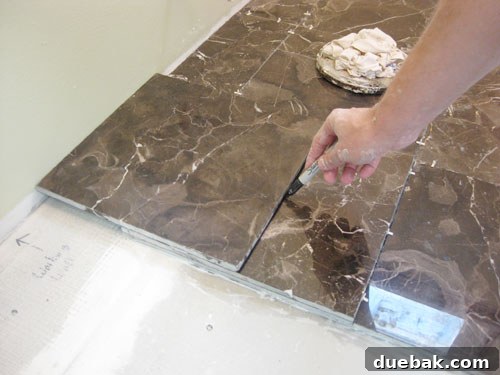
Another invaluable trick we learned, which proved immensely helpful for the floor, was a simple yet brilliant method for measuring cuts against a wall. Once you’ve set the closest full tile, carefully place the next tile you intend to use directly on top of it (I found rubber spacers useful here to create a small buffer and prevent scratches). Then, take a third, spare tile and place it on top of this stack, but slide it gently until it touches the wall. Just like that, you’ve visually exposed the precise portion of the middle tile that needs to be cut to perfectly fill the empty space. I simply used my Sharpie to mark the cut line on the middle tile and headed to the wet saw for a quick, accurate trim. Lo and behold, this method worked like a charm every single time, saving countless minutes of complex measuring.
A Triumphant (and Exhausting) Completion
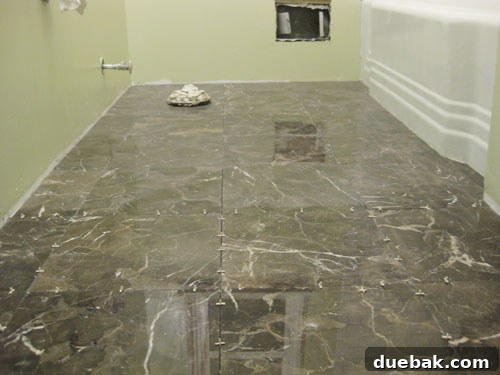
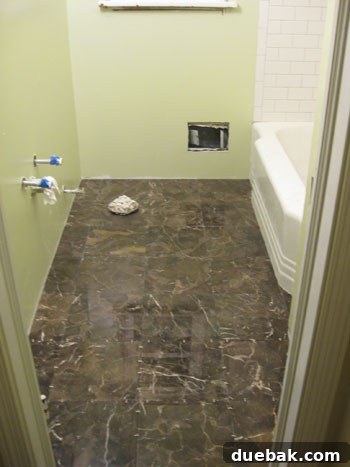
Tiling the floor, which involved wet-sawing more than half of the 37 tiles, consumed most of my Christmas Eve (as much as I could do before we had to jump into the car to spill the beans about our baby girl bean to the family) and another few hours on the evening of the 27th when we returned home. All in all, it was a tremendous amount of work, but the feeling of accomplishment upon completing all that tiling was indescribable. Though, I must admit, I was almost going to miss the wet saw. We shared some surprisingly good times together, transforming raw materials into a beautiful, functional space.
What’s Next: Grouting, Sealing, and More Adventures!
Laying the floor tiles, while a monumental step, isn’t the grand finale of this tiling adventure. We still have the crucial grouting and sealing processes to share, which are essential for protecting our beautiful new surfaces and ensuring their longevity. But for now, this chapter concludes. I’ll be posting later in the week with updates on the remainder of our holiday bathroom adventures, so stick around – and no, that wasn’t an intentional thinset pun!
As I mentioned earlier, our first venture into tiling involved referencing a variety of experts. We quickly discovered that instructions can vary significantly and are rarely perfectly tailored to your exact situation. Therefore, it’s crucial to always consider what methods and advice will work best for your specific project and home. Here are some of the invaluable resources we consulted, which we hope will also prove useful for your DIY endeavors: All Bower Power, AskTheBuilder, eHow, Home Depot, and Lowe’s.
Psst – Eager to catch up on the initial phases of our major bathroom makeover? Dive into Chapter One, Chapter Two, Chapter Three, and don’t miss a little teaser post we recently shared!