
First-Time Home Buyer’s Guide: Navigating the Path to Your Dream Home
Embarking on the journey to purchase your first home is an incredibly exciting, yet often overwhelming, experience. Many first-time buyers, like Erin who posed the question to us, are looking for a property with “potential” – a place that might need a little love and updating but can be transformed into their ideal living space. This guide is crafted to offer you a roadmap, drawing from our own experiences and insights, to help you find not just a house, but the perfect home for *you*.
Defining Your Vision: What Does “Home” Truly Mean to You?
One of the most profound truths about home buying is that the “perfect” house doesn’t exist. Instead, the quest is to find the perfect house *for you*. This crucial distinction shifts the focus from an idealized, generic notion of home to a deeply personal understanding of your daily life, habits, and future aspirations. Before you even begin browsing listings, our biggest piece of advice is to dedicate significant time – hours, or even days – to a candid conversation about what you genuinely need and desire in a home.
Forget the lofty dreams of how you *might* use a home if you were living a different life; instead, concentrate on how you *will* actually live in it on a day-to-day basis. For example, you might envision grand parties and entertaining droves of guests, leading you to believe a giant formal dining room is a must-have. However, if deep down you know you’ll spend far more time relaxing in front of the television, a cozy TV room might get eons more use and truly serve your lifestyle better. Our personal decision reflected this approach: we chose a house with two distinct living areas – a formal living room and a more casual den – knowing this flexibility would be invaluable as our family grew and our needs evolved.
Considering Your Lifestyle and Family Habits
Beyond the core living spaces, consider the nuances of your household. Do you have children or pets? If so, think about their routines and how the home can accommodate them. A dedicated mudroom, for instance, could be a game-changer for keeping their gear organized and containing messes, preventing them from tracking dirt throughout the house. Think about your own habits: do you often cook and surf the web simultaneously? A computer counter in the kitchen with space for a laptop and a chair might seem like a small detail, but it could dramatically improve your daily efficiency. Conversely, if you rarely use a computer while cooking, this might be an upgrade you’d pay for and never fully utilize.
To streamline your search, organize all these considerations into two distinct categories: a “must-have” list and a “would-be-nice-but-not-necessary” list. This clear distinction will act as your compass, guiding you through countless listings and open houses. For instance, here were some items on our essential “must-have” list:
- A desirable location and welcoming neighborhood
- Access to good, reputable schools
- A private and secluded backyard
- At least three spacious bedrooms
- A minimum of one and a half bathrooms
- A functional garage for parking and storage
And these were the features that made our “would-be-nice” list:
- Elegant wood floors throughout
- A cozy and inviting fireplace
- Ample basement or attic storage space
- A charming front porch for relaxation
- A bright and airy sunroom
- A classic bay window offering extra light and character
Fixer-Upper or Move-In Ready: Aligning with Your Budget and Desires
Our lists clearly show a lack of items like brand-new granite counters or pristine curb appeal. This was a deliberate choice, born from several long, honest conversations about what we *really* wanted. We decided that a “fixer-upper” – a house with good bones but in need of cosmetic updating – would allow us to mold it into our truly perfect home, rather than paying a premium for someone else’s upgrades that might not align with our personal style. This strategy paid off immensely, allowing us to purchase a house for nearly $25,000 under our initial budget. The leftover funds became our renovation budget, transforming our new acquisition into our dream home.
If you’re considering a similar path, communicate clearly with your realtor. Ask them to show you homes that, crucially, have no obvious structural issues, but could significantly benefit from cosmetic enhancements. This approach often means that a bit of elbow grease, some fresh paint, and perhaps a bathroom or kitchen redo, can elevate an outdated property from “ick” to “ooh-la-la!”
Understanding Potential Pitfalls: What to Avoid
Conversely, it’s wise to steer clear of homes plagued by more substantial and problematic issues. Properties that have sustained severe flood or fire damage, for instance, can quickly become financial black holes, revealing far more extensive and costly repairs than initially apparent. Always, without exception, secure a thorough home inspection before finalizing your purchase. This critical step not only uncovers hidden problems but also provides an escape clause, allowing you to withdraw your offer if the extent of necessary repairs proves too daunting or expensive.
On the other hand, you might know yourself well enough to recognize that you simply do not want the headache and stress of a renovation. In this scenario, updated kitchens, new windows, and modern finishes should absolutely be on your “must-have” list. This ensures you’ll walk into a home that wows you from day one, allowing you to enjoy your new space without immediate projects.
Prioritizing Functionality: How Your House Can Work Hardest for You
Before making an offer, reflect deeply on how the house will serve *your* unique lifestyle and daily needs. This self-awareness can truly make or break your choice, distinguishing between a house that might impress others and one that genuinely enhances your family’s life. For example, while hardwood flooring and granite counters are popular, they might not be your personal priority. If you do laundry five days a week, choosing a house with a spacious, well-appointed laundry room might bring you more joy and convenience for years to come than any high-end countertop.
Our own selection process perfectly illustrates this principle: we weren’t initially wooed by the house itself, but rather by the exceptional lot it sat upon. The prime location and excellent school district – two incredibly important considerations for long-term satisfaction – were major draws. Furthermore, the private backyard, boasting nine-foot privacy hedges and extending into a half-acre of woods, promised a serene, secluded existence where our future children could play safely and freely for hours.

Seeing Beyond the Surface: Unlocking Hidden Potential
As mentioned, the house itself didn’t immediately captivate us. It looked exactly like the ‘before’ pictures you see – complete with less-than-desirable wallpaper…
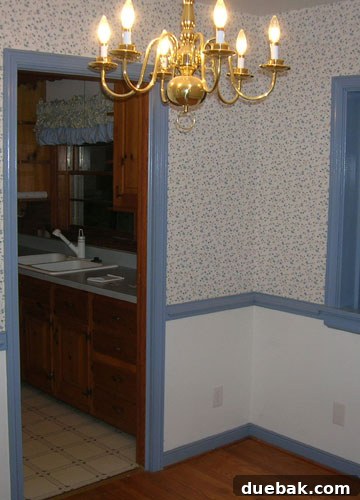
…and a distinctly green toilet and empty rooms. Yet, we possessed the vision to look past these superficial flaws and recognize its underlying “good bones.” We saw that it already possessed many items from our “would-be-nice” list, and then some! It boasted a delightful sunroom with three full walls of glass, offering gorgeous private views. It had two working fireplaces, generous basement and attic storage space, hardwood floors in roughly half the house, and a sweet little front porch perfect for morning coffee. Despite its array of “grievous features” – including terrible floral wallpaper, oversized ceiling fans that dwarfed nearly every modestly sized room, and the infamous stove-microwave combo with its faux-brick backsplash we inherited…
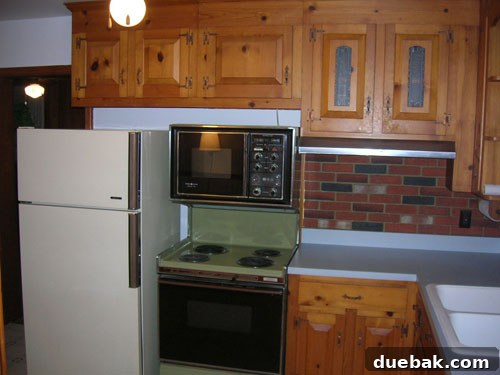
…we knew, with certainty, that a fresh coat of paint and a planned kitchen remodel would transform our home from a caterpillar to a beautiful butterfly.
Optimizing Layout and Maximizing Space
In our careful consideration of how we truly live, we also deeply appreciated the abundance of common space within a relatively small footprint. Although our home measures only 1350 square feet, it thoughtfully incorporates a back patio, a sunroom, a den, a living room, and a front porch. These diverse areas provide ample opportunities for reading, relaxing, and enjoying downtime – features that will be invaluable for our future children, offering them various spaces to play together (or perhaps to hide from their “annoying” siblings!). We were also drawn to the intelligent layout, with bedrooms thoughtfully grouped on one side of the house for enhanced privacy, and the more open living areas situated on the other. This configuration simply “made sense” as we walked through it. While we have made numerous changes over time and it certainly wasn’t perfect from the outset (we would have loved for our master bedroom to be on the back of the house instead of the front), it has unequivocally proven to be the perfect house for us.
Evaluating the Cons: Disregard vs. Substantial Investment
A highly effective strategy in your house hunt is to dedicate time to explicitly writing out the “cons” of any property you’re seriously considering. This exercise can be incredibly eye-opening. It helps you distinguish between minor flaws that are easily remedied and significant issues that demand substantial investment.
Here are some common “cons” you can generally disregard because, with less than $100 and a single afternoon, you can typically rectify them:
- The walls are painted bright pink, green, yellow, or other colors you dislike.
- There’s an outdated or ugly light fixture above the dining table or in a bathroom.
- The home features hideous wallpaper with clowns, flowers, or fruit patterns.
- There’s ugly furniture or excessive clutter left by previous occupants (which will be removed).
By contrast, the following “cons” often require a substantial financial and time investment to rectify. If you are entering the home-buying process with a clear budget for renovations, these might be acceptable. However, if you have little to no money leftover for significant remodels, you’ll likely want to avoid properties with these issues:
- The bedrooms are inconveniently far apart (e.g., on different floors) and you desire them to be together.
- The kitchen is significantly smaller than you require or envision.
- There isn’t enough room to comfortably accommodate your existing furniture.
- There is hideous or damaged flooring throughout the home that necessitates complete replacement.
- The house lacks a sufficient number of bedrooms, bathrooms, or primary living spaces to meet your needs.
Keeping both the pros and these contrasting categories of cons firmly in mind will empower you to objectively evaluate whether you’ve found a nice house for *someone else*, or truly a nice house *for you*.
Bonus Tip: Live in It Before You Transform It
Once you’ve successfully purchased your new home, here’s a crucial bonus tip: we highly recommend resisting the urge to undertake any major restructuring or significant renovations immediately. Instead, allow yourself and your family time to settle in, live in the space as it is, and truly understand its flow and your genuine needs. This period of immersion will confirm whether you’ll genuinely utilize that dining room turned library, or if you truly want to sacrifice a family room for a larger kitchen.
While your initial instincts are often on track, living in the home can reveal unforeseen opportunities. For instance, we didn’t even consider widening doorways for about six months after moving in. Had we commenced our kitchen renovation immediately, it wouldn’t possess the open and airy feel it enjoys today. John and I intentionally lived with our house largely “as is” – making only cosmetic changes like painting, but no structural or layout modifications – for almost a full year. This patient approach allowed us to confidently determine that we truly wanted an additional bedroom more than a formal dining room (you can read more about how we majorly restructured our home’s layout to work for us). This waiting period ensured we were absolutely certain about what we wanted (and, equally important, what we *didn’t* need) in our new kitchen.
We hope these insights and tips empower you on your first-time home buying journey. Happy house hunting, and may you find the perfect place to call your own!