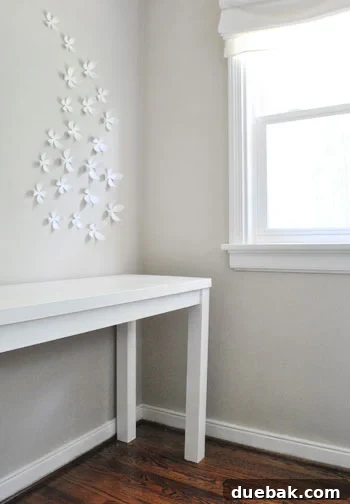
Crafting the Perfect Dual-Purpose Workspace: Our DIY Desk Journey for a Small Guest Room Office
In the evolving landscape of modern living, the line between dedicated spaces often blurs. For many homeowners, a guest bedroom isn’t just a place for visitors; it’s a versatile area that frequently doubles as a home office, a creative studio, or even a cozy reading nook. This multifunctional approach, while practical, introduces unique design challenges, especially when working with limited square footage. Our particular dilemma revolved around transforming our modestly sized guest bedroom into a functional two-person home office, all while ensuring it could still comfortably accommodate occasional house guests with a full-sized sofa bed. The central question that dominated our initial planning: where do the desks go? Or, more accurately, where do the two desks go?
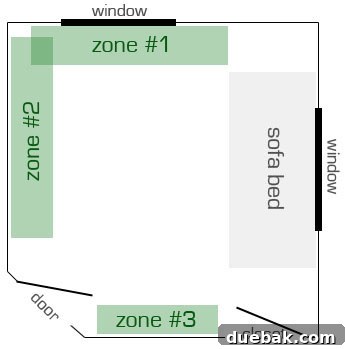
This wasn’t a trivial consideration for a room measuring just 10 feet by 10.5 feet. Every inch had to be meticulously planned to ensure both functionality and comfort. To navigate this intricate puzzle, we embarked on a strategic pre-planning phase, starting with a simple, not-to-scale floor plan to visualize potential desk placements. This crucial step allowed us to weigh various options and anticipate how each would interact with the room’s existing and planned elements.
The Initial Challenge: Maximizing Space in a Modest Room
Our guest room’s compact dimensions presented a significant hurdle. We needed a workspace that could accommodate two individuals, ideally side-by-side for collaborative projects, without impeding the functionality of the sofa bed. This meant any desk solution had to be long enough for two but shallow enough to allow the sofa bed to fully extend. We carefully considered three distinct zones within the room, each with its own set of advantages and drawbacks:
-
Zone #1: The Window View Dilemma
Placing a desk in Zone #1 initially seemed appealing. The idea of one of us enjoying a pleasant view of the backyard through the window was a definite draw. However, this option quickly revealed its limitations. With the sofa positioned nearby, the other person would feel noticeably cramped, sacrificing comfort for a view. Furthermore, we had ambitious plans for a tall bookcase on that very wall, intended to visually balance the uncentered window and provide much-needed storage. This spatial conflict rendered Zone #1 less ideal for a dual workstation, prompting us to explore other possibilities.
-
Zone #2: The Long Wall Potential
Zone #2 emerged as a strong contender. This wall boasted the longest uninterrupted stretch, offering the most potential for a continuous two-person desk. The primary challenge here was the requirement for a very specific, custom-sized desk. Not only did it need to fill the considerable length of the wall, but its depth was critical to ensure the sofa bed could fold out completely without obstruction. Despite the custom design necessity, the blank canvas of this wall also presented exciting opportunities for integrating art, pinboards, or other productivity-enhancing decor.
-
Zone #3: The Single Desk Compromise
Zone #3, while offering space for one desk, didn’t quite align with our primary need for a two-person workspace. While it could theoretically house one of us, with the other occupying Zone #1 or #2, this arrangement meant we’d be working with our backs to each other. This setup is far from ideal for collaborative tasks where seeing each other’s screens or easily communicating is essential. The lack of direct interaction made Zone #3 less attractive for our shared office vision.
After careful consideration and weighing the pros and cons of each zone, the decision became clear: Zone #2 was the undisputed winner. Its expansive length was paramount for accommodating two workstations, and the blank wall offered unparalleled flexibility for future personalization and decor. This strategic choice laid the groundwork for our next challenge: finding or creating the perfect desk to fit this unique space.
The Quest for the Ideal Desk: Off-the-Shelf vs. Custom Solutions
With Zone #2 chosen, our attention turned to the desk itself. The space offered roughly 7 feet of length between the window and the fully open door. However, the critical constraint was depth: we could only accommodate about 21 inches before encroaching on the folded-out sofa bed’s space. This precise set of dimensions immediately narrowed our search considerably. We scoured furniture stores and even delved into thrift store hunting, eventually identifying two promising retail options:
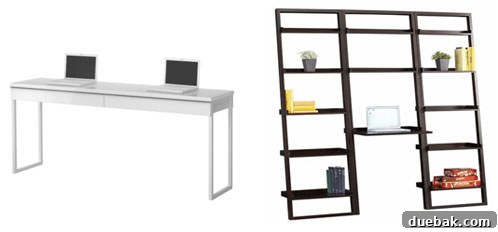
Examining Retail Options: IKEA Besta Burs and Crate & Barrel Sloane Desk
-
IKEA Besta Burs: This sleek desk caught our eye with its modern aesthetic. However, its dimensions proved problematic. At 5’10” long, it was significantly shorter than the 7 feet we had available, meaning wasted space that could be used for desktop real estate. More critically, its depth of only 15 inches felt too shallow for comfortable, long-term work for two people, even with minimalist setups. The $249 price tag, while not exorbitant, still felt a bit steep for a solution that didn’t fully meet our spatial requirements or provide adequate workspace.
-
Crate & Barrel Sloane Leaning Bookcase Desk: This option offered a more integrated look, potentially combining a desk with shelving. However, it came with its own set of drawbacks. The price of $379 was considerably higher, pushing beyond our budget. Moreover, it was designed primarily as a single workstation, meaning we would likely need two units or a significant customization to accommodate both of us. This also raised another concern: the room was already slated to have a large bookcase next to the uncentered window, and adding more shelving with this desk would lead to an overabundance of bookcases, making the room feel cluttered rather than functional. It became increasingly evident that off-the-shelf solutions were proving inadequate.
Our prolonged search left us feeling a bit out of luck. Retail options either missed the mark on size, depth, or functionality, or simply didn’t align with our budget. It was at this point that a familiar sense of confidence, perhaps a residual effect from a prior successful self-building project, began to bubble up. The answer, we realized, wasn’t on a store shelf; it was in our own hands. It was time to embrace the DIY spirit and build a custom desk tailored precisely to our needs.
Embracing DIY: The Birth of a Custom Desk Project
The decision to build our own desk was a pivotal moment. It wasn’t just about saving money; it was about achieving a perfect fit and a truly personalized solution. I had been eager to take on a larger project with my Kreg Jig, a tool known for its ability to create strong, concealed joints, and this seemed like the ideal opportunity. The initial thought was deceptively simple: “How hard could it be? Just screw some legs onto a big slab of wood, right?” This seemingly straightforward approach, however, overlooked one significant logistical challenge: transporting a “big slab” of wood. Our only vehicle, a Nissan Altima, is not exactly conducive to hauling 7-foot pieces of lumber.

The Unexpected Gem: Repurposing a Hollow-Core Door
Just as we were pondering the transportation dilemma, a moment of inspiration struck Sherry. She remembered an old hollow-core door that had once served as the door for our bathroom linen closet but had since been residing in our garage. This door, which we had removed when we opted for open storage (a style we genuinely love), was a constant presence in the garage, always “in the way.” Now, it was poised for an incredible comeback. This wasn’t a wholly original idea; Sherry had seen other creative individuals in the blogosphere repurposing doors into tabletops and desktops. She quickly convinced me that we should join their ranks.
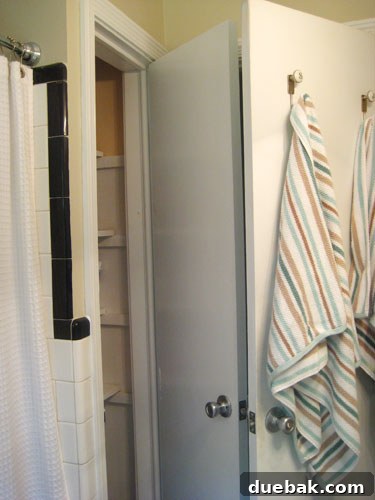
And serendipitously, this door was almost a perfect fit for our Zone #2 dimensions with minimal alteration. It measured just under 7 feet long and approximately 18 inches wide—remarkably close to our ideal length and within our crucial 21-inch depth limit. The advantages were manifold: it was completely free, eliminating a major material cost, and it required absolutely zero hauling from a store. This unexpected discovery felt like a stroke of genius, sparking genuine excitement (and perhaps some celebratory jazz hands!).
Designing Our Custom Desk: Functionality Meets Simplicity
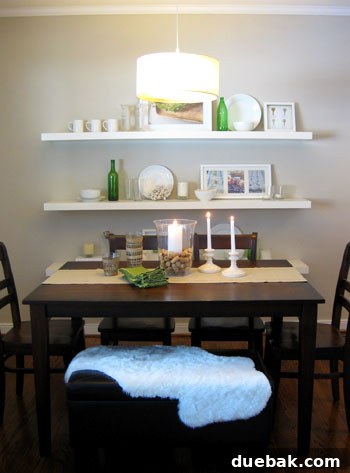
With the desktop material secured, the next step was to design the base. I wasn’t aiming for complex carpentry with fancy drawers on this, my first substantial furniture-building attempt. I felt a bit adventurous, opting for simplicity and solid functionality. Instead of relying on detailed woodworking plans, I found my design inspiration right under our noses: our dining room table. It featured the exact basic leg and rail design—sturdy, clean lines—that we envisioned for our DIY desk. While the dining table’s measurements were different, its fundamental construction provided the perfect template to mimic for our project. A few quick measurements of our dining table’s structure provided all the guidance I needed for the legs and connecting rails.
Gathering Supplies and Preparing Our Materials
Sourcing New Wood and Calculating Costs
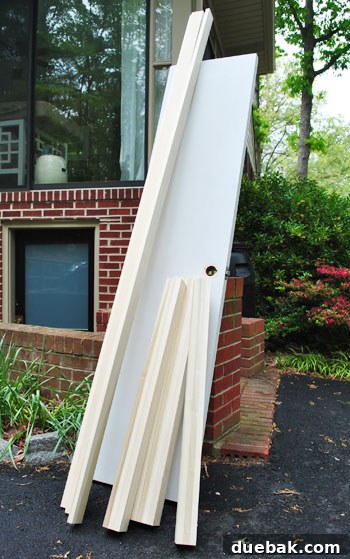
Armed with our measurements, we headed to Home Depot to gather the remaining materials: enough wood for four sturdy legs and the connecting rails for all four sides of the desk. We returned with a modest collection of poplar wood: several planks of 1×3-inch for the rails and four chunky 3×3-inch lengths for the legs, which I would cut to size. The total cost for this new wood came to approximately $70. This was a significant win, especially when compared to the $249 price tag of the smaller, shallower IKEA desk we had considered. This $70 outlay would ultimately be our only out-of-pocket expense for the entire project, making it an incredibly budget-friendly solution for a custom two-person desk. We added the old bathroom door to our collection for a complete visual representation before snapping a photo of our haul.
Prepping the Door for its New Life
Before any assembly could begin, there was a fair amount of prep work required to transform a dusty garage door into a sleek desktop. This involved several crucial steps:
-
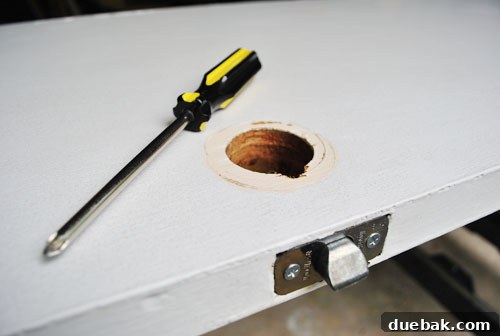
Removing Hardware and Clever Cable Management: First, I removed all the existing door hardware—hinges and the handle mechanism. The hinge indentations, which would face the front of the desk, were carefully filled with wood putty to create a smooth surface. However, a brilliant idea from Sherry led us to intentionally leave the handle hole open. This strategically placed opening, now at the back of the desk, would serve as a convenient channel for feeding all our wires and power cords, satisfying my type-A wife’s desire for pristine cable management.

-
Cleaning and Sanding: The door had spent two years in the garage, accumulating some peeling paint and grime. A thorough “scrubfest” with vinegar-infused water tackled the scum, followed by a light sanding to smooth out the peeling paint. While this wouldn’t fully restore its pristine appearance, it prepared the surface perfectly for the upcoming priming and painting stages.
-
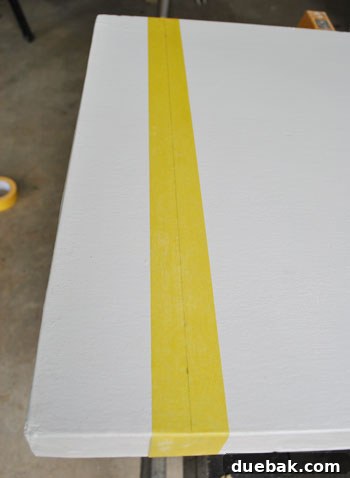
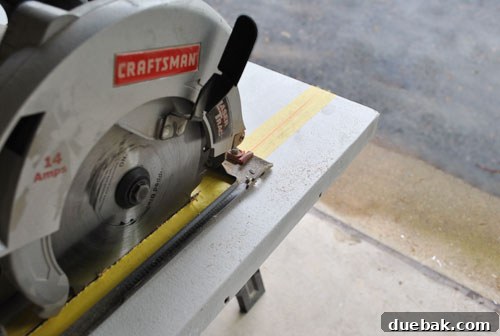
Cutting to Size: Even though the door was already slightly shorter than the 7-foot space, we decided to trim a few more inches off its length. This would create essential “breathing room” on either side of the finished desk, preventing it from appearing crammed into the space. I carefully measured and marked the cut line. To prevent splintering, a common issue with hollow-core doors, I applied painter’s tape along the cut path, tracing the line directly onto the tape for clear visibility. Then, my trusty circular saw made quick work of the cut.
-
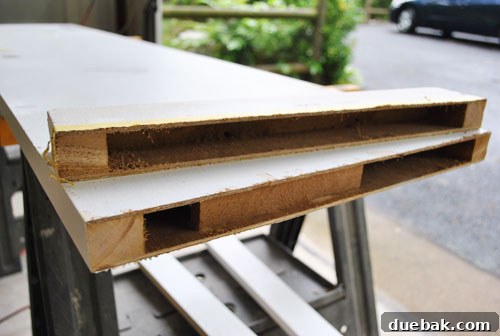
Revealing the Hollow Core: The cut offered a peek into the inner structure of a hollow-core door. While the exposed end would face the wall, I still gave it a quick sanding to smooth things out. There was no need for extra effort to seal it with a new piece of wood, a clever shortcut given its unseen location. (And no, I won’t tell you to use it for hiding secret stashes—the internet already knows!)

Priming for a Flawless Finish
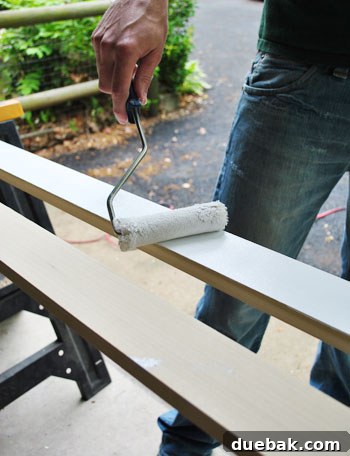
With all the cutting and initial surface preparation complete, the next critical step was priming. I made the strategic decision to prime all the wood components—both the door and the newly purchased lumber—before assembling the desk. My reasoning was simple: construction inevitably leads to minor scrapes and dings. By priming first, I wouldn’t have to worry about every little mark during assembly, saving the final, pristine coat of paint for after the entire structure was built. This approach minimized stress and ensured a smoother overall finishing process. (It’s worth noting that I initially used a water-based primer, which caused some issues during construction, but a later coat of oil-based primer before painting rectified the problem perfectly.)
Step-by-Step Construction: Bringing the Vision to Life
With all materials prepped and primed, the exciting phase of construction could begin. This is where the custom desk truly started to take shape, piece by painstaking piece.
Building the Legs and Attaching to the Desktop
I began with the legs, using the incredibly versatile Kreg Jig to drill precisely angled pilot holes. For each leg, I drilled one pilot hole on two of its inside faces. This tool makes creating strong pocket-hole joints remarkably simple. For those unfamiliar with this fantastic tool, you can learn more about its workings and benefits in this detailed post.

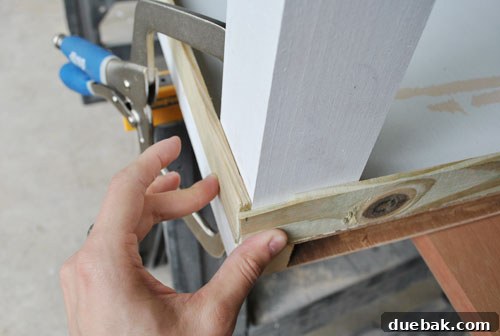
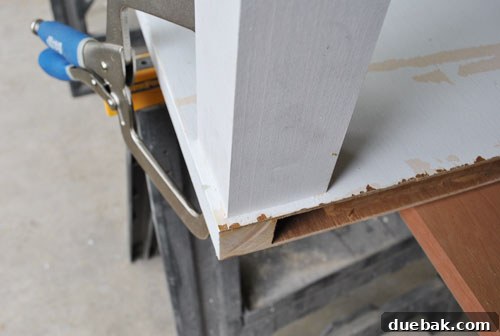
Once the pilot holes were drilled, attaching the legs to the door—which was finally on the brink of becoming a desktop—was a straightforward process. To ensure each leg was set back uniformly from the edge, rather than flush, I used some leftover furring strips from our bathroom renovation project as impromptu guides. This simple trick guaranteed consistent placement and a clean, professional look. With the help of a trusty clamp to hold everything steady, I screwed each leg securely into place. It was a moment of quiet satisfaction seeing the desk finally gain its first structural elements. A quick note: the door might appear a bit rough in this picture due to some scrapes that occurred during assembly. I later realized my initial water-based primer wasn’t ideal for the door’s surface, but a good once-over with an oil-based primer before painting completely resolved any issues.
Installing the Support Rails
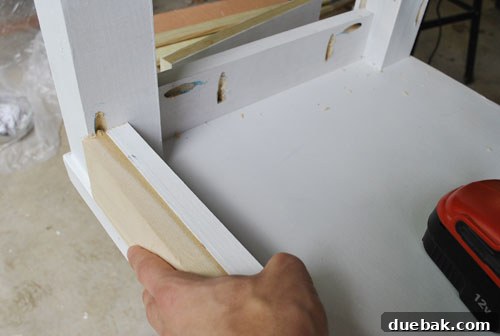
With all four legs firmly in place, the next step was to attach the support rails, which are crucial for the desk’s stability and structural integrity. I meticulously measured and cut these four pieces using my miter saw to achieve precise lengths. Then, I once again employed the Kreg Jig to drill pilot holes for each rail. On each rail, I prepped holes designed to connect both into the legs and directly into the door itself, spaced roughly 8 inches apart. Similar to the legs, I wanted the rails to be set back even further, creating a recessed look. So, I used another impromptu guide—a leftover 1×3-inch piece of wood—to ensure all four rails were positioned at the exact same depth from the edge.
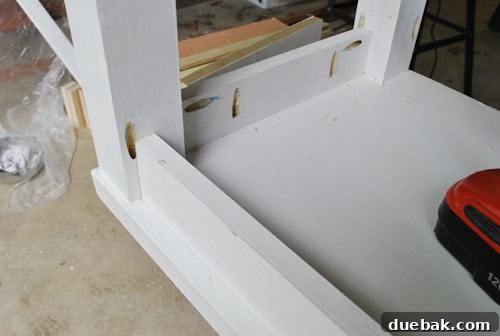
A minor concern during this stage was the hollow-core nature of the door. I worried that my screws might not hit solid wood. Fortunately, with the exception of the very end I had sliced off, all my screws were angled sufficiently by the Kreg Jig to firmly anchor into the solid internal frame that runs along all sides of the door. This ensured a robust and stable connection. The progress was satisfying to see, with two of the rails securely in place, forming the basic framework of our custom desk.
The Grand Reveal: Our Custom DIY Two-Person Desk
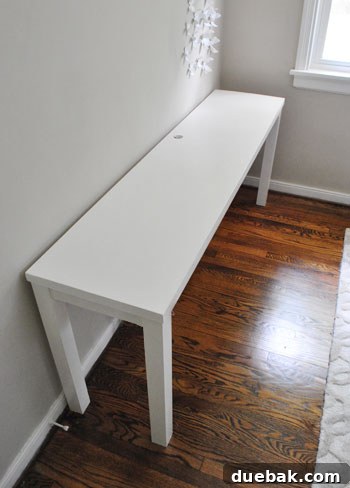
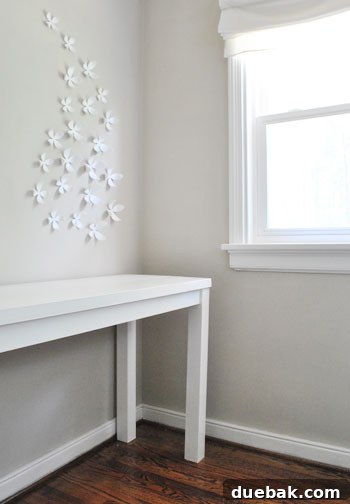
Now, through the magic of the internet (and skipping over the detailed but somewhat repetitive steps of wood puttying, repriming with the correct oil-based primer, painting, and applying a protective polycrylic coat—a process similar to how we painted this dresser), we present the culmination of our efforts! And voila! Here is our brand-spanking-new, custom-built two-person desk:
A Functional and Aesthetically Pleasing Workspace
While a plain white table might not immediately ignite widespread excitement, we were absolutely thrilled upon completing this project. (Yes, I actually tackled this right before Clara’s arrival; she simply distracted me from writing about it until now!) The desk fits the designated space in Zone #2 perfectly. This is the beauty of custom measurements – every inch is utilized optimally. It provides an abundance of room for both of us to work comfortably side-by-side, a crucial feature for our collaborative projects.
Crucially, its carefully planned dimensions ensure it remains far enough out of the way for the sofa bed to be fully folded out without any obstruction. Although the desk might appear “crazy skinny” in some photos, it’s actually 18 inches deep. This depth easily accommodates our two laptops, which are only 9 inches deep, along with any other essentials we need to keep on hand. From a financial standpoint, the desk was an incredible bargain, costing us just $70 for new wood, since we already owned the door, all the screws, wood filler, primer, and paint. Beyond the practical benefits and cost savings, there’s an immense sense of satisfaction that comes from having built something so perfectly suited to our needs with our own hands. Score!
Transforming the Workspace: Future Plans and Community Engagement
Furnishing Our New Home Office
The desk is built, and now the truly exciting part begins: transforming it into a fully functioning workspace for both of us. This involves selecting ergonomic chairs, integrating smart storage solutions, setting up electronics, choosing inspiring wall decor, and adding any other productivity-inducing elements we discover. We’re approaching this next phase with a slow-and-steady mindset, largely out of necessity given that we now have a newborn daughter! Despite the slower pace, we’re thrilled to report that we’ve already logged several successful workdays at our new door-turned-desk, and it’s performing fantastically well. In fact, I’m typing this very post from its sturdy surface right now!
While the walls are still bare and there’s a long way to go, we’re incredibly proud to announce that we’ve already embarked on two more office-related projects since Clara’s arrival. So, stay tuned for the play-by-play on those exciting undertakings coming soon!
Your Turn: Share Your Home Office Hacks!
But enough about our journey. We’d love to hear from you! Have you recently stumbled upon any unique or ingenious desk solutions? Or perhaps you’ve creatively tackled your own “where do I put my workspace?” dilemmas in a small space? We’re always eager to learn from our community, so please feel free to share any fun, functional, or budget-friendly home office ideas that might inspire others who are currently planning their own home offices. Let’s share and share alike!
Continue Your Home Office Journey
Psst – Eager to follow the entire office/guest bedroom/playroom makeover from the very beginning? Click here for the introductory post and here to read all about our extensive hunt for the perfect sleeper sofa!