
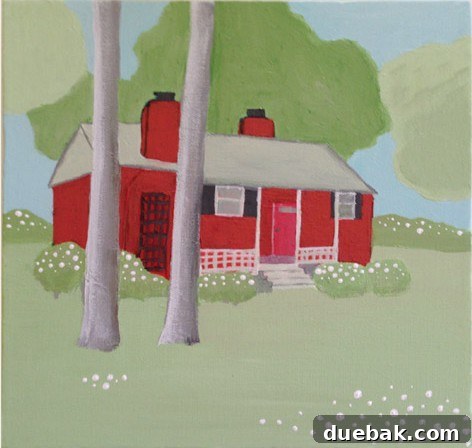
This week’s craft project made me a little nervous. For the last month and a half I’ve been doing a simple, quick craft each week — making a fall wreath, stenciling a pillow, painting baskets, decorating pumpkins and gourds, creating vacation keepsake globes, and trying ceramic paint on a bowl of colorful cacti. Those projects were easy and took under an hour. So I don’t know what got into me this week that made me decide to paint a small portrait of our first house.
It took far longer than my usual Weekly Crafty projects — probably five times as long — and I’ve been anxious about how it turned out. It’s cute and simple, and John really likes it. It certainly didn’t start out great, but it evolved a lot. This blog is about sharing the good, the bad, and the messy moments, so here’s how the project unfolded.
Materials: I used a 10 x 10″ canvas from JoAnn (bought during a sale) and acrylic paints I already had. If you need to buy a basic acrylic set, expect to pay around a dozen dollars at most craft stores.
The most entertaining and cringe-worthy part was watching the painting progress. I took ten photos as I worked and many of those stages made me groan, but I kept reminding myself: just keep painting.
I’m listing the steps I took because it might help anyone who wants to try building a simple house portrait in layers.
- Step 1: I blocked in a base coat — green at the bottom for grass and blue at the top for the sky. They started out too bright and primary, but I planned to layer over them, so I wasn’t worried.
- Step 2: Using a photo of the house as a reference, I sketched the house’s basic shape on the canvas, including chimneys and perspective. The initial brown I used for the house felt too dark, but I knew I could adjust it later with more paint.
- Step 3: I painted the roof black and added some red over the brick to take away the brown. I outlined edges with a thin black line to give the house a bit of definition.
- Step 4: Once the red was dry, I added shutters, chimney caps, and the lattice with black paint. I used a single flat-tipped brush for the whole piece, cleaning it between steps. The brush’s edge worked well for crisp lines, which kept things simple and efficient.
- Step 5: With several shades of green I built up bushes and trees. Mixing colors gave the foliage a few tones instead of a flat single color.
- Step 6: I added white details for the porch and window ledges. That’s when I realized the porch needed to be accounted for in the roofline, so I extended and lightened the roof. I also toned down the neon grass by mixing green with a lot of white.
- Step 7: I lightened the trees and bushes the same way, blending on an old plate and dabbing excess paint on paper towels.
- Step 8: I painted two front trees on the left and experimented with a gray-brown on the roof and foliage. Some of those marks made the scene look muddy.
- Step 9: To unify the composition I layered more light green onto bushes and trees and added a subtle green tint to parts of the roof and porch. It created a more harmonious look than stark white areas did.
- Step 10: I used the back of the paintbrush to dot white paint for azaleas in the bushes. I liked the effect and went a little overboard, adding dots to other bushes and trees. I quickly repainted the darker dots on the tree that didn’t work and kept only the dots that felt right in the bushes and a few in the grass.
After those layers I stared at the painting for a while before deciding it was done. The process took about five hours spread over three days. I enjoyed how forgiving acrylics are — you can always paint another layer if something doesn’t work. It felt like a challenge with plenty of do-overs.
Once it was dry, I sealed the painting. An artist friend recommended Liquitex High Gloss Varnish. I bought a small bottle and applied three thin coats about four hours apart. The product is pricey for a small bottle, but a little goes a long way and it should cover many small paintings.
Now it’s hanging in a corner of the office. John says it looks great there, and I think it would look even better paired with another painting — maybe of our second house if I decide to paint it.
Up close the painting feels sweet. I debated painting the canvas sides white, green, or charcoal, but in the end I wrapped the scene around the edges by continuing the sky, trees, and grass. That finished look works well.
Looking back, I wish I had made the tree behind the house a lighter green and the outer trees slightly darker to create a subtle halo effect around the house. Still, I’m happy with the result and the learning process.
Have you tried a house portrait? Was it painted, made with mixed media like fabric or decorative paper, created digitally with a filter, or was it a photographed and framed portrait? I’d love to hear how you tackled yours.