
Call it a small step, but we’ve just completed our first project in the nursery. And yes, that was a pun.
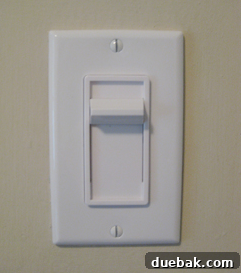
The room has had a dimmer switch since its days as a dining room, but for as long as we’ve lived here it never actually dimmed. It only turned the light fully on or off. As we prepare for late-night trips into a sleeping baby’s room, having a setting between blinding brightness and total darkness suddenly felt essential.
Thanks to our spot on the True Value DIY Blog Squad, solving this lighting problem was straightforward. We used a $14 replacement slide dimmer from True Value and followed some basic electrical steps. You don’t need an engineering degree to swap out a simple switch—just attention to detail and basic safety precautions.
Our usual approach to electrical projects is to carefully observe how the existing fixture is wired before removing it, then replicate those connections with the new part. Whether it’s a light fixture, ceiling fan, or switch, we note which wires connect where and reattach the new wires in the same pattern. And because we’re cautious about preventing shocks, we ALWAYS turn off the main breaker to the house so there’s no chance of electrocution. You can’t be too careful with electricity.
First we removed the old switch by unscrewing the faceplate and gently pulling the switch box out from the wall. Be careful not to yank too hard or disturb other wiring. The old switch we found was clearly worn out. Some connections were so loose they separated when the switch was pulled free, which likely explains why the dimmer never worked properly. The only obvious omission was a grounding wire, but most new switches now include a green ground for improved safety.
We untwisted the old wire nuts and attached the new dimmer’s wires in the same configuration. Hoping the old switch was the sole problem (rather than a deeper wiring issue), we twisted on fresh wire nuts and wrapped black electrical tape around each connection to cover any exposed stripped wire. The stripped ends are the live parts, and the tape adds an extra layer of protection around the wire nuts.
Before testing the circuit, we carefully secured the switch back in the wall so we wouldn’t be holding it when the power returned. Then we flipped the breaker back on and tested the dimmer.
It worked perfectly. We regained full on and off control and everything in between. Our new slide dimmer also includes a faint red locator light that glows when the lights are off, which makes middle-of-the-night trips to the nursery easier—no fumbling for the switch in the dark.
If the replacement hadn’t fixed the problem, the dimmer included troubleshooting instructions, and there’s always online research to consult. Fortunately, this was a quick, successful start to updating the nursery. It took about 15 minutes, a $14 replacement dimmer from True Value, and a good reason to finally replace the broken switch.
What about you? Have you tackled any small projects recently, electrical or otherwise? Is there a minor task you’ve been putting off that could move to the top of your to-do list this weekend? Often the smallest projects are the ones that linger the longest.
Psst—In addition to turning off your home’s main power, electrical work demands extra safety precautions. It’s wise to do your first few projects with someone experienced present (for us, having John’s dad show us how to swap light fixtures and switches was invaluable). A new fixture is never worth a trip to the emergency room. Safety first!