

Elevate Your Hallway: A Comprehensive Guide to DIY Wainscoting & Board and Batten
Our upstairs hallway recently underwent a remarkable transformation, receiving a sophisticated wainscoting treatment that has elevated its character and charm. This design is a more refined evolution of the simple board and batten we installed in our previous home, blending classic board and batten elements with the elegance of picture-frame molding. It’s a stylish upgrade that truly enhances the architectural detail of our colonial-style house, creating a welcoming and visually appealing passage.

What is Wainscoting and Why Choose It?
Wainscoting refers to decorative paneling that covers the lower portion of an interior wall. Historically, it was used to insulate rooms and protect walls from damage, but today it’s primarily chosen for its aesthetic appeal. There are several popular styles, each offering a distinct look:
- Board and Batten: Characterized by vertical strips (battens) spaced evenly over a wall, often topped with a horizontal rail. It creates a clean, classic, and often farmhouse-inspired look.
- Picture Frame Molding: This style uses trim pieces arranged to create decorative, recessed panels on the lower wall, mimicking the look of framed artwork. It offers a more traditional and elegant feel.
- Raised Panel: Features panels with a raised center, offering a formal and architectural presence.
- Beadboard: Consists of narrow, vertical planks with a rout or “bead” between each, providing a cottage or casual charm.
Choosing wainscoting for your home offers numerous benefits. Beyond its undeniable visual appeal, it adds a layer of protection to your walls, especially in high-traffic areas like hallways, making them more durable and easier to clean. It can also add significant architectural interest and value to your home, transforming bland spaces into sophisticated focal points. For DIY enthusiasts, it’s a rewarding project that allows for significant customization in design and finish.
Our DIY Journey: From Simple Board & Batten to Elegant Wainscoting
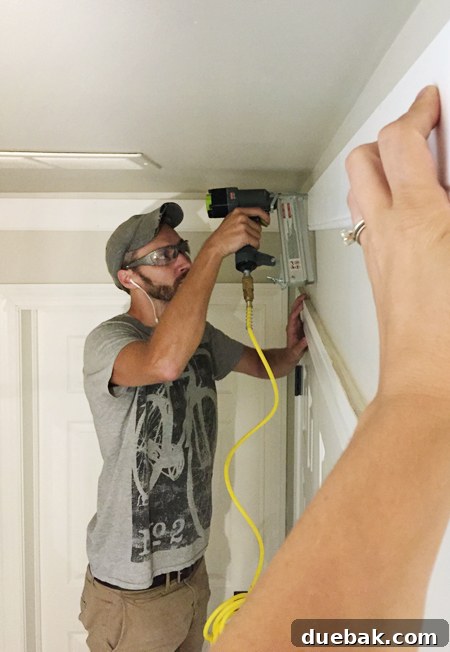
Our project initially began with the intention of replicating the straightforward board and batten style from our previous house. We adored its simplicity and the impressive impact it had, a project that even fostered a fond relationship between us and our trusty nail gun. Below is a throwback to its early days:

UPDATE: While we still cherish the memories with our original air-powered nail gun, we’ve since upgraded to a battery-operated model. It’s incredibly convenient, eliminating the need for an air compressor, making it lighter, more versatile, and easier to use for various projects.
Initial Vision: The Classic Board & Batten
For a detailed breakdown of our original board and batten method, you can refer to our previous tutorial. In essence, it involved installing vertical lattice pieces, typically spaced 16 inches apart (to align with wall studs for secure attachment), topped with a horizontal 1×3-inch pine board to create a chair rail. The process concluded with caulking, priming, and painting for a seamless finish.
This time, we started with great enthusiasm. We purchased the wood, loaded the caulk gun, and even prepped our air compressor. We took it a step further by installing crown molding around the ceilings, utilizing a baseboard underneath to achieve a more substantial look, consistent with other rooms in our home.
Encountering Design Hurdles: The “Meh” Moment
Despite our diligent efforts, once the initial board and batten was complete, we found ourselves underwhelmed. The “magic” we’d experienced in our old house simply wasn’t translating. We couldn’t pinpoint the exact reason, but the hallway felt somewhat incomplete, lacking the refined character we envisioned.
The Refinement Process: Elevating the Look
After letting the idea marinate for a while, we identified two crucial adjustments:
- Doubling Batten Thickness: We added a second layer of lattice to the vertical battens, effectively doubling their thickness. This simple change instantly gave the wainscoting a more substantial, custom-built appearance.
- Adding a Cap Rail/Ledge: We installed a 1×2-inch pine board on top of the existing 1×3-inch top rail, creating a ledge or cap rail. This detail is a hallmark of traditional wainscoting and added significant visual weight and architectural depth to the entire installation.

These initial modifications certainly improved the look, but we still felt it wasn’t quite “there.” The crisp, clean lines that perfectly complemented the flat slab doors and mid-century ranch aesthetic of our previous home weren’t harmonizing with the more intricate six-paneled doors common in our colonial house. It was an “aha!” moment: our new home’s traditional style demanded more intricate detailing. The solution was clear: more molding!

Embracing Traditional Elegance: Picture Frame & Cove Molding
To truly achieve the sophisticated, traditional look we desired, we introduced two additional types of molding:
- Decorative Shoe Molding: We sourced decorative shoe molding from Home Depot, which perfectly fit within the panels created by our board and batten. This molding, when cut and installed to form a “picture frame” within each panel, added a beautiful, intricate profile. Installation involved simply holding strips along the inside edges, marking for length, and making precise 45-degree miter cuts at the corners before nailing them into place. We found that finishing nails provided sufficient hold without the need for additional adhesive.
- Cove Molding: To further enhance the traditional feel, we opted to add cove molding directly beneath the cap rail. This small, concave trim piece added another layer of architectural detail, softening the transition and contributing to the wainscoting’s classic charm.

PRO TIP: For most of the lighter molding pieces (vertical battens, shoe molding, cove molding), finishing nails alone are often sufficient to secure them to drywall, especially if using lightweight wood like pine lattice. However, for heavier components like the top rail and cap rail, we highly recommend using a reliable stud finder to ensure you’re nailing directly into wall studs for maximum stability and security.
A Comprehensive DIY Guide to Installing Decorative Wainscoting
Ready to tackle your own wainscoting project? Here’s a detailed, step-by-step guide to help you achieve a professional finish:
1. Planning and Measurement
Begin by meticulously measuring your walls. Decide on the desired height for your wainscoting – typically one-third to two-thirds up the wall. Sketch out your design, including the spacing of vertical battens (often 16 inches apart to align with studs, or evenly spaced for lighter pieces) and the dimensions of your picture frame panels. This planning phase is crucial for an accurate material list and a smooth installation.
2. Gather Your Tools and Materials
Having everything on hand before you start will save time and frustration. You’ll need:
- Wood: Pine lattice for vertical battens (doubled if desired), 1×3-inch pine for the top rail, 1×2-inch pine for the cap rail, decorative shoe molding for picture frames, and cove molding.
- Tools: Miter saw (essential for precise angle cuts), nail gun (battery-operated for convenience or air compressor model), measuring tape, level (a long one is very helpful), stud finder, caulk gun, sandpaper, painter’s tape.
- Finishing Supplies: Wood filler, caulk (paintable acrylic latex), primer, and your chosen paint color for the wainscoting and trim.
3. Install Vertical Battens and Top Rail
Start by installing the vertical battens. Use your level to ensure they are perfectly plumb. If doubling their thickness, apply the second layer now. Next, install the 1×3-inch top rail horizontally across the top of your battens, using a level to keep it perfectly straight. Secure it firmly, especially into studs.
4. Add the Cap Rail (Ledge)
Nail the 1×2-inch pine board directly on top of the 1×3-inch top rail. This creates the cap rail or “ledge” that gives wainscoting its distinctive, substantial look. Ensure all pieces are flush and securely fastened.
5. Create Decorative Picture Frame Panels
This is where the magic happens! For each panel, measure the inside dimensions carefully. Cut your decorative shoe molding at 45-degree angles to create perfect mitered corners, forming a rectangular or square frame. Dry-fit each frame before nailing it into place with finishing nails. This step is repetitive but incredibly rewarding.
6. Install Cove Molding
If adding cove molding, measure and cut pieces to fit snugly underneath the cap rail. Again, use 45-degree miter cuts for seamless corners and secure with finishing nails.
7. Finishing Touches: Caulking, Filling, Priming, Painting
This phase is critical for a professional, built-in look:
- Caulking: Apply a thin bead of paintable caulk to all seams where wood meets wood and where wood meets the wall. This hides imperfections and creates a smooth, continuous surface.
- Filling Nail Holes: Use wood filler to cover all visible nail holes. Let it dry completely, then sand smooth.
- Sanding: Lightly sand any rough spots or filled areas for a flawless surface.
- Priming: Apply a high-quality primer to all new wood and caulked areas. This ensures uniform paint absorption and prevents bleed-through.
- Painting: Finally, apply two coats of your chosen trim paint. We recommend a semi-gloss or satin finish for durability and easy cleaning.
The Grand Reveal: Our Stunning Upstairs Hallway
After all the measuring, cutting, nailing, caulking, and painting – the transformation is complete! The project was indeed easy but somewhat tedious due to the sheer size of our hallway. However, for smaller spaces like a bathroom or a dining room, this project could easily be completed in a day or two. The effort was absolutely worth it!

UPDATE ON LIGHTING! We’ve successfully transitioned our entire home to energy-efficient LED lights. Not only do they save a significant amount of energy and money, but their incredible longevity means we rarely, if ever, have to change a bulb. For those curious, these are our favorite interior LEDs. They emit a warm, natural glow, avoiding the harsh blue tones sometimes seen with other LEDs, and are indistinguishable from traditional incandescent bulbs in these photos.
The hallway is now a far cry from the utilitarian space we first encountered. It’s almost hard to believe our washer and dryer once occupied this very spot (you can revisit how we reconfigured our laundry area here).

Decor and Styling Considerations
We’re still in the process of thoughtfully curating the art and decor for this refreshed space. We’ve learned that too many items on the walls can feel cluttered in a hallway, so we’re opting for a few carefully selected pieces. We’re using temporary frames to experiment with placement, helping us decide *where* we want things before committing to *what* specific art makes the final cut. Currently, a charming brass bird is making a strong case for permanent residency!

Our drum stool is another placeholder, temporarily filling a corner while we consider a tall basket or a small, kid-friendly furniture piece. But with an abundance of drum stools and faux succulents in our home, it serves its purpose perfectly for now.

Even without all the decorative elements finalized, we are absolutely thrilled with how far this hallway has come. The transformation from a mundane passageway to an elegantly detailed space is truly satisfying.

For these photos, we temporarily removed the baby gate at the top of the stairs (a necessity with toddlers!). When in place, it’s a simple white metal gate from Babies R’ Us, chosen because its design subtly mimics the existing stair railing, integrating rather than detracting from the space.

The only other addition we anticipate is a runner for the floor. We’re patiently searching for the perfect one that speaks to us, a testament to our philosophy of not rushing design choices. It seems even Burger, our furry friend, is carefully inspecting the floor, perhaps hoping for a cozy runner too!

Ultimately, our patience and willingness to adjust and fine-tune this project, rather than rushing to cross it off our to-do list, transformed our initial “meh” reaction into genuine delight. It’s a testament to the fact that sometimes, the best DIY outcomes come from an iterative process and an open mind.

This project has also been an interesting observation for us, as we find ourselves leaning more into our home’s inherent traditional style. This realization will undoubtedly influence our future projects (for instance, traditional picture frame molding like this would be an excellent option for other rooms). We’re also admittedly behind on holiday decorating this year, but we eagerly anticipate sharing some festive shots of the house once it’s all ready. Soon, we hope!
Project Sources
SOURCES:
Wall color: Edgecomb Gray by Benjamin Moore
Trim & wainscoting color: Simply White by Benjamin Moore
Framed print: Emily Jeffords
Brass bird: secondhand
Pendant lights: World Market
Wooden pegs: HethrFethr on Etsy
Ceramic garden stool: Amazon
Faux succulent: HomeGoods (source links may include affiliates)