
Transform Your Cluttered Kitchen: The Ultimate Guide to Junk Drawer Organization
Every home has one: that notorious “junk drawer” that somehow becomes a repository for anything and everything lacking a designated spot. It starts innocently enough, a convenient place for stray items. But over time, it morphs into an unruly chaos, a deep cavern of forgotten essentials and random paraphernalia. Much like a single, sprawling landmass can be harder to navigate than distinct, well-defined territories, a colossal junk drawer often proves far less efficient than a series of smaller, more focused storage solutions.
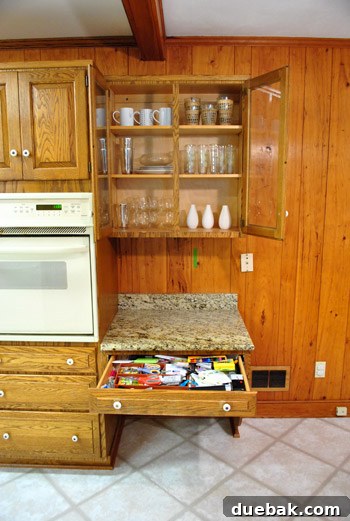
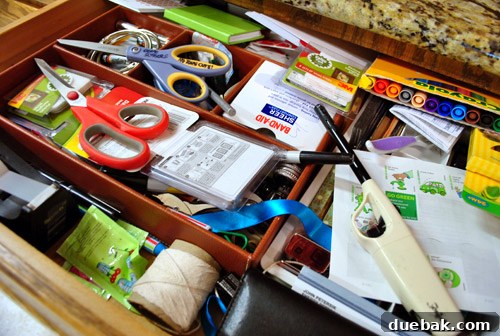
In our own kitchen, the double-wide junk drawer had reached peak “rowdiness.” It stood in stark contrast to the impeccably orderly glasses, mugs, and vases residing in the upper cabinets, a constant reminder of its escalating disarray. The time had come for a significant intervention, a complete transfer of its increasingly chaotic contents.
Why a Single Junk Drawer Isn’t Always the Answer
The concept of a single “junk drawer” often stems from a desire for convenience – a quick drop-off point for items without immediate homes. However, this convenience quickly diminishes as the drawer becomes a bottomless pit. Searching for a specific item turns into a frustrating archaeological dig, wasting precious minutes and frequently resulting in the retrieval of something entirely different from what was needed. This inefficiency can accumulate, creating unnecessary daily friction in what should be a functional space.
Our kitchen, fortunately, boasts an abundance of storage. On the opposite side, nestled near our home office, lay several completely empty smaller drawers, patiently awaiting purpose. This presented the perfect opportunity. Relocating the contents of the main junk drawer to these new, more accessible spots near the office made perfect sense. After all, a staggering 99% of the items traditionally found in that kitchen drawer were actually utilized within the office space, yet we hadn’t established a proper storage system there. Today, dear readers, you get to join us on this exhilarating junk-drawer-transfer adventure. So, fasten your seatbelts! Things are about to get gloriously organized!
Embarking on the Great Junk Drawer Transfer Adventure
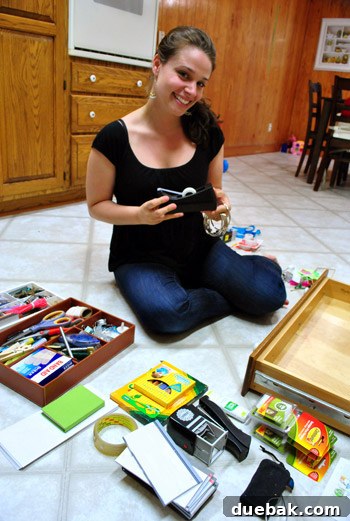
The first step in conquering any organizational Everest is often the most satisfying: emptying everything out. I found myself gleefully sorting through the pile, a process I’ve dubbed “cheesy sorting,” trying to decide the fate of each item. My preferred method involves pulling the drawers completely out of their cabinets and parking them directly on the floor. This allows for an expansive view, a broad canvas upon which to spread every last item. This panoramic perspective is crucial for truly understanding the volume and variety of what you possess, enabling informed decisions. From there, I meticulously separate items into three distinct piles: “keep,” “store somewhere else,” and “donate/trash.” This systematic approach ensures that nothing is overlooked and every item is consciously evaluated for its utility and rightful place.
Essential Tips for Effective Drawer Organization and Decluttering
While I wouldn’t call myself a varsity-level organizer – let’s just say I dabble, more like a JV player – I’ve picked up a few practical tips that have proven incredibly effective in transforming cluttered spaces into functional ones. These aren’t groundbreaking secrets, but rather common-sense strategies that, when consistently applied, yield remarkable results.
-
The “One Year Rule” for Decluttering
A cornerstone of effective decluttering is the “use it or lose it” principle, often manifested as the “six months to a year” rule. If an item hasn’t seen the light of day or served its purpose within this timeframe, it’s highly probable you don’t genuinely need it within arm’s reach. This isn’t to say it’s entirely useless, but it might be better suited for long-term storage, perhaps in a small, clearly labeled box in a closet, freeing up prime real estate in your everyday-use drawers. This simple guideline helps differentiate between essential tools and forgotten relics.
-
Grouping Like Items for Efficiency
Imagine needing to mail a letter. How much faster would it be if your address book, postage stamps, and return address stamp were all conveniently located together? This is the power of grouping like items. When similar tools or components for a specific task are stored in close proximity, you eliminate the need to rummage through multiple compartments. This strategic organization minimizes retrieval time and maximizes efficiency, making daily tasks smoother and less frustrating.
-
The Pen and Paperclip Conundrum
It’s a universal truth: we accumulate pens and paper clips with startling ease. While useful, nobody genuinely needs five hundred pens or an equivalent mountain of paper clips. This accumulation often leads to drawers overflowing with redundant items. Take a moment to consolidate. Keep a practical supply for immediate use and either discard dried-out pens, donate excess usable ones, or designate a single, contained backup storage area. Less is often more when it comes to small office supplies.
-
Rethinking Unused Supplies: The Post-It Note Revelation
During my sorting spree, I stumbled upon a stack of Post-It Notes that had seemingly traveled with us through multiple moves. The realization hit me: we hadn’t used a single one since moving in, or even before! We’re simply “not Post-It people.” This revelation was incredibly valuable. It highlighted how easily items can occupy valuable drawer space for years without ever being utilized. Identifying these “never-used” items is a key step in reclaiming space for things that truly serve a purpose in your current life.
-
The Power of Divided Storage Boxes
Small, disparate items like paper clips, pins, staples, and rubber bands are the ultimate culprits for creating visual and functional chaos. Without any structure, they quickly become a jumbled mess. The simple solution? Little divided boxes or drawer organizers. These inexpensive tools create clear boundaries, ensuring each type of item has its own designated cubby. This containment prevents items from migrating and tangling, making them infinitely easier to locate and retrieve.
-
Shallow Piles vs. Deep Piles: Maximizing Visibility
When stacking items, especially in drawers, depth can be your enemy. Deep piles mean you have to dig through layers to find what you’re looking for, inevitably disturbing the entire arrangement. Shallow piles, conversely, allow you to see more items at a glance. This increased visibility reduces rummaging and helps you pinpoint the desired object without creating a new mess. Think wide and shallow, rather than narrow and deep, for optimal accessibility.
-
Fueling Your Organizing Efforts: The Snack Strategy
Let’s be honest: organizing can be mentally and physically draining. It requires focus and decision-making. That’s why I advocate for the “snack strategy.” A small, energizing treat, like a handful of jelly beans or some nuts, can provide that much-needed boost to keep your motivation high and your energy levels steady throughout the task. It’s a small indulgence that makes the process feel more enjoyable and sustainable.
Here are those previously empty drawers, now ready for their new purpose, conveniently located right off the office in the corner of the kitchen. Their potential for orderly storage was palpable!
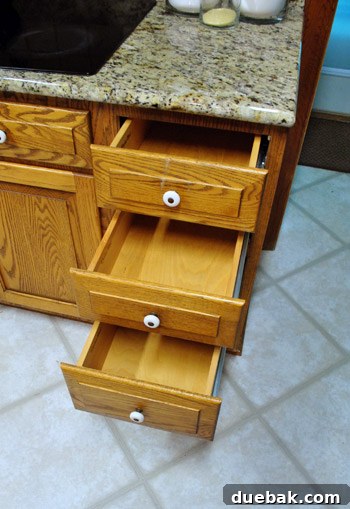
The Transformation: Our New, Purposeful Storage Solutions
The true satisfaction comes from seeing the method in the madness, the order emerging from the chaos. With a clear plan and the right tools, those empty drawers quickly transformed into highly functional storage hubs, each with its own distinct purpose.
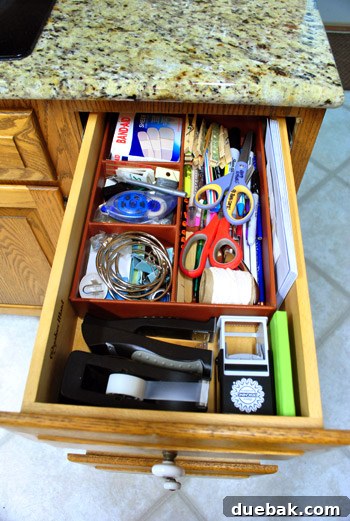
Drawer One: Office Essentials and Everyday Supplies
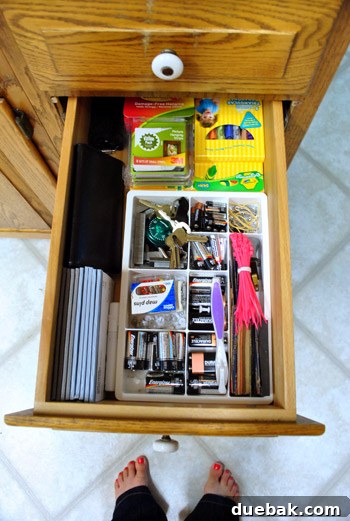
The top drawer now serves as a dedicated hub for office essentials and frequently used household supplies. On the right, a neat stack of envelopes and postage stamps stands ready for correspondence. Our familiar green address book, complete with our address stamp, tape, and a stapler, occupies the front, ensuring easy access. The bulk of the small items – a plethora of pens, pencils, various scissors, paper clips, binder rings, wire, and even a few band-aids for quick fixes – are neatly contained within a brown, cubbied organizer box. This arrangement ensures that every item has its place, eliminating the frantic search that once characterized our old junk drawer.
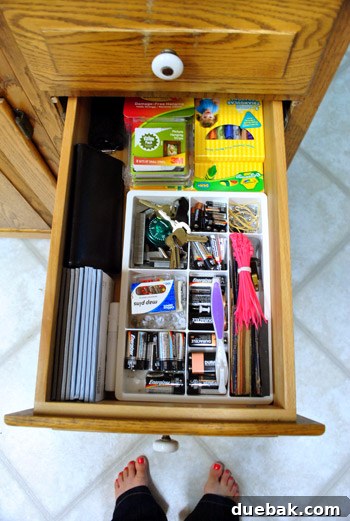
Drawer Two: Practical Bits, Bobs, and Important Documents
The second drawer is home to a collection of practical bits and bobs, ranging from batteries of various sizes and an assortment of rubber bands to safety pins and a creative cache of markers and crayons. We also strategically placed a roll of 3M heavy-duty Velcro here – an invaluable tool for babyproofing, especially for securing frames and preventing our little Clara from pulling them down. Originally, this drawer also housed our checkbooks and paper bank tubes for rolling change. Update: John, understandably, wasn’t keen on the entire internweb knowing the precise location of our checkbooks, so they have since been relocated to a more private spot. (My argument about our alarm system thwarting any potential “Ocean’s Eleven” scenarios fell on deaf ears, apparently!)
Update regarding babyproofing: Our approach to babyproofing is organic; we tackle it as needs arise. Currently, Clara shows no interest in opening kitchen drawers or cabinets, and she is always supervised while in the kitchen. However, the moment she demonstrates any curiosity – even a simple touch – we will implement full babyproofing measures and share our evolving home safety strategies with you.
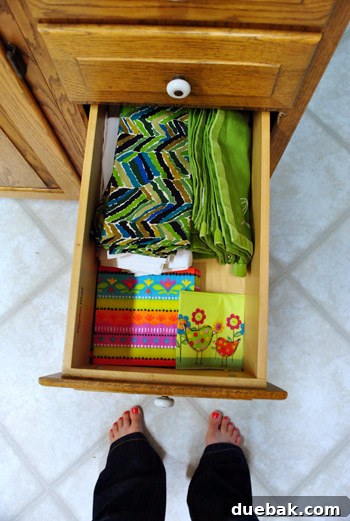
Drawer Three: Keeping Linens Neat and Accessible
And finally, the third drawer has been repurposed to elegantly house all our cloth napkins, table runners, and paper napkins. What was once a haphazard collection now resides in a tidy, accessible space, ready for any mealtime or special occasion. This simple reallocation transformed a potentially messy area into a neat and highly functional linen storage solution.
More Than Just Clutter: Unearthing Memories and Nostalgia
Beyond the satisfaction of organization, decluttering often holds a delightful surprise: the rediscovery of long-forgotten treasures and quirky relics from the past. At the very bottom of the old, cavernous junk drawer, amidst the dust and debris, I made an unexpected find. No, not a cute baby girl, but a distinct, permanent red ink stain. Its origin? An old floppy disk! How utterly random and delightfully retro is that? It was a tangible reminder of a bygone technological era, a little whisper from the past, eliciting a nostalgic chuckle.
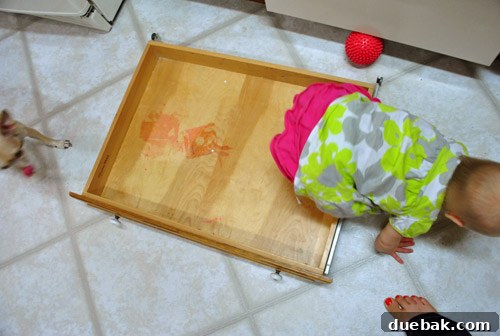
Another amusing realization during this project was the unexpected prevalence of my feet in the progress photos. They appeared in a remarkable 33% of the pictures – surely an all-time record for accidental photo bombing! It added a lighthearted, almost unintentional, element of personal touch to the visual narrative of the organization process.
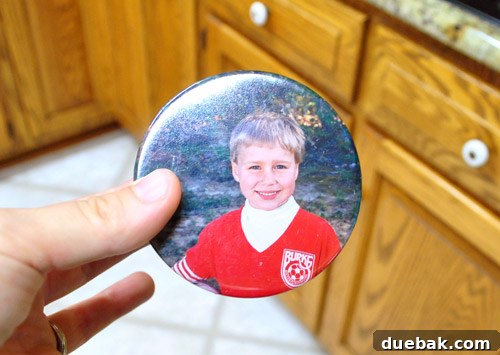
However, my absolute best discovery was a worn, old soccer button. Adorning it was a picture of a little boy – none other than my husband, John, some twenty years ago! It was an instant jolt of pure cuteness. Of course, he’s still incredibly handsome today, but this picture revealed a whole new level of endearing charm. What struck me even more profoundly was seeing so much of our sweet Clara in his innocent, youthful face. It was a beautiful moment of connection across generations. And take note of the unique eyeball cabinet knobs in the background, seemingly peering out at little John, adding another layer of whimsy to the nostalgic scene.
The Lasting Impact of a Simple Organization Project
This seemingly small project offered a three-fold takeaway, impacting both my immediate surroundings and my perspective on household tasks. First, I was reminded that organizing always feels like a far bigger, more daunting, and annoying task than it actually is. The entire transformation, from emptying to sorting to restocking, took me less than thirty minutes. Simply committing to the task, parking myself on the floor, and “getting ‘er done” was the key.
Secondly, investing those thirty minutes now will undoubtedly save me countless hours in the long run. By staying on top of these newly organized drawers and consistently returning items to their designated places, finding anything I need will be quick and effortless. This efficiency translates directly into saving at least an hour a month that would have otherwise been spent rummaging and searching.
And thirdly, there’s an undeniable, quiet joy in waking up to a freshly organized space, even something as mundane as a junk drawer, on a sunny Thursday morning. It’s a subtle but significant boost to well-being, a testament to the power of a tidy environment. Yes, that’s right. I absolutely know how to have a good time. It truly is the little things that make life sweeter, isn’t it?
What “little things” are you tackling these days? Has any organization bug bitten you lately? I hope you stumble upon at least one floppy disk, or compelling evidence thereof, somewhere in your own decluttering adventures. Ah, those were the days! John and I were just reminiscing about the distinctive sounds of dial-up internet connecting to the modem. I can still perfectly mimic that shrill, iconic symphony. Oh yeah, I’m *that* old. And once again, $herdog proves she knows how to have a remarkably good time.