
Unlocking Potential: How LEGO Fuels Child Development and Imagination
Watching your child grow is one of life’s most profound joys. Every new word, every attempted step, every moment of independent discovery fills a parent’s heart with immense pride. For me, these moments are particularly vivid with my son, Jett. He’s at that incredible age where curiosity is boundless, and every day brings a new skill, a new concept grasped, or a fresh burst of creativity. Observing him master new tasks, from following simple instructions to independently tackling more complex challenges, truly highlights the amazing journey of childhood development.
Jett is now learning to read and meticulously follow instructions, abilities that are foundational for future academic success and everyday life. There’s a unique satisfaction in witnessing his ability to accomplish new things, especially when these accomplishments come through engaging, hands-on play. This isn’t just about fun; it’s about active learning, cognitive growth, and the blossoming of a young mind. As he navigates through various activities, I see the gears turning, the connections being made, and his confidence steadily building.
The Evolving World of Play: Tracking Developmental Milestones with LEGO
As a parent, I’ve had the privilege of observing the fascinating evolution of play across my children, especially when it comes to iconic toys like LEGO. I’ve previously discussed how my younger boys interact with their LEGO sets, noting distinct changes in their play patterns and cognitive engagement as they grew. This observation highlighted the unique role LEGO plays in a child’s developmental journey. For those interested in seeing these earlier developmental stages in action, you can get a glimpse into their LEGO adventures and progress in this video:
The progression in play, from simple manipulation to complex construction and imaginative role-playing, is a clear indicator of advancing developmental milestones. What starts as basic stacking and sorting with larger Duplo bricks gradually transforms into intricate construction with smaller, more specialized LEGO pieces. This transition isn’t just about physical dexterity; it’s deeply rooted in cognitive development, spatial awareness, and problem-solving abilities. Each stage of LEGO play presents unique challenges and opportunities for learning, perfectly aligning with a child’s expanding capabilities and preparing them for more complex learning experiences.
LEGO and Learning: Mastering Instructions and Building Confidence
With Jett now at six years old, I’ve observed a significant leap in his approach to LEGO. The LEGO sets designed specifically for his age group are absolutely perfect for him, offering just the right balance of challenge and achievable success. These sets are meticulously crafted to engage young minds and hands, providing a structured yet immensely rewarding building experience. What struck me about some of these specific sets, particularly those featuring vehicles, was a subtle but impactful design difference: the main body of the car or truck might be a single, pre-formed piece, rather than requiring complete assembly from individual bricks. This design choice, while seemingly minor, allows the child to focus on the intricate details and additions, reducing initial frustration and boosting early confidence in their building prowess.
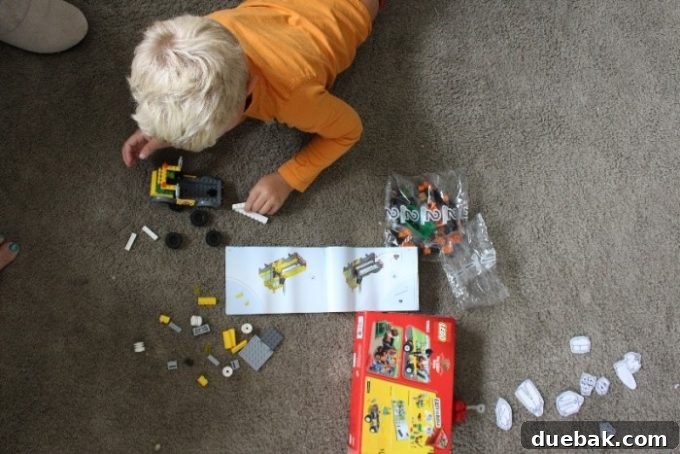
Jett’s experience with these sets has been a testament to their thoughtful design. He was able to methodically follow the step-by-step instructions, meticulously identify each correct piece from the assortment, and then confidently assemble the entire set by himself. This seemingly simple act encompasses a multitude of critical developmental skills. It requires strong visual discrimination to distinguish between similar-looking bricks, excellent fine motor skills for precise placement, and sustained attention and focus to work through each stage of the building process. The ability to follow sequential instructions is a cornerstone of early learning, preparing children for academic tasks that require similar logical progression. The immense satisfaction on his face upon completing a set, knowing he did it all on his own, is priceless and a powerful motivator for continued learning and exploration.
Beyond the Blueprints: Nurturing Imagination and Creative Storytelling
As children grow, their play evolves from simply following instructions to actively creating their own narratives and worlds. With Jett, this imaginative phase has truly blossomed. Once the structured building is complete, the real magic begins. The LEGO trucks, cars, and figures are no longer just static models; they spring to life as characters in his elaborate stories. Each truck develops a distinct personality, making its own unique noises and performing specific jobs within the imaginary world he constructs.
This kind of imaginative play is incredibly vital for a child’s holistic development. When Jett’s trucks “make noises and move,” and “everything has a job to do,” he’s not just playing; he’s actively developing his language skills, expanding his vocabulary, and practicing complex narrative structures. He creates dialogues, invents scenarios, and assigns roles, all of which are critical for social and emotional intelligence. His LEGO trucks are often the protagonists in sprawling tales, transforming his play space into a vibrant stage. We, his family, are frequently invited to “sit down to watch the show he puts on,” an invitation we gladly accept. These impromptu performances are more than just entertainment; they are windows into his developing mind, showcasing his ability to sequence events, express emotions, and engage in collaborative storytelling.
This shift from guided construction to free-form, imaginative play demonstrates a significant cognitive leap. It signifies a child’s growing capacity for abstract thought, symbolic representation, and creative problem-solving. It’s where they truly make the toys their own, imbuing them with meaning and purpose that extends far beyond their original design. The diverse range of LEGO bricks serves as a perfect medium for this creative expression, offering endless possibilities for children to build anything their minds can conjure, fostering a love for innovation and independent thought. This freedom to create allows them to test ideas, experiment with designs, and develop a unique sense of self.
Building More Than Just Blocks: Fostering Confidence and Self-Esteem
Beyond the cognitive and creative benefits, LEGO play is a powerful tool for building a child’s confidence and self-esteem. I love seeing Jett gain confidence and break out of his shell through these experiences. There’s a noticeable difference in his demeanor when he successfully completes a challenging LEGO build or masterfully orchestrates an elaborate play scenario. This sense of accomplishment translates into a broader belief in his own abilities, encouraging him to tackle new challenges with less hesitation.
Each small victory, whether it’s snapping two tricky bricks together or devising a clever solution to a self-imposed play problem, contributes to a robust sense of self-efficacy. This confidence isn’t confined to the playmat; it spills over into other areas of his life, from engaging more readily with peers to approaching schoolwork with a positive attitude. Seeing him meet these developmental milestones—from fine motor dexterity and spatial reasoning to complex problem-solving and imaginative expression—fills me with such profound joy. It truly makes me such a proud mom to witness his growth, knowing that these playful moments are laying essential groundwork for a lifetime of learning and creativity.
Tips for Parents: Maximizing the Benefits of LEGO Play
If you’re looking to encourage similar growth in your own children, here are a few practical tips to maximize the incredible benefits of LEGO play:
- Choose Age-Appropriate Sets: Start with LEGO Duplo for younger children to develop basic motor skills, and gradually transition to classic LEGO sets as their fine motor skills and attention spans develop further. The recommended age ranges on the boxes are an excellent guide to ensure the challenge is just right.
- Encourage Independent Building: While it’s tempting to jump in and help, try to let your child follow the instructions independently first. Offer gentle guidance and encouragement when they get stuck, but allow them the immense satisfaction of figuring things out on their own. This fosters problem-solving and perseverance.
- Foster Free Play: Once a set is built, encourage them to take it apart and create something entirely new from their imagination. Provide a large collection of generic bricks in various shapes and colors to fuel boundless creativity and innovative thinking.
- Engage in Their Stories: When your child invites you into their imaginative world, participate enthusiastically! Ask questions about their characters, their plot, and their creations. This validates their play, boosts their verbal and narrative skills, and strengthens your bond.
- Create a Dedicated Play Space: A clear, accessible, and organized area for LEGOs can encourage more frequent and focused play. Consider storage solutions that make cleanup easy for both of you, promoting a sense of responsibility.
- Celebrate Achievements: Acknowledge and praise their efforts and accomplishments, whether it’s successfully building a complex model, creating a unique story, or simply showing persistence. Positive reinforcement goes a long way in building self-esteem and a love for learning.
Conclusion: LEGO – More Than Just a Toy, a Foundation for Growth
The journey of watching Jett interact with LEGO has been a heartwarming reminder of the profound power of play. It’s not merely a collection of colorful plastic bricks; it’s a dynamic tool that nurtures essential skills, sparks creativity, and builds lasting confidence. From the methodical process of following instructions and developing spatial reasoning to the boundless freedom of imaginative storytelling and emotional expression, LEGO offers a rich tapestry of learning experiences. Each click of two bricks together represents a step forward in a child’s development, a moment of discovery, and a building block for their future.
As parents, providing opportunities for such engaging and enriching play is one of the greatest gifts we can offer. It’s through these seemingly simple activities that children learn to problem-solve, innovate, communicate, and dream – skills that are invaluable in navigating an ever-changing world. Encouraging a playful approach to learning helps cultivate a lifelong curiosity and a resilient spirit. So, the next time you see your child immersed in a world of LEGO, remember that they are not just playing; they are actively building their future, one colorful brick at a time. And as Jett continues his journey of discovery, I’ll be right there, cheering him on, a proud mom witnessing the incredible potential that unfolds through the magic of play.
This post has been brought to you in thanks to the generosity of JimJam Communications. As always, all opinions expressed are my own and I’m thrilled to share with you why Lego is such a big part of my kids’ childhood.