

Unlock the secrets of Mancala, one of the world’s oldest and most captivating strategy games. This comprehensive guide will take you from a curious beginner to a confident player, demystifying the rules, unveiling winning strategies, and exploring the rich history behind this timeless classic. Prepare to embark on a journey of skill, foresight, and fun as we delve into the official Mancala board game rules and more.
What Is Mancala? The Ancient Game of Strategy and Skill
Step into the fascinating world of Mancala, an ancient board game with a legacy stretching back thousands of years. Originating in East Africa and the Middle East, Mancala is not just a game; it’s a cultural phenomenon enjoyed by generations across the globe. Often referred to as “count and capture” games, Mancala variations share a common objective: to strategically sow and capture seeds (or stones) to win. While its core mechanics are surprisingly simple, Mancala offers an incredible depth of strategy, making it a favorite for both casual players and seasoned strategists.
Unlike many modern board games, Mancala relies purely on intellectual prowess, requiring players to think several moves ahead, anticipate their opponent’s actions, and master the art of resource management. It’s a game that hones critical thinking, mathematical skills, and problem-solving abilities, all while providing hours of engaging entertainment. Whether you’re looking for a challenging mental exercise or a delightful way to connect with friends and family, Mancala stands as a testament to the enduring appeal of traditional games. Its rich history and accessible gameplay make it a must-try for anyone seeking a blend of cultural heritage and strategic fun.
How to Play Mancala: A Step-by-Step Guide for Beginners
Mancala is a two-player strategy game, renowned for its engaging gameplay and straightforward rules, making it perfect for family game nights or a quick mental challenge. Typically recommended for ages 7 and up, a single game can be completed in approximately 15 minutes, though the strategic depth ensures endless replayability. The game revolves around a distinctive board featuring rows of holes or “pits,” and a set of small game pieces, traditionally stones or marbles. The primary objective is simple: capture more of your opponent’s game pieces than they capture of yours. Let’s dive into the specifics of how to play Mancala, starting with the setup.
DIY TIP: No Mancala board on hand? No problem! You can easily create a makeshift board using an empty egg carton for the pits and two larger cups for the stores. This creative solution allows you to enjoy the game anytime, anywhere! If you’re ready to invest in a classic, explore Mancala board options.
Setting Up The Mancala Game: Understanding Your Board and Pieces
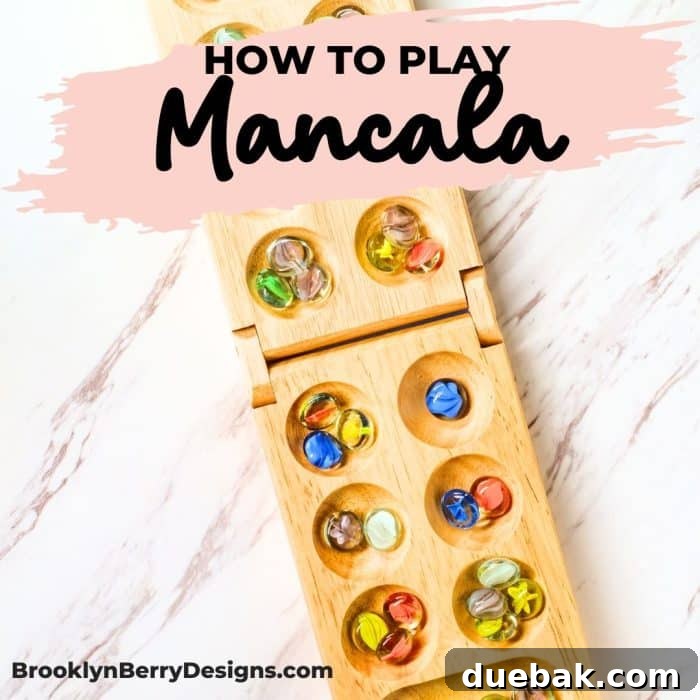
Before the first move, it’s crucial to understand the layout of the Mancala board and how to prepare it for play. A standard Mancala board features two rows of six smaller pits (12 total), often referred to as “houses,” “pockets,” or “holes.” At each end of these rows, you’ll find two larger pits. These larger pits are known as “stores” or “Mancalas,” and they serve as the collection points for captured stones. Each player “owns” the six smaller pits on their side of the board and the larger store to their right. To maintain clarity throughout these rules, we’ll consistently refer to the smaller depressions as “pits” and the larger collection areas as “stores.”
To begin the game, you’ll need a sufficient number of game pieces. The most common setup requires 4 stones or marbles to be placed into each of the 12 smaller pits. This means you will need a total of 48 stones (4 stones x 12 pits). While traditional games often use natural stones, seeds, or beans, any small, uniform objects can serve as tokens—marbles, beads, or even buttons work perfectly. Ensure all pits are filled with their starting four pieces, and the two larger stores remain empty at the outset. This balanced initial setup creates an even playing field for both participants, ready for strategic engagement.

Customizing Your Game: Adjusting Starting Stones While 4 stones per pit is the standard, Mancala offers flexibility to adapt the game’s duration and complexity. For a more challenging and longer game, advanced players often begin with 6 stones in each pit, requiring more foresight and complex calculations. Conversely, setting up with only 3 stones per pit results in a faster-paced game, ideal for quick rounds or introducing new players. The beauty of Mancala lies in its adaptability, allowing you to tailor the experience to your preferences and skill level. Choose your own adventure and experiment with different starting configurations!
Mastering Mancala Rules: Gameplay, Captures, and End Game
Mancala is a two-player strategy game where the ultimate goal is to collect more stones in your store than your opponent. The player who successfully accumulates the highest number of stones by the end of the game emerges victorious. The rules are designed to be intuitive, yet they open up a vast array of strategic possibilities. Let’s break down the core mechanics of a Mancala turn, special moves, and how the game concludes.
Gameplay: The Core Mechanics of a Mancala Turn
The game begins by deciding which player will go first. This can be done by a coin toss, rock-paper-scissors, or any agreed-upon method. Once the first player is determined, turns alternate between the two players until the game ends.
- Choosing a Pit: On your turn, you must select one of the six pits on your side of the board that contains at least one stone. You cannot choose a pit on your opponent’s side.
- Sowing Stones: After selecting a pit, you pick up all the stones from that pit. You then distribute these stones, one by one, into successive pits in a counter-clockwise (to your right) direction. This distribution includes your own pits, your own store, and your opponent’s pits.
- Skipping the Opponent’s Store: An important rule is that you *do not* drop any stones into your opponent’s store. If your sowing path would lead you to their store, simply skip over it and continue distributing stones into the next available pit. You *do* drop stones into your own store.
- The Extra Turn (Mancala Bonus): If the very last stone you sow lands in your own store, you are immediately granted an extra turn. This allows you to pick up stones from another one of your pits and continue playing. This is a powerful strategic advantage to aim for.
- The Capture Move: This is where Mancala truly shines strategically. If your last stone lands in an empty pit on your side of the board, you get to capture not only that last stone but also all the stones currently residing in the directly opposite pit on your opponent’s side. All these captured stones (your last stone + opponent’s stones) are then placed into your own store. This is a fantastic way to quickly increase your stone count and deplete your opponent’s resources. Remember, captures only occur if your last stone lands in an *empty* pit on *your* side.
Players continue to take turns, sowing and capturing stones, until one of the end-game conditions is met. Each turn requires careful consideration of not only your current move but also the potential outcomes for your opponent’s next turn.
Ending the Game: When the Pits Go Empty
The game of Mancala concludes when a specific condition is met, bringing an end to the strategic sowing and capturing. The game ends when one player has no more stones left in any of the six pits on their side of the board. This signals that they can no longer make a legal move. At this point, the game enters its final scoring phase:
- Remaining Stones: The player who still has stones remaining in their pits collects all these stones and adds them to their own store. These stones are not considered “captured” but simply gathered as part of their final count.
- Final Count: Both players then count the total number of stones in their respective stores.
- Determining the Winner: The player with the most stones in their store at the end of the game is declared the winner! In the rare event that both players have the exact same number of stones, the game is a draw.
Understanding these end-game rules is crucial for strategy, as players often aim to clear their side of the board to force the opponent to yield their remaining pieces, or to make a final capture that secures their victory.
Strategy To Win Mancala: Elevate Your Game
While Mancala rules are simple, mastering the game requires a blend of foresight, tactical thinking, and a bit of mathematical calculation. Here’s where your strategic skills truly come into play. By employing these advanced Mancala strategies, you can significantly improve your chances of victory and consistently outmaneuver your opponent.
- Master the Free Turn (Mancala Bonus): This is arguably the most powerful move in Mancala. Always look for opportunities to end your turn by dropping your last stone into your own store. This grants you an immediate extra turn, allowing you to make another move without your opponent having a chance to respond. Plan your moves to set up these free turns, especially in the early and mid-game, to gain significant momentum.
- Capitalize on Capture Opportunities: Capturing stones is your primary method of accumulating points. Continuously scan the board for moments when your last stone can land in an empty pit on your side, opposite an opponent’s pit containing a large number of stones. Setting up these captures can drastically swing the game in your favor by not only increasing your score but also weakening your opponent’s board presence.
- The Fourth Hole Opening Strategy: A popular and effective opening move is to pick up the stones from the fourth pit on your side (counting from left to right, excluding your store). If you have 4 stones in each pit, this move will result in your last stone landing in your own store, granting you an immediate extra turn. This aggressive opening puts pressure on your opponent from the start.
- Maintain Board Balance: While capturing is important, avoid emptying too many of your pits if it leaves you vulnerable. Try to keep a balanced distribution of stones across your pits. This prevents your opponent from easily making large captures on your side, as an empty pit on your side is a potential capture point for them if they can land their last stone there.
- Control the Center Pits: The middle pits on the board often offer more strategic flexibility. Stones sown from these pits can reach a wider range of other pits, including your own store and your opponent’s pits, creating more capture and free-turn opportunities. Focus on controlling and utilizing these central areas.
- Starve Your Opponent: A defensive strategy involves trying to empty your opponent’s pits, especially those with few stones, to prevent them from making moves or setting up captures. If you can clear out their side of the board, the game ends, and you collect any remaining stones in your pits.
- Look Ahead: Always consider not just your current move, but also the ripple effect it will have on subsequent turns – both yours and your opponent’s. Think two or three moves in advance. What opportunities does your move create for your opponent? What opportunities can you set up for yourself later?
- Practice Makes Perfect: The best way to improve your Mancala game is through consistent practice. Play against different opponents, analyze your moves, and learn from your mistakes. The more you play, the more intuitive the strategic nuances will become.

The Benefits of Playing Mancala: More Than Just a Game
Beyond the simple joy of playing, Mancala offers a wealth of cognitive and social benefits, making it an excellent choice for individuals of all ages. This ancient game is not just a pastime; it’s a valuable tool for mental development and social interaction.
- Enhances Strategic Thinking: Mancala is a pure strategy game, devoid of luck. Players must constantly plan ahead, anticipate their opponent’s moves, and adapt their tactics to changing board conditions. This rigorous mental exercise significantly boosts strategic thinking and problem-solving skills.
- Develops Mathematical Skills: The core mechanic of “count and capture” naturally strengthens basic arithmetic. Players are constantly counting stones, calculating potential outcomes, and estimating the best moves, often without even realizing they’re doing math!
- Improves Focus and Concentration: To play effectively, players must remain focused on the board, tracking stone distributions and potential moves. This concentration helps develop sustained attention, a crucial skill in many areas of life.
- Boosts Memory: Remembering past moves, understanding patterns, and recalling successful strategies all contribute to an improved working memory. Players learn to recognize advantageous board states and replicate them.
- Fosters Social Interaction: As a two-player game, Mancala encourages direct interaction, conversation, and friendly competition. It’s an excellent way for families and friends to bond, share laughs, and engage in meaningful play away from screens.
- Teaches Patience and Sportsmanship: Mancala often requires careful consideration and the ability to wait for the right moment to strike. It also teaches players to win gracefully and lose with dignity, embracing the spirit of good sportsmanship.
- Cultural Appreciation: Playing Mancala connects you to a rich historical tradition. It offers a glimpse into ancient cultures and the enduring human love for games of intellect and skill.
Looking for More Games and Fun Activities for Kids and Family?
If you’ve enjoyed the strategic depth of Mancala and are searching for other engaging activities to entertain and educate, look no further! Our collection of resources offers a variety of games, crafts, and puzzles perfect for children and families. Discover new ways to spark creativity and strategic thinking:
- Grab these printable bingo cards for a classic, fun game of Bingo that everyone can enjoy!
- Kids will love expressing their creativity with these delightful Squishmallow Coloring Pages.
- Explore these cute and educational animal dot to dot pages for younger children.
- For a more challenging puzzle experience, these printable extreme level dot to dot pages are perfect for older kids and adults!
- Discover our hand-picked list of the best board games for 6 year olds that parents will genuinely enjoy playing too!
- Deepen your understanding of other classic games, like learning the Mancala official rules – it’s another fantastic game the entire family will cherish!
Embrace the joy of learning and playing together. Happy Gaming and Crafting!
