
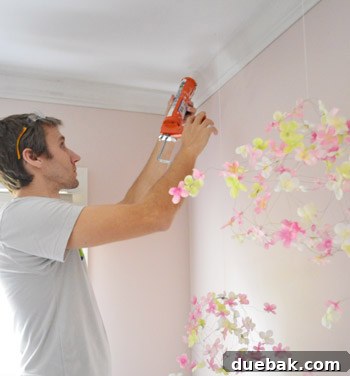
Are you considering adding crown molding to your home but feel intimidated by the installation process? You’re not alone. Many DIY enthusiasts find themselves hesitant to tackle this project, fearing complex cuts and costly mistakes. However, we recently transformed our daughter’s bedroom with beautiful crown molding, and it was a surprisingly affordable and straightforward endeavor, costing less than $100! This experience has truly shifted our perspective, turning a once-dreaded task into a rewarding one we’re eager to repeat.
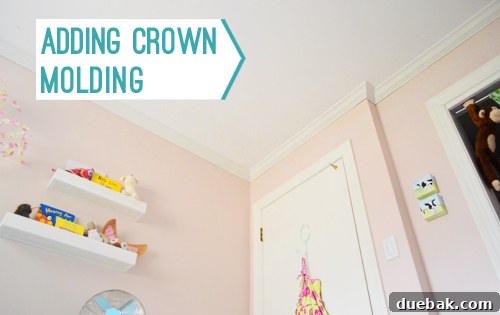
Crown molding adds an undeniable touch of elegance and sophistication to any room, elevating its aesthetic appeal and increasing perceived value. What often seems like a daunting professional job can, in fact, be a highly achievable weekend project for homeowners. We’re excited to share our step-by-step guide, demystifying the process and demonstrating why installing crown molding went from one of our most feared home improvement tasks to a genuinely enjoyable one. With the right tools, a bit of patience, and attention to detail, you too can achieve stunning results and enjoy the immense satisfaction of a job well done.
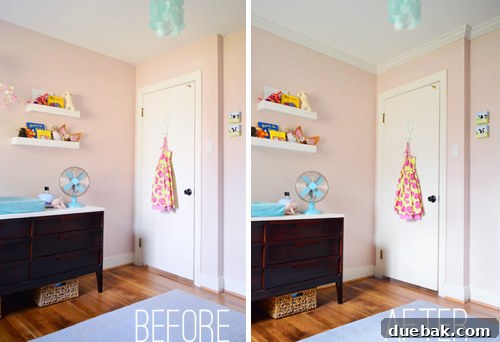
Crown Molding Installation: A Comprehensive DIY Guide
Before diving into the detailed photographic and video tutorials, let’s outline the fundamental steps involved in installing crown molding in any room. This overview will provide a clear roadmap for your project, ensuring you’re prepared for each stage of the process:
- Choose Your Crown Molding Style: Select the profile and material that best complements your home’s aesthetic.
- Gather Essential Tools & Materials: Prepare all necessary equipment, from cutting tools to finishing supplies.
- Master the Spring Angle: Understand how your chosen molding sits against the wall and ceiling.
- Accurately Measure Wall Angles: Identify and account for any variations in your room’s corners.
- Precisely Measure Wall Lengths: Determine the exact dimensions for each molding piece.
- Set Your Miter Saw Angles: Configure your saw for accurate inside, outside, and scarf cuts.
- Execute Precision Cuts: Learn the correct techniques for cutting crown molding safely and accurately.
- Secure Molding in Place: Attach the molding firmly to your walls and ceiling.
- Finish with Caulk and Paint: Achieve a seamless, professional look with proper finishing touches.
Visual Learning: Watch Our Crown Molding Installation Video Tutorial
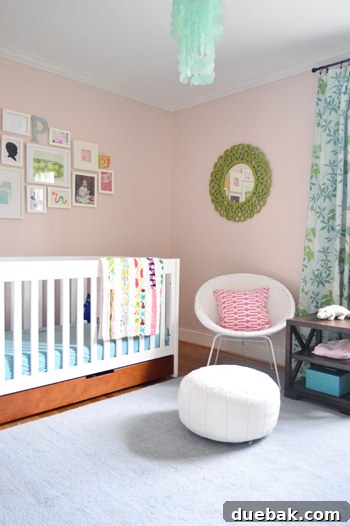
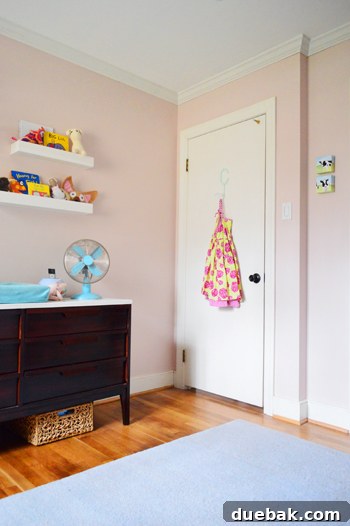
While the photographs in this article illustrate our crown molding installation in our daughter’s nursery, the process was so straightforward and rewarding that we decided to install it in all the other bedrooms as well. For a more immersive and detailed understanding, the video below demonstrates each step in real-time as we install crown molding in her new “big girl” room. Watching the process unfold visually can significantly enhance your comprehension and confidence before you begin your own project.
Selecting the Perfect Crown Molding for Your Home
The first step in any crown molding project is selecting the right molding itself. For our project, we chose standard 3 5/8″ pre-primed crown molding from Lowe’s. This size and profile closely matched the existing molding in other areas of our home and offered an incredibly affordable solution. However, the world of crown molding is vast, offering a variety of profiles, materials, and sizes to suit every architectural style and budget.
When selecting your molding, consider the scale of your room. Taller ceilings and larger rooms can typically accommodate wider, more ornate profiles, while smaller rooms might benefit from a more modest design to avoid overpowering the space. Materials range from solid wood (pine, oak, maple), which offers classic beauty and stainability, to more budget-friendly and paint-ready options like Medium-Density Fiberboard (MDF) or polyurethane, which are resistant to moisture and easy to work with. There are also plaster options for highly decorative, intricate designs, though these are typically best left to professionals.
If you prefer a bolder, more substantial look without the added cost of custom molding, consider this clever trick to make standard crown molding appear thicker and more elaborate. This method often involves adding a simple trim piece below the crown, creating a “built-up” look that adds significant architectural weight and presence to your room. Explore different profiles and materials at your local home improvement store to find the perfect match for your design vision and budget.
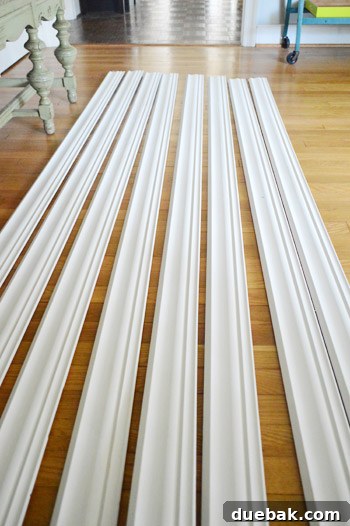
Each 8-foot, pre-primed piece of our chosen molding cost approximately $9.50. By purchasing a few extra pieces to account for any miscuts or future repairs, our total material cost for the room was a mere $72. This affordability makes DIY crown molding an incredibly attractive option for homeowners looking to add significant value and style without breaking the bank.
Essential Tools & Materials for DIY Crown Molding
While installing crown molding by hand is possible, utilizing basic power tools will dramatically increase your efficiency and accuracy, making the project much more enjoyable. For our installation, we relied heavily on a quality miter saw and a reliable nail gun. (Please note: the specific models pictured in older photos may no longer be available, so the links provided have been updated to our current top recommendations).
Here’s a comprehensive list of the tools and materials you’ll need to successfully install crown molding:
- Miter Saw: Indispensable for making precise angle cuts. A compound miter saw is ideal, as it allows for both miter and bevel cuts.
- Nail Gun: A brad nailer or finish nailer makes securing molding quick and efficient. Cordless options are fantastic for portability, eliminating the need for an air compressor.
- Kreg Crown-Pro: This tool is a game-changer for simplifying complex crown molding cuts. It’s truly the unsung hero of this project.
- Measuring Tape: For accurate length measurements of your walls.
- Stud Finder: Essential for locating studs and ceiling joists to ensure secure nailing.
- Pencil: For marking cut lines and wall measurements.
- Caulk & Caulk Gun: To fill gaps, seams, and nail holes for a flawless finish. Opt for paintable caulk.
- Paint: To match your existing trim or ceiling color.
- Short-Handled Paint Brush: For precise application of paint to the molding.
- Ladder or Step Stool: For safe access to ceiling height.
- Safety Glasses: Always protect your eyes when operating power tools.
- Ear Protection: Miter saws can be loud; safeguard your hearing.
- Dust Mask: To avoid inhaling wood dust during cutting.
While we already owned a miter saw and nail gun, our strategic purchase of the Kreg Crown-Pro proved to be a pivotal investment. This ingenious device significantly simplified the cutting process, turning what could have been a frustrating challenge into a remarkably manageable task.
Simplifying Cuts with the Kreg Crown-Pro Tool
Having read numerous glowing reviews for the Kreg Crown-Pro, and being a devoted fan of the Kreg Jig, I decided that its $30 price tag was a small investment for potentially enormous time and frustration savings. Spoiler alert: this tool exceeded all expectations and quickly became an indispensable part of my DIY arsenal.
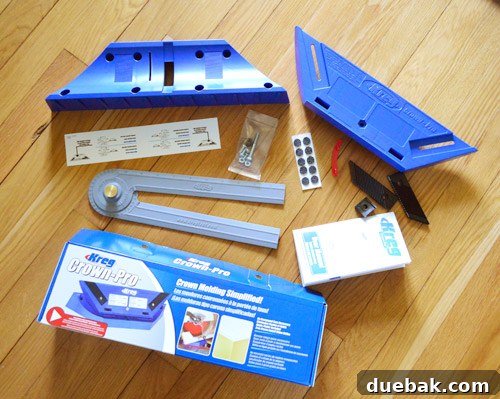
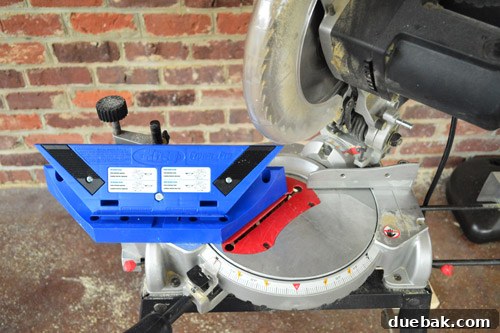
Once assembled – a process that takes no more than five minutes – the Kreg Crown-Pro transforms your miter saw setup. It creates an angled, adjustable platform that allows you to cut your crown molding in the exact same orientation it will sit against your wall and ceiling. This seemingly simple innovation is a monumental advantage, eliminating much of the guesswork and complex calculations typically associated with crown molding cuts.
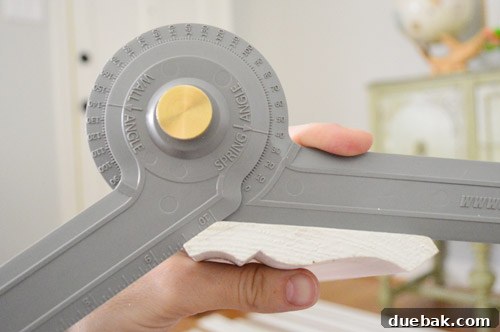
A key feature of the Kreg Crown-Pro is its included Angle-Finder tool. This handy device is used to determine the “spring angle” of your crown molding – which is the fixed angle at which the molding naturally leans away from your wall. Most standard moldings have a spring angle of either 38°, 45°, or 52°. In our case, after a quick measurement, we found our molding had a 38° spring angle.
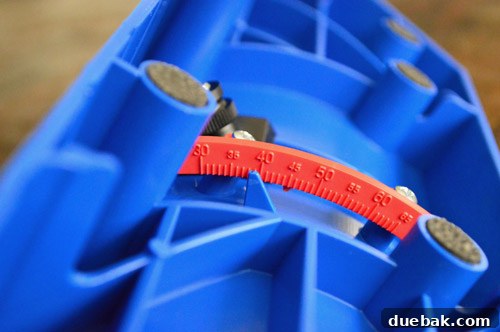
Once you’ve determined your molding’s spring angle, simply adjust the red guide on the underside of the Crown-Pro to match. This sets the cutting platform precisely, ensuring every cut aligns perfectly with how the molding will be installed.
With the cutting guide meticulously prepared, your miter saw is now ready to assist you in making consistently accurate and frustration-free crown molding cuts.
Accurately Determine Your Wall Angles for Perfect Corners
Before making any cuts, it is absolutely crucial to measure and record the exact angles of each corner in your room. A common misconception is that all corners are perfectly 90 degrees. In reality, walls are rarely perfect, and even slight deviations can lead to unsightly gaps and ill-fitting joints in your crown molding. Overlooking these subtle imperfections can quickly derail your project.
Fortunately, the same angle-finding tool included with the Kreg Crown-Pro can be used for this vital task. By precisely measuring each internal and external corner, you can account for any variations and adjust your miter saw settings accordingly.
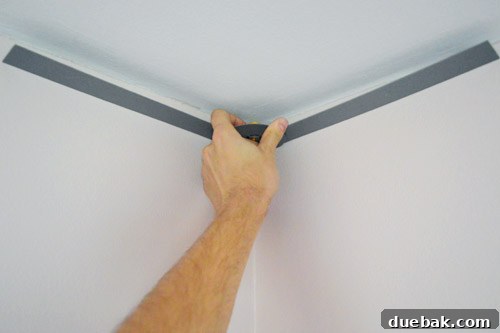
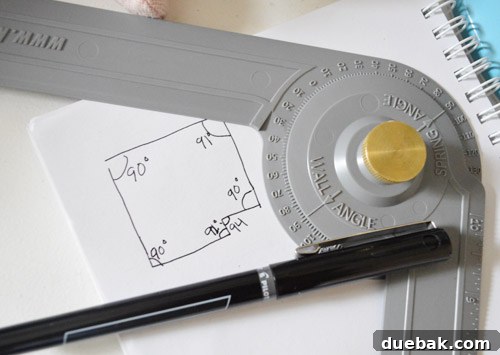
After carefully measuring and documenting every corner angle, I was able to determine the precise miter saw settings required for each cut. Thankfully, most of our room’s corners were very close to 90 degrees, allowing me to set my saw at a standard 45 degrees (half of 90 degrees) for the majority of the pieces. This simplified the process significantly.
For those less-than-perfect corners, a bit of additional calculation was necessary. The specific adjustments depend on your particular miter saw’s labeling and how you approach the cut. The instruction booklet accompanying the Kreg Crown-Pro, however, provides excellent, clear illustrations and guidance for navigating these tricky angles, ensuring you can achieve tight, professional-looking joints even in imperfect rooms.
Accurately Measure Your Wall Lengths for Crown Molding
With your wall angles meticulously documented, the next critical step is to take precise length measurements of each wall, from corner to corner. This task is significantly easier and more accurate with an extra set of hands. My partner, Sherry, and I worked together, using a standard tape measure to get highly accurate readings. Alternatively, investing in an inexpensive laser tape measure tool can make this step remarkably fast and precise, especially for longer walls or when working alone.
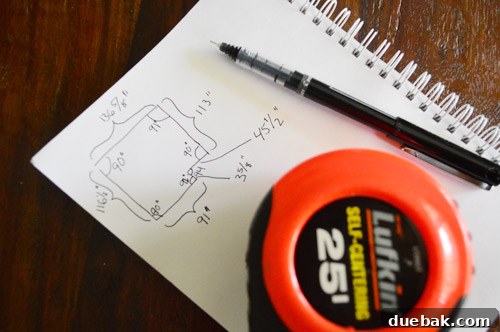
To maintain organization and minimize errors during the cutting phase, we created a simple sketch of our room. On this sketch, we clearly marked every wall length, as well as the previously measured corner angles. This visual reference became an invaluable guide, helping us keep track of which piece of molding was destined for which section of the room and ensuring that each cut was made to the correct specifications. Proper planning at this stage saves a tremendous amount of time and prevents costly mistakes later on.
Setting the Miter Saw Angle for Crown Molding Cuts
Cutting crown molding effectively requires understanding how to properly angle your miter saw blade. The direction you swing your blade – to the left or right – depends entirely on the type of corner you’re addressing (inside versus outside) and which side of that corner your piece of molding will be installed (left or right). This can often be the most confusing aspect of crown molding installation, but it becomes much clearer with practice and the right guidance.
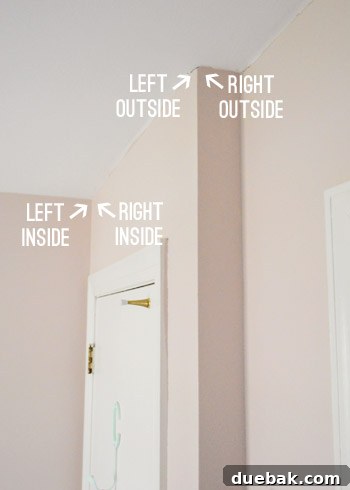
Fortunately, the Kreg Crown-Pro tool comes equipped with an extremely helpful visual guide printed directly on its underside. This practical diagram explicitly illustrates how your miter saw blade should be angled and where to position your molding piece to achieve each of the four most common cuts: inside left, inside right, outside left, and outside right corners.
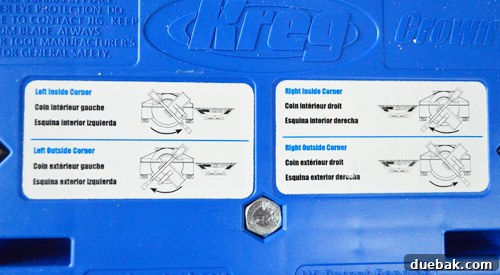
While you are getting accustomed to this process, always take a moment to double-check this guide before initiating any cut. This quick verification ensures that your saw is correctly set, preventing miscuts and preserving your valuable molding material. A few moments of caution can save hours of frustration and extra trips to the hardware store.
Executing Precision Cuts for Your Crown Molding
Beyond setting the correct angle for your miter saw and relying on the Kreg Crown-Pro’s guidance, there’s one more critically important rule to remember when cutting crown molding: always place your molding pieces UPSIDE DOWN on the Crown-Pro platform. This means that the edge of the molding that will eventually sit flush against the ceiling should be positioned flat against the bottom of your saw’s fence. This “upside down and backward” orientation is essential for achieving accurate compound miter cuts that will fit perfectly when installed.
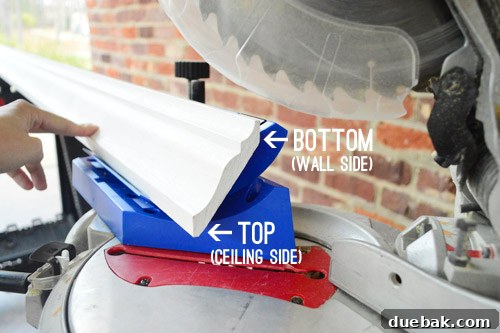
With all my measurements meticulously taken, the Kreg Crown-Pro expertly set up for the appropriate spring angle, and my miter saw blade accurately angled according to the corner diagrams, I was finally ready to begin cutting. The precision offered by this setup greatly reduces the intimidation factor of crown molding cuts, allowing for a smoother, more confident workflow.
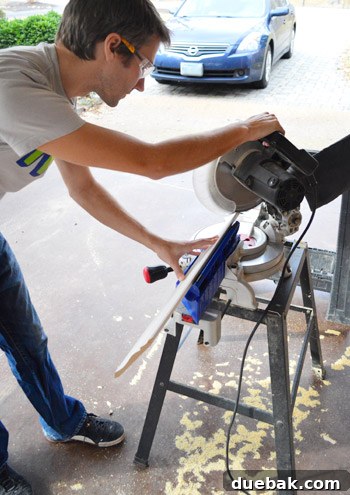
Always adhere to the woodworking adage: “measure twice, cut once.” Better yet, especially when you’re starting, consider leaving your initial cut a fraction of an inch long. You can always trim off a small amount of excess wood to achieve a perfect fit, but you can’t add material back once it’s been cut too short. This cautious approach can save you from wasting expensive molding pieces and ensure a professional result.
Nail Your Crown Molding Securely in Place
Once your crown molding pieces are cut to precision, securing them to the ceiling and walls is the next straightforward step, especially if you have a reliable nail gun on hand. The nail gun featured in some of our earlier project photos was initially purchased for our DIY board and batten project; however, we’ve since upgraded to a cordless model that offers greater portability and eliminates the need for an air compressor, making installation even more convenient.
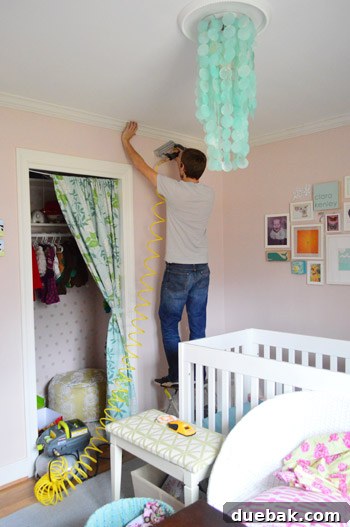
We used 2-inch, 18-gauge brad nails for this project. The key is to drive nails into both the top and bottom edges of the crown molding, spacing them approximately every 12-16 inches. This technique ensures that the molding is held tightly against both the ceiling and the wall, minimizing any gaps and creating a secure, long-lasting installation. Before nailing, it’s always a good idea to use a stud finder to locate ceiling joists and wall studs where possible, providing extra holding power for your molding.
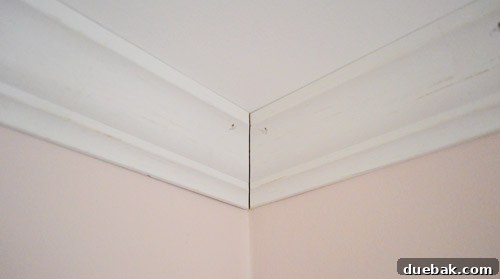
With careful planning and the right tools, the cutting and nailing phase can be completed surprisingly quickly. For this room, it took me just about two hours to get all the molding pieces cut, fitted, and securely nailed into position. This efficiency allows you to see tangible progress rapidly, which is incredibly motivating.
Creating Seamless Connections: The Scarf Joint
One common challenge in crown molding installation, which the Kreg tool doesn’t directly address, is how to join two pieces of molding along a straight wall section, rather than at a corner. This situation arises when a wall is longer than a single piece of molding. Given that I could only transport 8-foot pieces of crown molding in my car, I encountered three such “scarf joints” within the room we were working on.
To achieve the most seamless and professional-looking transition, it’s best to create an overlapping “scarf joint” rather than simply butting the two pieces together. This technique minimizes the visibility of the joint and helps prevent separation or gaps over time, especially with seasonal changes in humidity.
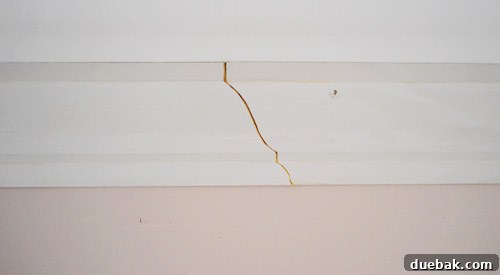
To create a scarf joint, you’ll need to cut one end of the first molding piece like an inside left corner and the corresponding end of the second molding piece like an outside right corner. Alternatively, you could reverse these (inside right and outside left), as long as the cuts are opposite and create an overlap. When these two angled pieces meet, they create a longer, sloping joint that blends much more smoothly than a blunt butt joint. Secure both pieces with nails, ensuring the overlap is tight and flush.
The Finishing Touches: Caulk & Paint for a Professional Look
Once all your crown molding pieces are meticulously cut, installed, and securely nailed in place, the final steps of caulking and painting are crucial for achieving that polished, professional finish. These finishing touches effectively hide any minor imperfections, gaps, or nail holes, transforming your DIY project into a seamless architectural detail.
We opted for white, paintable DAP caulk, a standard choice for trim work. Using a caulk gun, carefully apply caulk in the following key areas:
- Where the crown molding meets the ceiling: This fills any slight gaps caused by uneven ceilings.
- Where the crown molding meets the wall: Similarly, this conceals inconsistencies in your wall surface.
- Where two pieces of crown molding meet: This is especially important for scarf joints and corner joints, ensuring they appear as one continuous piece.
- Any nail holes: While caulk works well for small brad nail holes, you could also use wood putty or spackle for larger holes if desired, ensuring a perfectly smooth surface.
Applying caulk is a skill that improves with practice. Aim for a smooth, even bead, and wipe away any excess immediately with a damp cloth or your finger (wearing a glove is recommended). This process not only hides minor imperfections in your walls or ceiling but also creates a perfectly smooth, ready-to-paint surface that will showcase your new molding beautifully.
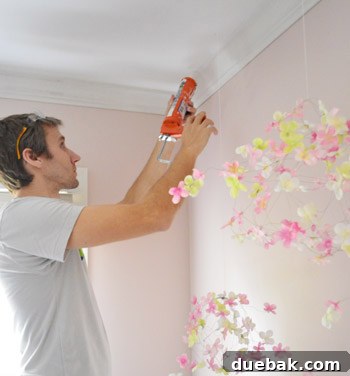
As you can see, even before paint, the difference after caulking is remarkable. The room instantly looks more refined and complete.
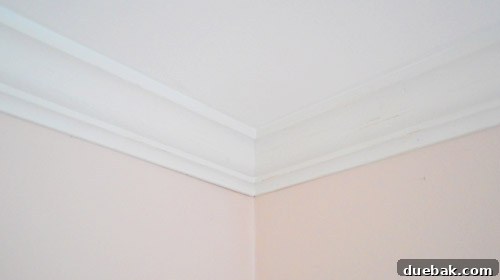
Once the caulk had fully dried (always follow the manufacturer’s recommended drying times), we used a small angled paintbrush to apply a coat of semigloss paint. We matched the color to the existing trim throughout the room, creating a cohesive and polished look. The semigloss finish is durable, easy to clean, and subtly reflects light, enhancing the architectural detail of the crown molding.
Total Crown Molding Project Cost: An Affordable Transformation
One of the most appealing aspects of a DIY crown molding project is its incredible cost-effectiveness. Our total material cost for the room came in at just $67, which included the crown molding pieces and finishing supplies. When you factor in the one-time purchase of the invaluable Kreg Crown-Pro tool at $30, our grand total for this significant room transformation was an astonishing $97.
This minimal investment yields a substantial return in terms of aesthetic appeal and perceived home value. We’ve observed countless real estate listings touting “crown molding throughout” as a key selling point, highlighting its desirability. Completing this project ourselves not only saved us hundreds, if not thousands, compared to professional installation, but also brought us one step closer to achieving a fully “crowned” home. It’s a testament to how impactful and accessible home improvement can be with the right approach.
Expand Your Skills: More Crown Molding Projects & How-Tos
Since the initial publication of this guide, our enthusiasm for crown molding has only grown, leading us to tackle a variety of additional installations and explore more advanced techniques. The confidence gained from that first project opened doors to more creative and challenging endeavors. If you’re looking to expand your DIY skills or explore different crown molding applications, check out some of our other helpful resources below:
- How To Install Chunky Crown Molding For An Upgraded Look: Learn how to build up standard molding to create a more substantial, luxurious profile that truly makes a statement.
- Adding Crown Molding To Kitchen Cabinets: Discover techniques for extending crown molding seamlessly from your ceiling across your kitchen cabinetry, unifying the space.
- Installing Crown Molding Around Built-In Bookcases: Master the art of wrapping crown molding around custom built-ins for a truly integrated, high-end look.
Do you have any ingenious tips, tricks, or insights from your own crown molding installations that you’d be willing to share with our community? Or perhaps, like us, you had a discouraging initial encounter with crown molding, only to bravely revisit the project and ultimately crack the code on your second attempt? We love hearing about your experiences and learning from fellow DIY enthusiasts!