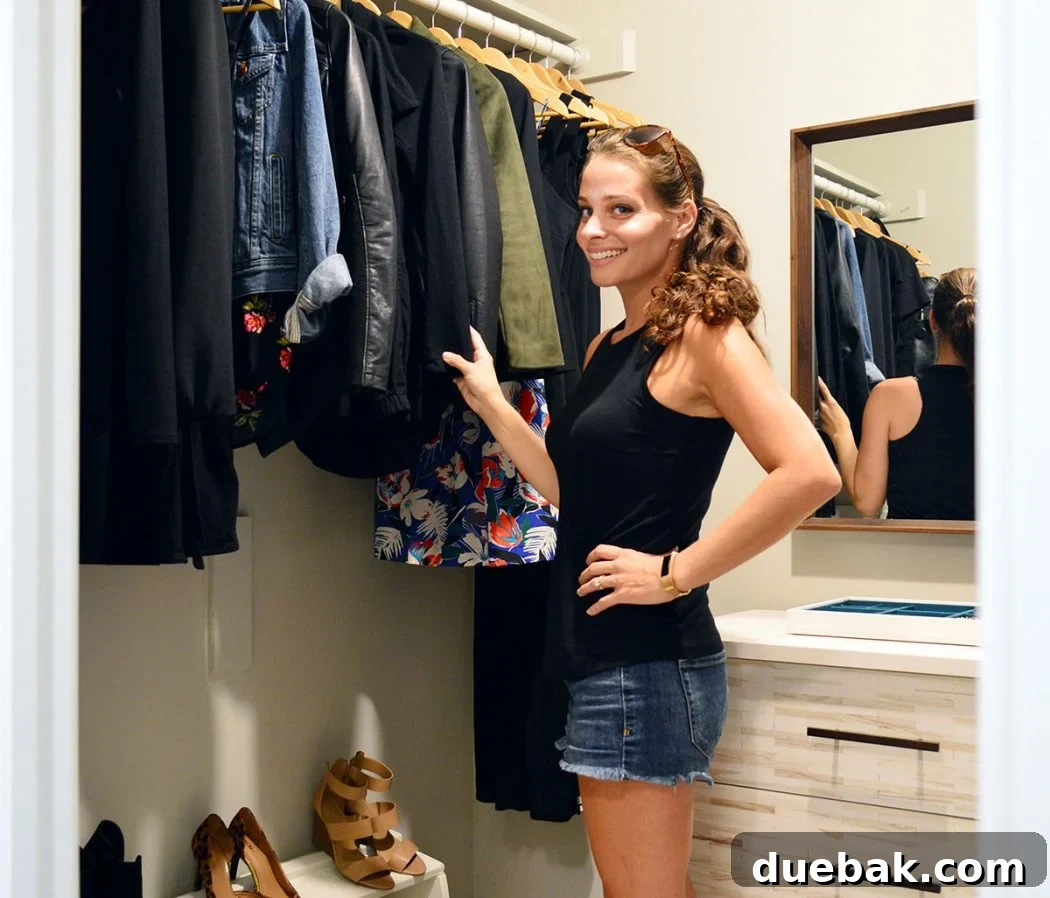
For years, whenever the topic of my attire comes up, I’ve playfully remarked that I practically wear the same ensemble every day. It seems, however, that despite my consistent mentions (and even openly sharing on the blog that I relied on just one bra for a significant period), a recent glimpse into my closet on Instagram caused quite a stir. My DMs were flooded with astonished messages about my sparse, predominantly black wardrobe. One individual even declared, and I quote, that seeing my closet was “the wildest thing they’ve seen on the internet in 2018.” That’s a bold claim, especially considering 2018 also introduced us to cultural phenomena like Gritty.
To clarify, I don’t literally wear the exact same items of clothing on repeat daily. Rather, I possess a carefully curated collection of garments that I genuinely adore and wear consistently. These pieces share similar color palettes, styles, and silhouettes, forming what I affectionately call “my uniform.” Picture figures like Steve Jobs or Michael Kors, but perhaps with fewer turtlenecks and a less billionaire-esque aura.
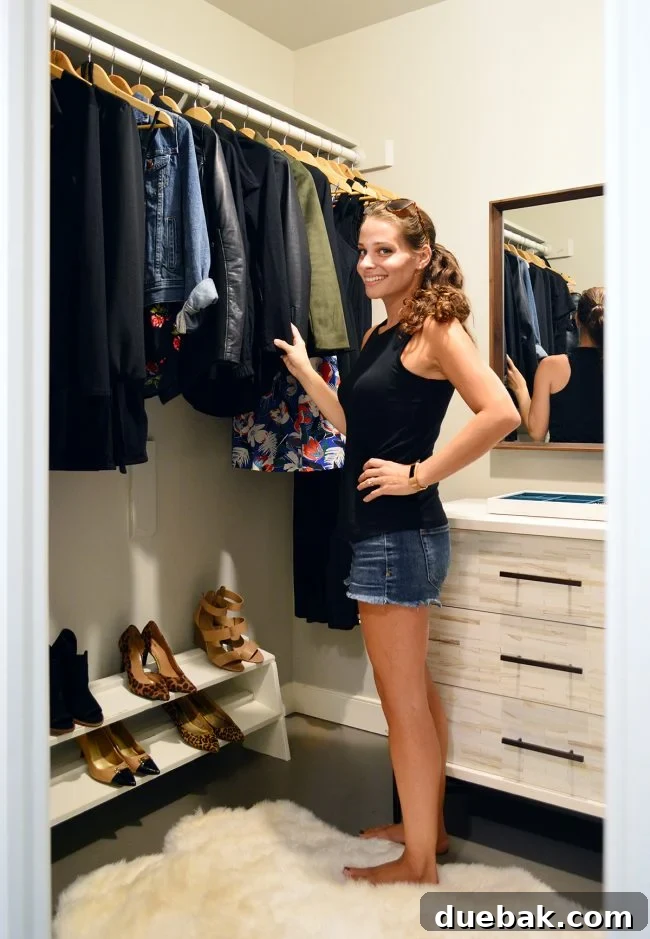
My laundry routine is no more frequent than anyone else’s – we typically do it once a week, which I consider fairly standard. The essence of my approach is simply having enough beloved outfits to comfortably bridge the gap between laundry days, regardless of whether they need to be warm, formal, or suited for any specific life event. The key is to eliminate the excess clutter that stands in the way of the clothes you actually wear and love.
So, if you’re feeling overwhelmed by overflowing drawers and closets, or if the concept of a more minimal wardrobe filled with cherished items – and consequently, less money wasted on unnecessary clothing – resonates with you, then this article is tailored for you. While there are certainly individuals who embrace even fewer clothes, and various methods for paring down, I’m simply sharing the system that has proven effective for me. Conversely, if you’re a wardrobe maximalist who thrives on an extensive collection of clothes, relishes diverse looks, and absolutely adores your comprehensive wardrobe, then this post may not be your cup of tea. And that’s perfectly fine! Do whatever brings you joy; I wholeheartedly support it!
My aim here is to take you on a journey through my closet and drawers, walking you through my personal process and formula for maintaining a minimal wardrobe. I’ll demonstrate how I effortlessly create a multitude of outfits – ranging from casual to dressy, and suitable for both warm and cold weather – all from a remarkably streamlined selection of tops and bottoms that comprise my beloved “uniform.”
It’s important to note that even if your profession dictates a vastly different dress code, or if my personal style, color choices, and silhouettes don’t align with your taste, the principles I’m sharing are fundamentally a formula. You can easily adapt this framework by plugging in your own favorite silhouettes, colors, and other elements that you love, making this system perfectly functional for your unique needs! You can even easily dye clothes at home to better integrate them into your personalized uniform!
Embracing Clarity: A Peek Inside My Minimalist Closet
Let’s kick things off with a visual exploration. I’m well aware of the numerous questions many of you might have, having seen the deluge of DMs I received on Instagram. As they say, a picture is worth a thousand words, and a video often surpasses a thousand pictures. So, I invite you to join me as I walk you through my closet and open all my drawers (and yes, John’s too – you’ll get a laugh out of that!) to reveal precisely what I own and how I organize it, all while sharing more about why and how this system works so effectively for me. Note: If the video below isn’t visible and you’re reading this in a feed reader, please click through to the original post to view it. We’ve also uploaded it here on YouTube.
Update: Following the video, I received a few questions about where my painting clothes are stored, especially since you saw John’s. I actually employ a rather *unconventional* method, which we’ve even shared in our archives. I paint in my pajamas, turned inside out! You can spot my tags proudly sticking out in this old post from 2011. I never claimed to be conventional, folks!
Now that you’ve had a tour and heard a bit about my uniform, let’s delve deeper into the philosophy behind it. I’ll address some common questions in a Q&A format below.
Unpacking the “Uniform” Concept: More Than Just Repetition
When I speak of a “uniform,” I’m not referring to a rigid school uniform where your closet is brimming with dozens of identical skirts and polo shirts. Instead, it’s about discovering your own personal “dress code” – the specific cuts, colors, and styles that you love most and feel fantastic wearing. Logic dictates that if you find something that truly works for you, it will naturally be your go-to item, worn far more frequently than anything else. So, why not take a moment to understand precisely *why* it works and *why* you love it so intensely, allowing you to cultivate that same affection for every single item in your closet? Sounds appealing, doesn’t it?
This is the fundamental principle underpinning my “uniform” approach: identifying what genuinely resonates with you and breaking free from the detrimental cycle of purchasing items merely to stay “on trend,” or for the sake of “variety,” or to simply “look different.” This often leads to the realization, months later, that you never wear these purchases because they don’t make you feel as good, or you dislike the cut or color compared to your proven favorites. The truly liberating aspect is that once you grasp your preferences, you can effortlessly navigate stores and dressing rooms, swiftly eliminating clothing that doesn’t align with your criteria. You can literally halt the pattern of buying yet another item you won’t truly cherish, thereby preventing your closet and drawers from overflowing with unnecessary extras. An added bonus? You keep more cash in your wallet.
I don’t believe there’s a magical “right” number of clothes that suits everyone. Someone who exercises daily, works on a farm, or participates in team sports will naturally have different clothing and laundry needs than someone with a more sedentary lifestyle. However, I’ll soon showcase my “uniforms” as a practical illustration. I say “uniforms” (plural) because you can certainly have different iterations for various seasons and occasions – think casual weekend uniforms, workout uniforms, professional work uniforms, and so on. The core idea is to determine how many of these specific “uniforms” you genuinely need, avoiding the common pitfall of having double or triple that amount crammed into your drawers and spilling onto your closet floor. And did I mention the money you’ll save? Yes? Good, just making sure.
So, don’t let the thought that an office job requiring dressy attire, or living in a colder climate, prevents you from achieving a simpler closet. That simply isn’t true! I successfully employed this method during my time in NYC, working an office job that demanded constant professional dress. This was in a colder climate where I navigated city streets and endured frigid subway platforms, necessitating ample layering. Why does it still work, even with dress-up requirements or the addition of coats, scarves, and hats? Because, at its heart, this is all about practical, glorious math!
My Go-To Wardrobe: The Exact Items Forming My “Uniform”
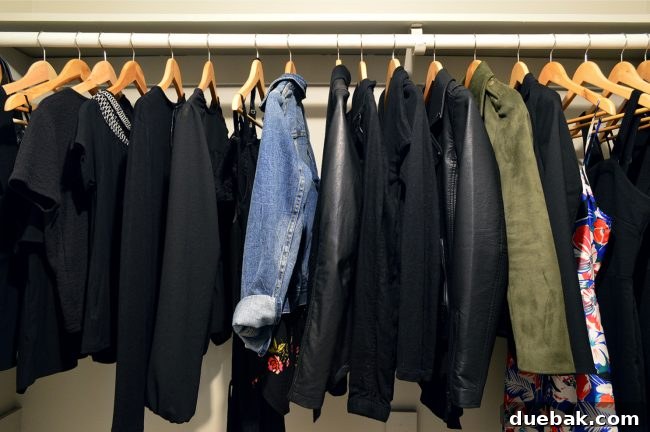
If you’ve followed my journey for any length of time, you likely already have a good grasp of my uniform. It largely consists of black v-neck tops, jeans, black scoop-neck tanks, denim shorts, blazers, and leather or suede jackets. Add a black dress or two to complete the collection. It’s become a running joke, as many of you consistently spot me in a blazer at nearly every speaking engagement or book signing. But here’s the crucial point: it’s not accidental. This is simply how I dress. These items have become my uniform for such occasions because I genuinely love how they feel and look on me. Critically, I actually reach for them in my closet and wear them (yes!), so I know they aren’t occupying precious space unnecessarily. Consequently, I cherish these items. They work hard for me, instill confidence, and unequivocally earn their place in my closet.

Six years of living in New York City solidified my affinity for black. While I do occasionally venture out (I’ve been known to get wild and incorporate navy or olive green here and there), I’ve learned over the years that when I deviate and purchase something in a brighter color, I rarely wear it consistently. Why? Because I invariably have other options in my closet that I prefer. And guess what? Those preferred options are black. This was a realization that unfolded over time, but ever since I fully embraced my love for black and stopped attempting to force myself into other colors I ultimately didn’t enjoy as much (a truly vicious cycle!), two significant things have happened: 1) I feel great in my clothes, all the time. There’s zero clothing drama when I get dressed. 2) I’ve stopped wasting money and time buying items I’ll likely just return or donate later. It’s incredibly freeing!

top: Old Navy but no longer sold / jeans / heels
I’ve also discovered over the years that most of my favorite tops tend to be slightly more fitted than the average loose-cut garment. This helps my 5’2″ frame appear less amorphous, avoiding the “potato sack” look. This insight makes it effortless to bypass anything with a drapey silhouette in a store, regardless of how glamorous it appears on a mannequin or a long-torsoed model in the fitting room.
The same principle applies to shorts. I opt for shorter shorts because of my petite stature; I’ve found that longer shorts tend to make me look frumpy, as if I’m heading to the golf course. Those longer shorts would inevitably earn my “stink eye” for wasting drawer space before eventually being donated. This realization – that shorter shorts flatter my body type more – has been incredibly liberating. I no longer waste time or money purchasing longer shorts “just for variety” or “to have something different,” because they simply don’t look as good on me. So, naturally, I wouldn’t wear them as much, and they’d ultimately end up in the donation pile!
This logic extends to specific cuts of jeans or any other item. It’s easy to succumb to marketing that proclaims, “these bellbottom high-water pants that end at your shin are the new cool thing!” But I must tell you, it might not be something you genuinely like or feel good in. I’m not advocating for a blanket avoidance of all trends. Rather, before your next shopping trip, simply review your existing clothes and identify what you *don’t* wear – then, critically, figure out *why*. If you pull out a pair of jeans with an unusual cut that you bought “just to be different” but never wear because you don’t like how they look as much as your other pairs, it becomes significantly easier to resist the urge to repeat that same pattern in the dressing room next time.

Now, perhaps you’re at this point, thinking, “But all your clothes are black! That’s so incredibly boring. I would perish.” Yes, my clothes are predominantly black, but this system works with every color of the rainbow, all styles, and all body types. If you were to pull out your absolute favorite outfits from your closet – just the items you actually wear and love – and lay them on your bed, I’d wager they share some commonalities. Even if there’s a vibrant array of colors on the bed, I’d bet certain hues appear more frequently because you adore how you look and feel in them. You might also notice trends in cuts and silhouettes; chances are, if a specific cut of jeans makes you feel your best, it might also be your preferred cut for dress pants. And you might have several blazers or jackets with similar shapes that flatter your body in just the right way. Things become our favorites for a reason, don’t they?

I am also a fervent advocate for layering. It’s how I managed to thrive in NYC while working at an agency that required me to dress up, all without the luxury of a dresser in my apartment. That’s right, I had one small, narrow closet, and that was it. So, I mastered the art of layering. Imagine five shirts that can be layered under five different jackets or blazers – that immediately yields 25 distinct combinations! I mean, how incredibly efficient is that math?! And if you integrate a few different pairs of shoes and some fun jewelry to swap out, you can generate a plethora of looks without owning an excessive number of individual items. Did I literally only have five of each thing? No, that would likely feel a bit restrictive – but I probably had fewer than 10 tops that I layered with perhaps 7 blazers, jackets, or cardigans, and then about 5 options for bottoms (jeans for days I didn’t have to present, and black pants for when I did).
The amusing part is that my current “typical uniform” of a black top plus a denim bottom precisely mirrors what I did in NYC when I worked in an office – it’s just a slightly less formal version. This allows me to effortlessly transition between summer and winter simply by layering, exactly as I did back then. When the weather turns cold, I merely swap my denim shorts or skirt for skinny jeans and throw a jacket right over my black summer tank (perhaps a black leather jacket, a crisp blazer, or an olive green faux suede jacket). It can even shift from casual to somewhat dressy (like a date night) by adding some stylish heels and statement earrings, and I’m ready to go!
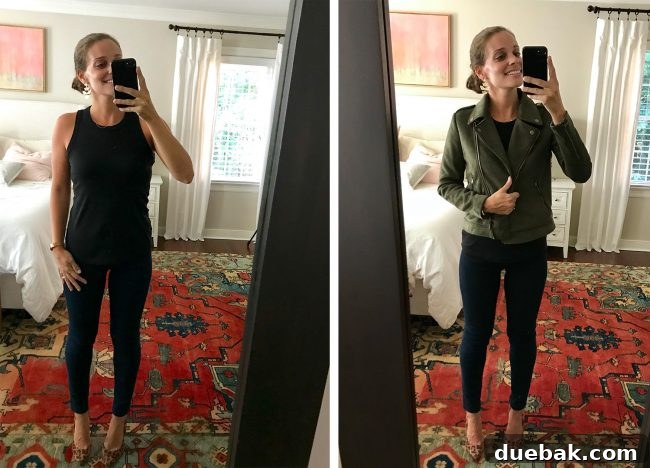
jeans / black tank / green faux suede jacket / leopard heels
Simplifying Your Closet: A Practical Guide to Paring Down
While I’m not here to dictate what *your* uniform should look like, an incredibly straightforward tip for discovering it is to employ a strategy I hinted at earlier. Simply pull out all of your absolute favorite outfits – the ones you genuinely love and wear constantly – and lay them neatly on your bed. Then, take a moment to count them. You might discover that you already possess enough outfits to comfortably carry you from one laundry day to the next. If so, congratulations! That collection right there on your bed *is* your uniform! The remaining items are excess. These can be placed into a large storage bin or two and stashed away in the attic or garage. Live with your core uniform for a while and see if you even miss those stored items. This serves as a “training wheels” method: if you genuinely need something, you can retrieve it. But if you don’t miss it, and this exercise proves that it’s merely dead weight in your closet or drawers, the feeling of consigning or donating that extra “fluff” and being left with a wardrobe you truly love and actually wear is immensely satisfying!
However, let’s say you only find five outfits on your bed, and you realistically need more than that to get through your laundry cycle. The next crucial step is to identify the common threads among your favorites, as these are the qualities you want to replicate in more clothes. Is there a particular color or color family that stands out among your winning garments on the bed? Perhaps it’s four favorite colors and tones, rather than just one like mine? Is there a specific cut or silhouette you gravitate towards – maybe a generally fitted shape, or a more voluminous skirt if you feel best in something fun and swingy? Do many of your favorite outfits follow a similar “formula” – perhaps a wrap dress paired with a cardigan and cute, colorful flats? Try to distill these preferences as much as possible, giving you clear direction for future purchases. Avoid vague statements like “I like boho stuff” or “anything from Anne Taylor!” A more detailed set of parameters will be far more helpful.
Mastering Your Wardrobe Needs: The Laundry Cycle Math
Again, this isn’t about hitting an arbitrary, fixed number or quota for your closet. However, I’ve found that thinking about this in terms of numbers can be incredibly insightful, particularly in illustrating why many of us accumulate too many pieces. The fundamental concept is to possess enough items to comfortably last you from one laundry day to the next, with a few – but not an excessive number – of extras. These extras are useful for those unpredictable moments, like spilling orange juice on your shirt, or when you simply fall a bit behind on washing a load.
In our household, we typically do laundry once a week. To cover those 7 days, my wardrobe includes 10 “bottoms”: 4 pairs of jeans, 4 pairs of shorts, 1 skirt, and 1 pair of yoga pants (I also have a few dresses for dressier occasions). And no, I’m not wearing shorts in winter to get from laundry day to laundry day! I simply don’t wash my denim after every single wear because I’m a rule-follower, and it’s generally not recommended (don’t torture your jeans, folks!). So, 4 pairs of jeans or 4 pairs of denim shorts easily last me 7 days if I wear a few of them twice before tossing them into the hamper. Nobody has ever told me I smell, and children are famously honest, so I feel perfectly confident in this approach.

Now, let’s shift the focus from my specific situation to yours. Consider all the different “uniforms” you might require for your unique lifestyle – whether for work, exercise, or any other activity. Mentally add up how many outfits you’ll genuinely need to comfortably last until your next laundry day. Keep that number in mind. Next, take a candid look into your actual closet and drawers and count the items you possess. If you tally 25 t-shirts and tanks for summer, my educated guess is that you probably rotate through your favorite 10 or so tops consistently from laundry day to laundry day, while the other 15 items remain relegated to their usual spots, simply occupying space because you have so many other pieces you prefer more. If this scenario rings true, then simply keep your 10 favorites and place the rest into that storage bin. You can do this! It’s not a permanent decision; it’s merely an experiment to see if you truly miss or need them.
This same logic applies to every component of your uniform. Why own 6 bathing suits if you only ever rotate between the 2 you like best? John recently discovered he had 8 running shirts in his drawer but was only wearing 3 each week, washing and repeating that cycle. This realization not only prompted him to declutter those space-hogging extras (he still kept a couple of backups) but also served as a powerful reminder that he doesn’t need to buy any more when he’s standing in the store, contemplating a purchase. It’s a win-win situation!
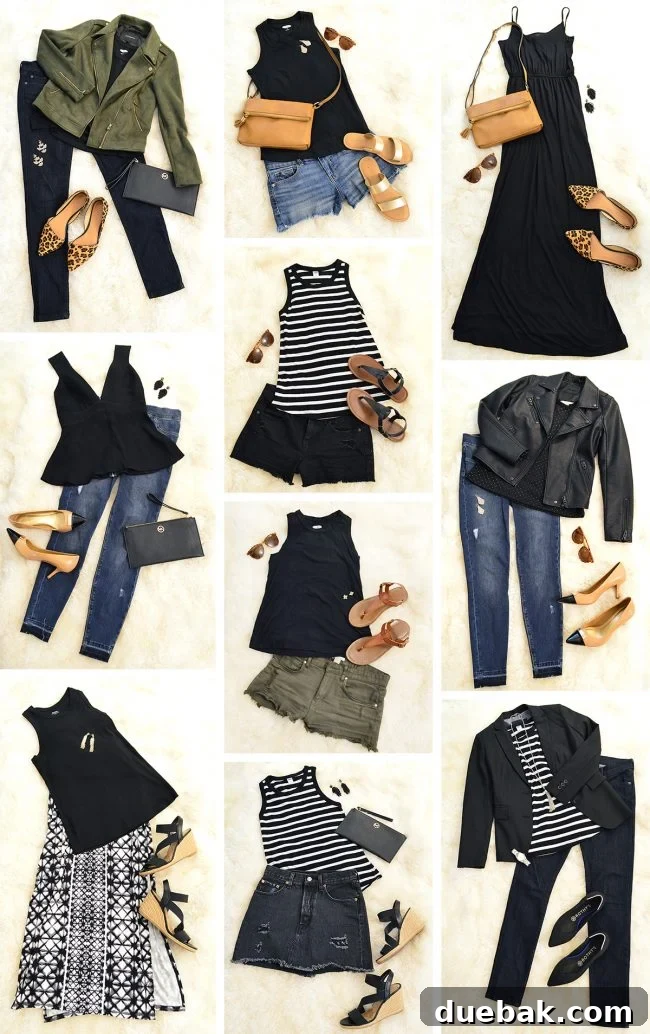
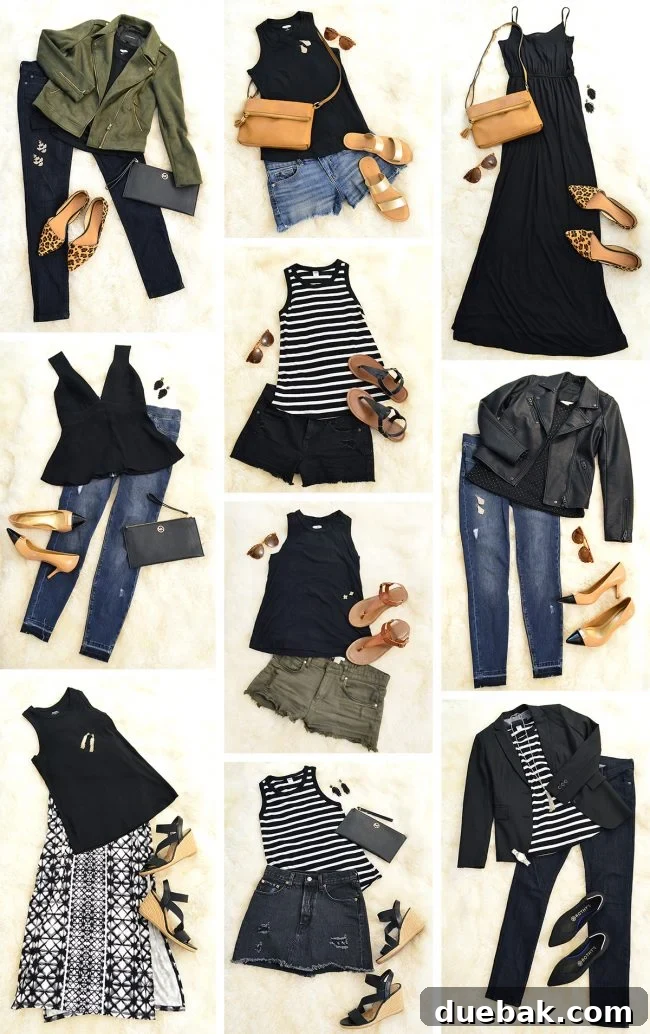
And for anyone who worries that having a limited number of beloved staples (i.e., a uniform) might make it seem like you’re wearing the exact same thing every day – it absolutely doesn’t have to. Even with my very restricted palette, I put together this little visual to demonstrate how effortlessly you can layer items and swap out accessories to truly transform your look. Yes, permutations! I told you this was math!
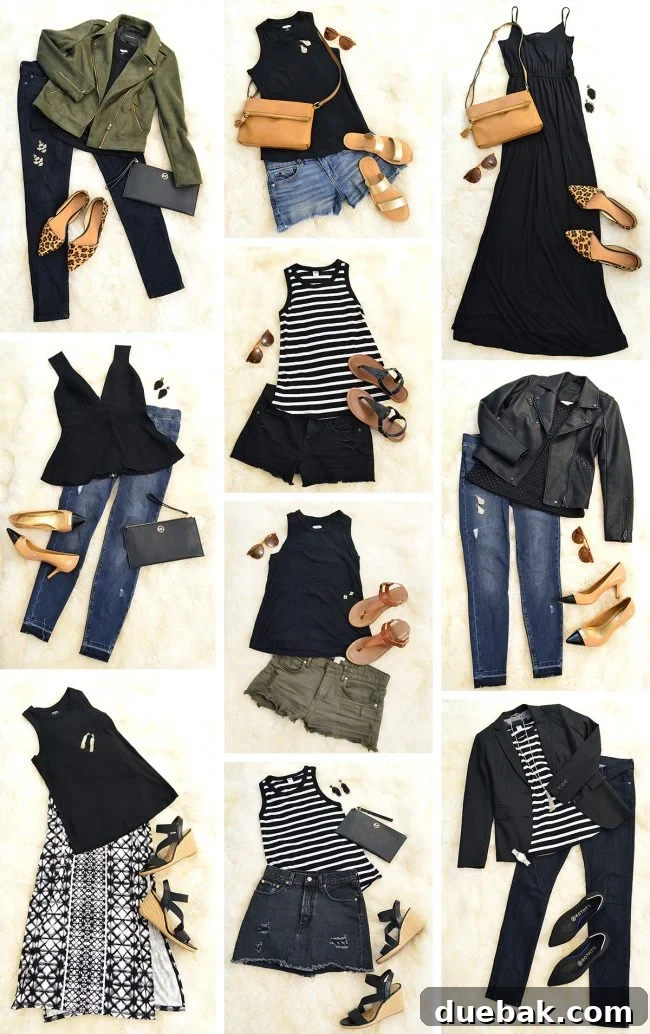
These are just a few of the combinations I can create from a handful of my favorite items. Notice that the image above showcases 10 distinct outfits, all constructed from just 4 different tops, 6 bottoms, and 2 dresses (the patterned skirt-like item is actually a dress that feels too “crazy” for me on its own, so I layer a tank over it to give the illusion of a skirt).
I find this demonstration particularly illuminating because, at first glance, you might think, “Okay, so if I want 10 work outfits and 7 casual outfits to get me comfortably from laundry day to laundry day with some wiggle room, that means I need 17 bottoms and 17 tops.” But hold on! That’s faulty math! Consider how you can re-wear your denim, and perhaps even a blazer if it hasn’t gotten too dirty. Then, think about the myriad combination moves you can make by layering things in different ways! Remember, the 10 outfits above are crafted from just 12 pieces – not the 20+ you might initially assume would be necessary if you simply thought you needed entirely different bottoms and tops every single day.
Am I re-wearing those black tanks between washes? No! So, it’s worth mentioning that I love them so much, and wear them so frequently, that I own three of them. They’re inexpensive, incredibly versatile, and this approach helps them stay crisp and fresh longer. Therefore, occasionally purchasing multiples of an item you wear a ton can be an excellent strategy to maintain its appearance long-term and allow you to wear it in various ways throughout the week.
Beyond the Hanger: Why We Acquire Clothes We Don’t Wear
A significant component of my method involves being brutally honest with myself about what I *actually wear* day in and day out, and then being willing to release everything else that’s merely consuming space. I know many of us cling to clothes we believe we’ll wear for some future, hypothetical occasion or circumstance. I’ve dubbed this the “aspirational wardrobe” – it’s when you purchase an item for an imaginary, incredibly glamorous event, but you never actually wear it because this is real life, not The Sims, and those types of events rarely materialize. This is often what leads us into the predicament of an overcrowded closet.
It might also be a “good deal” that sways your decision. “Oh, these are so cheap, I simply can’t say no! I absolutely must have them, even though I already own 15 shirts I like better, because THESE ARE ONLY TWO DOLLARS!” Or perhaps it’s the belief that buying a certain item will instantly make you more stylish or pulled-together. But then, you never actually wear it because it turns out you primarily wear and love super comfortable clothes, and that supposedly “pulled-together” item is far less cozy than your soft, beloved favorites. Sound familiar?
The Exception to the Rule: That One Super Colorful Item
See this vibrant dress? I know, it looks almost comical next to everything else in my closet. But it serves a specific purpose, and I wear it often enough to justify its permanent residence. Why do I own it? It’s almost like my one “fake uniform.” While I love how I look and feel in black, every few months or so, we need a bio picture or have a photoshoot (like for our furniture line, for example), and this dress is my go-to. An all-black ensemble in a picture can sometimes appear as a large dark void amidst an otherwise fun and colorful shot. So, I literally bought this dress from a J. Crew Outlet a few years ago exclusively for photos. Life is indeed peculiar, isn’t it?

We all have our unique wardrobe guidelines, and mine might be a bit more unusual than yours. I share this because the natural inclination might be to tell yourself, “Hey, I have this niche aspect of my life, and I need outfits for it, so I should probably grab about 10.” In reality, I don’t need 10 colorful “fake uniforms”; one does the trick perfectly. So, I have one.
Smart Shopping: Protecting Your Closet GPA
Here’s another powerful framework for rethinking your closet: strive to maintain a high “Closet GPA” (Grade Point Average). This is a concept I’ve applied to my wardrobe for years, and it’s remarkably effective in curbing impulse purchases. Imagine assigning every item of clothing you currently own a grade based on how much you truly like it AND how often you actually wear it. The items you wear constantly and genuinely adore are “A’s” – contributing to that perfect 4.0 average.
But that random yellow sweater you acquired on a whim or because it was on sale, and have only worn once? Well, that little stinker is definitely in “D” or “F” territory. It’s actively pulling down your *entire closet’s* GPA. Your goal is for your closet to be exclusively filled with your absolute favorite and most wearable items. So, when you’re out shopping, pause and ask yourself: “Is this new shirt demonstrably better than all the other shirts I already own, such that it will *raise* my average? Or do I love everything I currently have *more* than this shirt?” Because if the latter is true, that garment is going to plummet your GPA – and frankly, nobody has time for that.
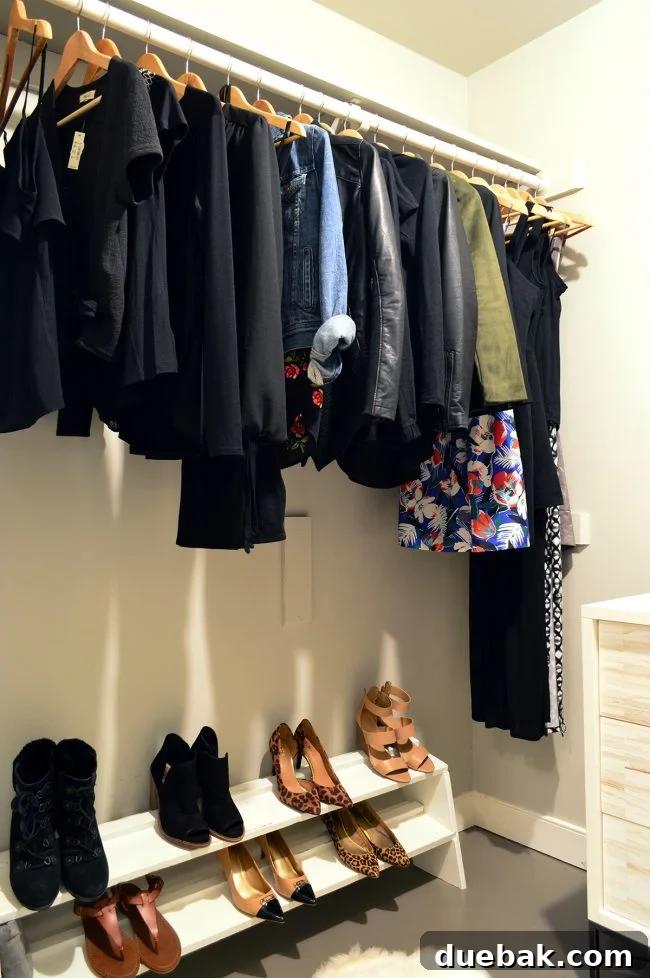
I believe that, generally, we tend to overcomplicate our clothing needs. Stores incessantly bombard us with messages that we require something new, different, and trendy to look better, live a happier life, or whatever narrative they’re trying to sell with those glossy commercials of people hailing cabs. Once I cultivated a deep satisfaction with my clothes – the feeling that they make me confident and happy, and that I truly love everything in my closet – it became a protective shield against all those temptations to buy the newest, trendiest clothing and accessories.
Minimalism, But Not Everywhere: A Caveat
It’s important to clarify: I am not a minimalist in every aspect of the word! So, here’s a crucial caveat to help you embrace certain items you might genuinely not want to pare down at all. My minimalist wardrobe philosophy is ultimately about simplifying my life and enhancing my happiness – it is absolutely not about deprivation! Not at all! Take my earrings, for instance. I probably own over 20 pairs of large, fun earrings, alongside classic studs and other jewelry like a few bracelets, a watch, and a couple of necklaces.
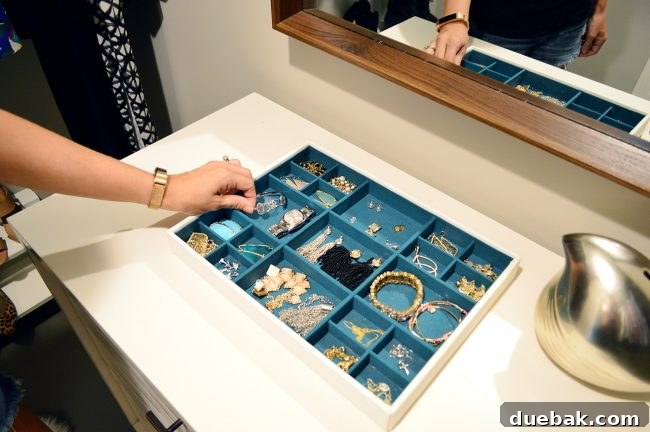
To some, that might seem like an excessive amount! You might not even own one pair of big, dangly earrings. But for me, they are an integral part of my “uniform,” just like blazers and black tanks. So, I fully embrace the fact that I have this many. I’m completely at peace with it, and I don’t fault myself. Incidentally, I believe my affection for them blossomed in NYC, where I had minimal space for clothes but could always squeeze a few more pairs of earrings into my tiny apartment! Ha!
The Myth of Increased Wear: Does Less Clothing Mean More Damage?
A frequent question I receive is about how my clothes withstand more frequent wearing and washing. I understand how one might jump to that conclusion, but… drumroll please… I’m simply washing things once a week, just like most people. Whatever you wear, you typically launder it every 7 days or so, on average, right? And you likely rotate through your favorite 10 or so outfits before laundering them. Well, the same applies to me! I just don’t have that extra clutter hanging between each item or stuffed into the back of a drawer.
Because I possess fewer items, I’m naturally incentivized to take better care of them. My clothes aren’t being jammed onto an overcrowded rod or crammed into an overflowing drawer, nor are they sitting crumpled somewhere due to lack of space. I hesitate to describe them as “precious” (as I do most of my shopping at affordable places like Old Navy and Target), but when I have fewer backup options, I’m far more inclined to dedicate the time to remove stains, fix missing buttons, or diligently follow the proper care instructions for the garments I do own.

tank / jeans / fitbit
In fact, I am incredibly meticulous with my clothes because my uniforms work diligently for me. I prefer to wash everything in cold water (which helps lock in colors, especially black), I wash denim and black items inside out (to minimize fading), and I always use a gentle wash cycle and tumble dry on low (nothing too harsh for my “babies,” I mean clothes!). I also make a conscious effort to put laundry away immediately after it’s done. This prevents me from losing track of piles of clothes and subsequently rewashing them because I’m unsure if they’re clean or dirty – a common predicament that my friends with larger wardrobes often confess to experiencing.
I own blazers, jackets, tops, and jeans that I’ve had for three, and even over five, years. This isn’t a case of rebuying this “minimal wardrobe” every season or even every year. Most of my staples endure for at least a few years, although I do occasionally purchase multiples of inexpensive items (like my black tanks) to ensure they maintain their fresh appearance for an extended period.
Outfit Combinations: Making My Uniform Work for Any Occasion
This section is fairly intuitive, so I won’t dwell on it excessively (and your closet favorites might look entirely different from mine). However, seeing how I switch out shoes, jewelry, purses, or other details below might just help the whole “permutations” concept click into place for you. So, here we go…
These examples illustrate what I might wear for a date night or a work meeting. You can observe the “uniform” in full effect here. Both outfits feature skinny pants paired with a fitted tank top and a jacket (a blazer on the right, a leather jacket on the left). I enjoy experimenting with shoes and jewelry, which helps add that little extra touch for me, and then I’m good to go.
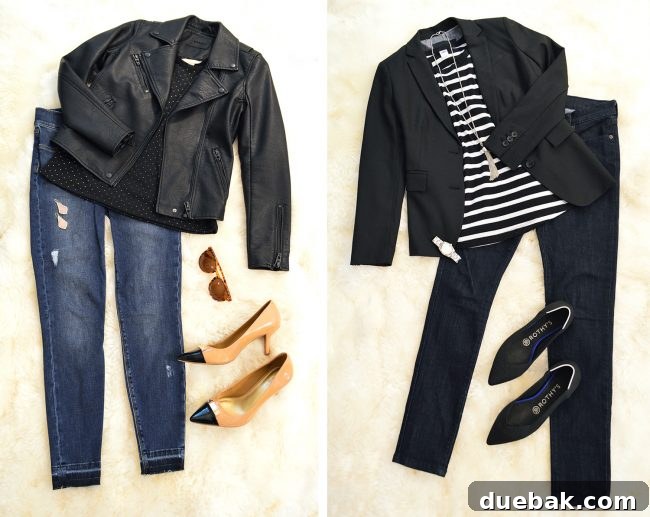
Left: jeans / heels / similar top / leather jacket
Right: jeans / shoes / striped tank / blazer / necklace / watch
This offers another example of what I might wear if I desire a slightly dressier look for a holiday gathering, a dinner out, or a party. Once again, it features skinny bottoms, a fitted top, complemented by statement earrings and stylish shoes. I also favor a simple black clutch (have we met? I appreciate simple black accessories!). One amusing detail I didn’t even notice until I took these photos is my consistent preference for nude and leopard prints in my shoes, alongside black.
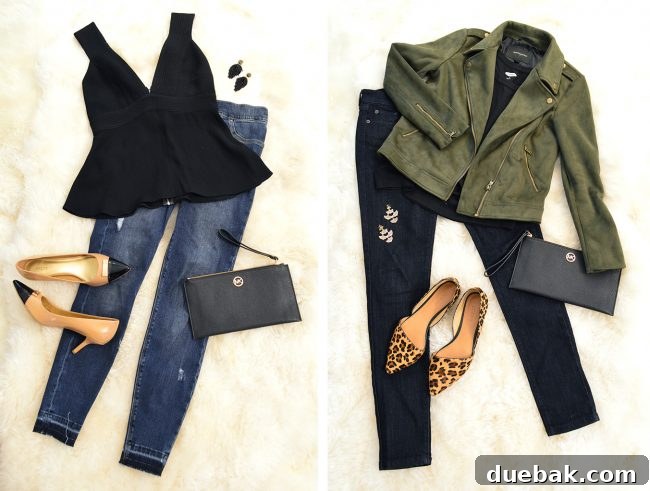
Left: jeans / heels / top / black clutch / earrings
Right: jeans / leopard flats / top / green jacket / similar earrings / black clutch
Here’s an illustration of what I might wear in the summer for a super casual outing (on the right) and a slightly less casual occasion (on the left). Oh, and to address everyone who inquired about what I wear for my walks (since I’ve been enjoying these wonderful long walks during lunch or after bedtime): the answer is simply whatever outfit I’m wearing that day, paired with sneakers or even flip-flops in the summer. I can’t emphasize enough how relaxed these walks are (no sweatbands and sprinting; these are delightful strolls), so as long as I have deodorant on, I’m perfectly fine.
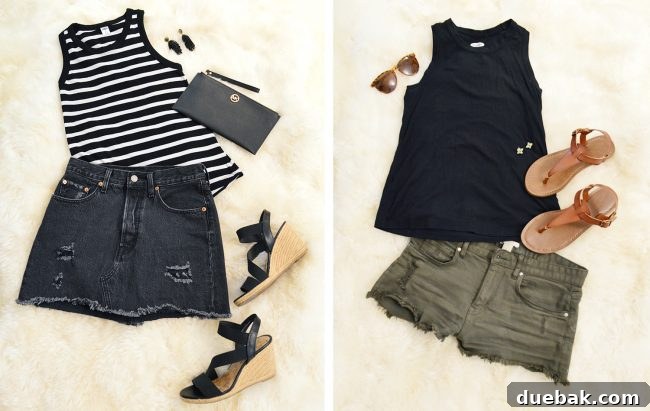
Left: skirt / similar shoes / striped tank / clutch / earrings
Right: shorts / sandals / tank / similar earrings /similar sunglasses
Here are a couple more examples of my everyday summer casual “uniforms” that I wear constantly. It might surprise you to learn that my go-to everyday purse is this tan crossbody bag (WHAT, IT’S NOT BLACK?!?!), but the reason I love it is precisely because I’m almost always wearing black. I appreciate that it introduces an interesting touch of another color and seamlessly complements everything.
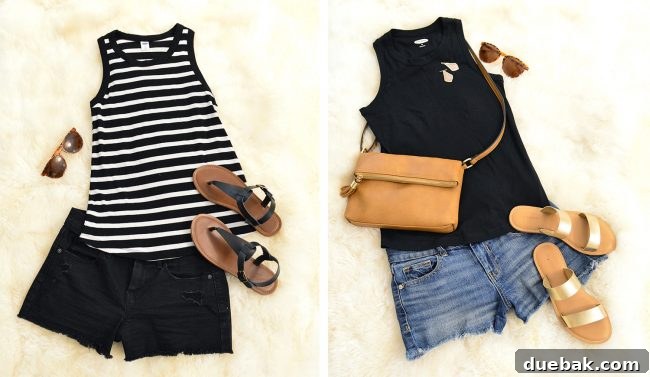
Left: shorts / sandals / striped tank /similar sunglasses
Right: shorts / sandals / tank / earrings / similar purse /similar sunglasses
If I need to dress up a bit for some reason (or no reason at all – I once wore the long black dress on the right to an ice cream parlor with the kids), these might be my choices. I mentioned earlier that the outfit on the left appears to be a patterned skirt and a tank, but it’s actually a dress that feels far too bold for me when worn on its own. However, I absolutely love it with a black tank layered over it. Once again, I simply add cute shoes and some statement earrings, and either of these outfits has me out the door in minutes. Isn’t it interesting that they also share the same silhouette? A creature of habit, indeed!
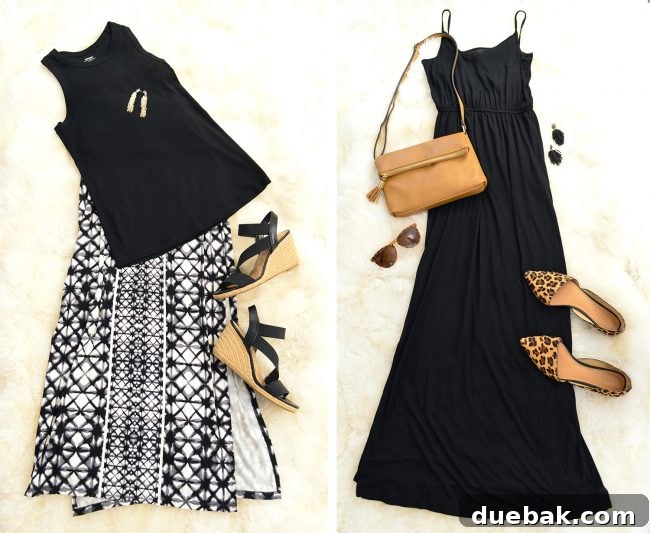
Left: dress / tank / similar shoes / similar earrings
Right: dress / leopard flats / earrings / similar purse / similar sunglasses
Simplifying Kids’ Wardrobes: Practical Tips for Parents
There are numerous clever strategies for accurately determining what you or your children *actually* wear, versus what you *think* you wear. One popular method involves turning all hangers in one direction and then flipping them around each time an item is worn. The theory is that after a few weeks or months, you’ll clearly see which items have remained untouched. Another variation is to move everything to one side of your hanging rod and shift it back once it’s been worn. Any version of this works exceptionally well for hanging clothes. However, many of us – and especially children – store a significant portion of their wardrobe in drawers. BUT I HAVE A SOLUTION for that!
You simply need to do one straightforward thing each week for a few consecutive weeks. Ready for it? On laundry day, just glance into their drawers and at their hanging bar. At this point, the clothes they love most and have already worn will all be in the hamper, meaning they’ve effectively and naturally pre-selected their favorites for you. Instead of being strewn across the bed, they’re neatly corralled in the hamper.
With their favorites temporarily removed from the main rotation, go through their drawers and hanging bar and meticulously note what remains. If you repeat this process for a few weeks, you’ll inevitably start to notice a clear theme. Certain items will consistently remain untouched in the drawer. A few things might always be shoved to the back of the closet or balled up on the floor. VOILA – there is your excess! Place those items into a storage bin and observe if they are ever needed again! If not, joyfully donate or consign them. And then, crucially, remember what those “space wasters” were the next time you’re standing in a store, contemplating buying another outfit for them – just to ensure you’re not repeating the pattern of assuming they’ll wear something when, in actuality, they never do.
Phew! Okay, that’s a comprehensive overview, and I’m ready to declare this extensive post complete. I sincerely hope this information has been helpful in some way if you’re seeking strategies to simplify the clothing situation in your home.
Psst – If you’re looking for more insights on this subject, here’s an older post I penned about my clothing philosophy. I also highly recommend an excellent book titled Simplicity Parenting, which delves into decision fatigue and the broader concept of simplifying our homes (it profoundly changed my life, and I’ve read it three times). Additionally, check out a podcast we did with an amazing man named Matt who worked on the show Hoarders; he shares some incredibly enlightening and compassionate perspectives on paring down. Lastly, Katie Bower recently published a fascinating post about her one-rack wardrobe, which is also a great read!
*This post contains affiliate links*