
The Ultimate DIY Console Table Journey: From Pallet Woes to Stained Perfection
The pursuit of crafting custom furniture often begins with a vision – a specific aesthetic, a desired functionality, and perhaps even a commitment to sustainable sourcing. Our ambitious project to build a mondo 12-foot long DIY console table was no exception. We envisioned a rustic, weathered-looking top, and our initial thought immediately turned to the stacks of old pallets left in our yard by the previous owners. It seemed like the perfect, free, and eco-friendly solution for achieving that coveted reclaimed wood aesthetic. What began as an exciting prospect, however, soon transformed into a challenging lesson in the realities of DIY woodworking, leading us down an unexpected path towards Plan B, and ultimately, a beautiful stained finish for the console’s base.
You might recall our earlier discussions about this expansive console table project (here and here). The plan was solid: construct a sturdy base and crown it with a top fashioned from salvaged pallet wood. The pallets, easily spotted lurking in the background of past posts, promised character and a unique story, making them an ideal candidate for our rustic design aspirations.
The Pallet Wood Predicament: A Lesson in Reclaimed Materials
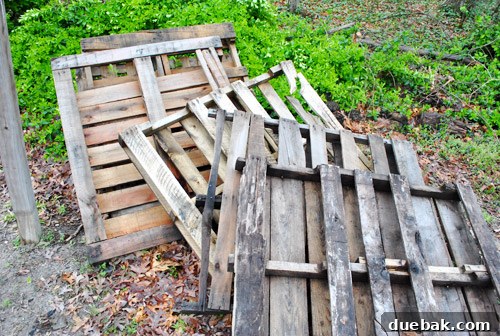
The first step in transforming these discarded pallets into a console tabletop involved bringing them indoors. After several days of persistent rain, the wood was thoroughly soaked, making the task of lugging these heavy, waterlogged behemoths into my basement workshop a significant back-breaker. But the effort was necessary; I wanted them to dry properly and quickly, preempting any sudden spring showers that could re-soak them and delay our progress even further. This preliminary phase alone was a testament to the physical demands often involved in working with reclaimed materials.
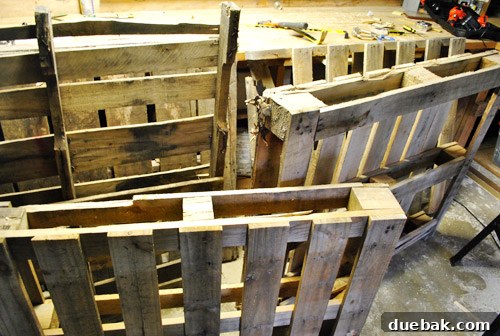
In total, we had five pallets. At first glance, the sheer volume of wood seemed more than sufficient. I confidently mused to myself, “This is far more material than I could possibly need.” Little did I know, the universe was already preparing to deliver a humble lesson in resource estimation. The journey from rough pallets to usable planks proved to be far more arduous and less fruitful than anticipated.
The Demands of Deconstruction: Tools and Techniques
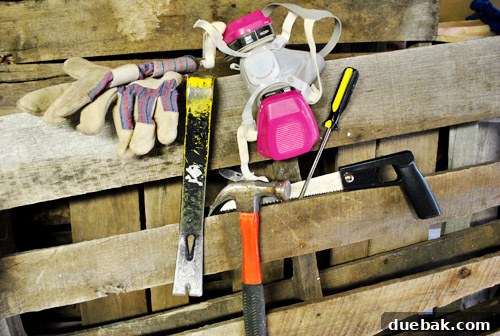
After a few days of patient drying, the moment arrived to tackle the deconstruction. During a quiet afternoon while Clara was napping, I assembled my arsenal of tools: heavy-duty work gloves to protect my hands, a trusty crowbar for prying, a hammer for stubborn nails, a hand saw for initial cuts, a flat-head screwdriver for finer prying, and critically, a mask. The mask wasn’t just for comfort; my wife, ever the diligent guardian of health, rightly reminded me that pallet sawdust isn’t exactly a recommended dietary supplement, especially given potential chemical treatments on some pallets.
It quickly became evident that this task would be significantly more challenging than my initial optimistic assessment. Each plank was not just nailed, but often stapled, in a minimum of three spots. Worse, each spot frequently harbored multiple nails or staples – sometimes 3 to 5 – making removal a formidable undertaking. My first attempts involved cutting the boards with a hand saw. However, with fasteners at both ends and in the middle, this method yielded only short, dinky, and largely unusable pieces. Prying, though more labor-intensive, offered a better chance of salvaging longer, more substantial planks. Yet, even prying was fraught with difficulty. The wood frequently cracked or split during the process, rendering the entire piece useless for our purpose of creating long, consistent planks for the console top.
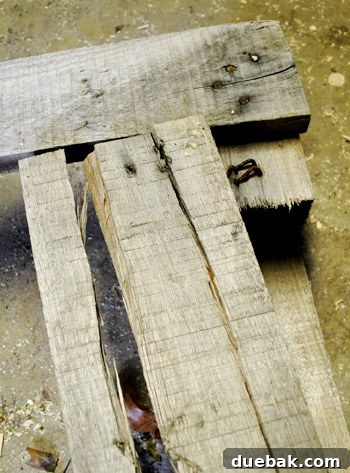
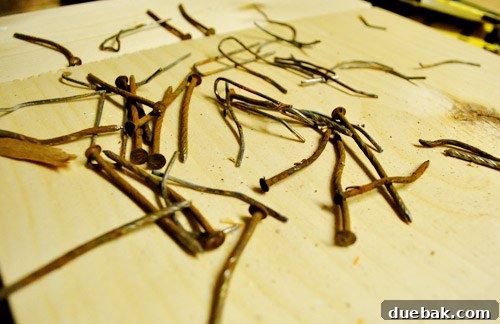
I’m no stranger to hard work, so I persisted, dedicating the entirety of Clara’s 90-minute nap to the task. By the end of this intense session, my collection of removed nails and staples had grown impressively, a small mountain of defeated metal fasteners:
The pile of potentially usable wood, however, told a different, more somber story:
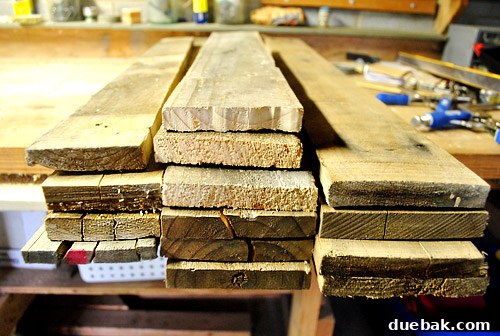
Fourteen pieces in 90 minutes wasn’t entirely disheartening at first glance. But a closer inspection, and a more rigorous definition of “usable,” quickly changed my perspective. The problem was clear: each plank varied slightly in width. For a tabletop comprised of four or five planks laid side-by-side across its entire 140-inch length, this inconsistency would be a nightmare. Achieving a uniform, specific width without the aid of a table saw (which I don’t own) to cut boards lengthwise seemed an insurmountable challenge.
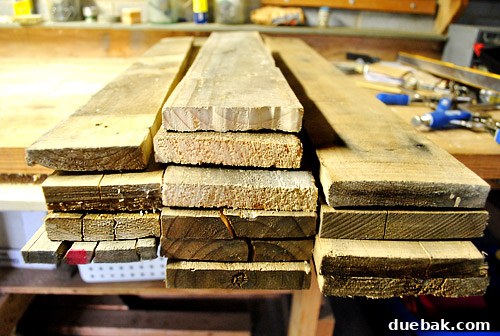
Nonetheless, I pressed on, determined to see if any of the salvaged pieces would meet the exacting requirements. After careful selection, I managed to find five pieces that offered the consistent width I needed – a precise 16 and 7/8 inches:
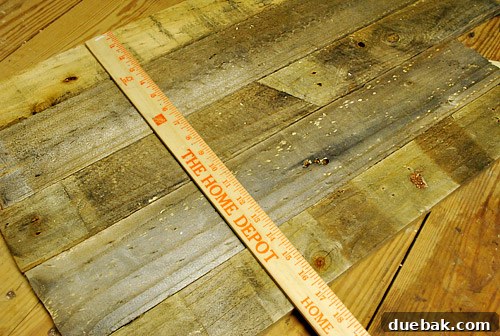
Out of fourteen pieces I had literally fought tooth and nail to free, only five proved suitable for the console top. In an hour and a half, I had wrestled enough wood to cover a mere two feet of tabletop. At this rate, constructing the entire 12-foot length would require approximately nine hours of intense, physically demanding deconstruction. And that was assuming the remaining four pallets contained enough “perfect” pieces to provide all the wood needed, maintaining the exact same width across the entire 140-inch countertop – an increasingly unlikely scenario, especially given that I had already completely stripped one pallet to yield only five truly usable pieces.
Plan B Emerges: Prioritizing Practicality and Safety
As much as I cherished the romantic notion of using reclaimed pallet wood, all signs pointed towards abandoning the idea. When I confided in Sherry about my doubts – the immense time commitment, the frustrating rate of wood cracking and breaking, the difficulty in achieving consistent widths (a success rate of roughly 33%), and the rapidly dwindling supply of viable material – her response echoed my own thoughts: “You tried your best; it’s time to move on to Plan B.” She also added a critical perspective that made the decision even easier: the growing health concerns surrounding potentially toxic chemicals found in some pallet wood. While we had planned to seal the wood with an eco-safe poly (by Safecoat) to ensure a baby- and family-friendly finish, the overall consensus was that letting go of the pallet plan was, in fact, for the best. Safety and practicality ultimately outweighed the initial aesthetic appeal and cost savings.
New Directions: Sourcing and Distressing Wood
Happily, Plan B is already well underway. We’re actively exploring local lumber yards and reclaimed wood suppliers in search of suitable material. An alternative, and increasingly appealing option, is to use standard store-bought white wood, similar to what we used for the console base. This would solve the consistency and labor issues immediately – hooray for uniform sizes and no arduous prying! The beauty of new wood is its predictability, and should we choose this route, we can always distress it ourselves. The idea of “testing” various techniques involving hammers, screws, and crowbars to create a custom weathered look is, I must admit, quite appealing. While it may not be as “cool” or as “free” as the original pallet plan, it’s a practical and efficient path forward. As for the unused pallets, they won’t go to waste; I might find another purpose for them or offer them a second life through platforms like Freecycle or Craigslist.
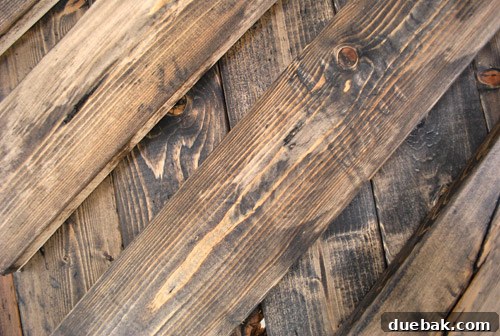
Update: We’ve made significant progress with our distressed wood alternative for the console top. Here’s a quick sneak peek at the evolving look. We’ll be sharing many more details, insights, and even videos about this process once the console is fully assembled and revealed. Our hope is to complete it by early next week, because honestly, this project feels like it’s taking forever!
Bringing the Base to Life: Expert Wood Staining
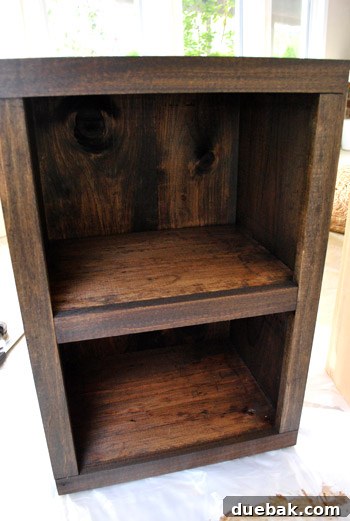
While the saga of the console top continues, progress has been made on another front: the console base. Specifically, Sherry has successfully stained the exposed sides of each console unit, including the practical little shelves designed for easy-access storage, last seen in our previous update here.
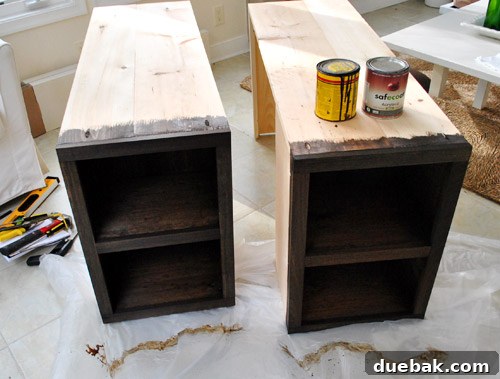
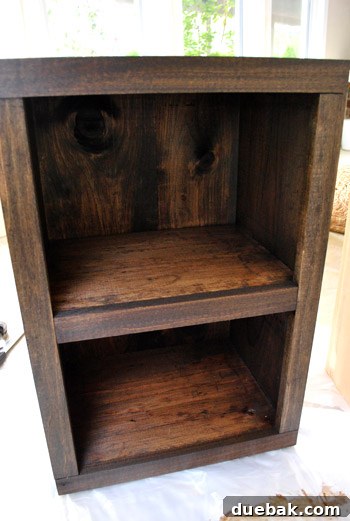
The picture above, while showing the beautiful result, is a little dark due to the angle. Here’s a more accurate depiction, highlighting the rich, warm tones of the stained wood. The result is truly appealing, adding a deep, inviting warmth to the piece.
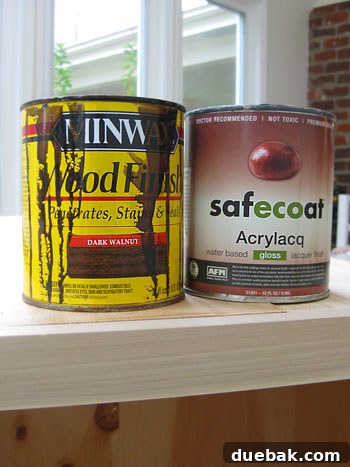
This staining phase of the project was remarkably cost-effective, being 100% free thanks to Sherry’s resourcefulness. She utilized leftover materials we already had on hand: Minwax stain in “Dark Walnut” and Safecoat Acrlacq, which is an excellent water-based, eco-friendly alternative to traditional polyurethane. Choosing these materials not only saved money but also aligned with our commitment to using healthier, low-VOC products in our home.
Given that most of the console will eventually be concealed – either behind our sofa (Karl) or beneath the yet-to-be-completed tabletop – only the shelves on the two exposed ends required immediate staining. Sherry set up her workspace in the sunroom, which is conveniently sealed off from the rest of the house, ensuring Clara wouldn’t inhale any fumes. She applied two coats of the Minwax stain using a foam brush, wiping off the excess after about five minutes with an old rag. This technique ensures a deep, even color saturation without blotchiness. For more detailed staining instructions, you can refer to our guide here.
The following day, after the stain had fully dried, Sherry applied two “thin and even” coats of the Safecoat Acrlacq with a brush. “Thin and even” are her golden rules for any painting or staining project, as they are crucial for achieving a flawless finish. This eco-friendly topcoat serves several vital functions: it seals in any residual stain fumes, creates a durable, water-based, low-VOC, and non-toxic “shell” that protects the wood, and effectively blocks off-gassing. Unlike high-VOC oil-based polys, Safecoat Acrlacq ensures the furniture remains safe and kid-friendly – a priority in our home. You might recall Sherry also used this same product to refinish Clara’s dresser, a project detailed here.
We are particularly pleased that the wood grain remains visible through the stain and topcoat, contributing to a varied and authentic rustic look. Our living room has a somewhat modern aesthetic, and adding substantial pieces with genuine character like this console will help to create a balanced and inviting atmosphere, blending different styles harmoniously.
Conclusion and The Final Countdown
So, we eagerly anticipate returning with a triumphant “the-console-is-finally-finished” post as soon as we make decisive headway on the tabletop. In the meantime, I find myself admiring those freshly stained shelves, a testament to Sherry’s incredible talent. Seriously, her ability to work magic with a rag and some stain is truly remarkable.
For those new to our console journey, or simply needing a refresher, you can learn how we built the base in our previous posts here and here. Rest assured, we will share every last detail, including comprehensive build guides and finishing tips, once this magnificent piece is finally complete. Hopefully, that will be very soon, as we are more than ready to put the finishing touches on this substantial DIY project.