
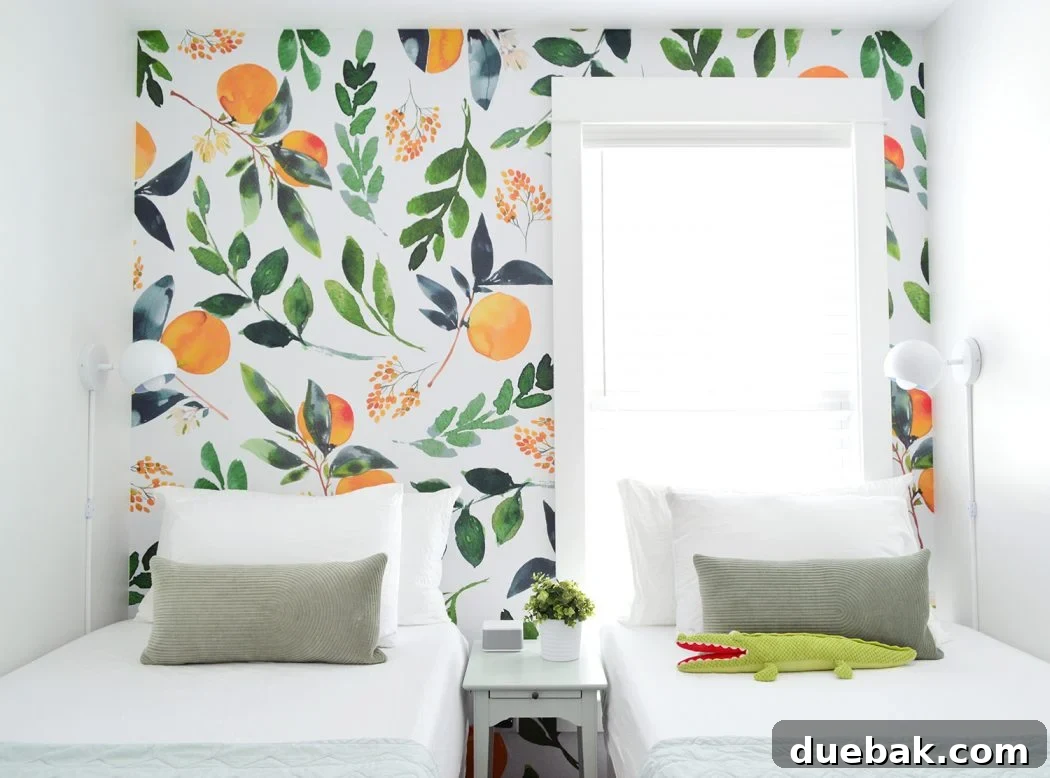
We’d been wanting to try wallpaper in our duplex for a while, and last week we finally installed two peel-and-stick wall murals. The whole process was far easier than we expected, and the results were even better than we imagined.

We considered several options before settling on removable wall murals from Society6. These are essentially peel-and-stick wallpaper, but the artwork is printed on wide, non-repeating panels (most are 8′ wide, some 12′). Since these rooms are small—about 8′ x 8’—the murals fit perfectly.
We also liked that they’re easy to remove, which was appealing after removing wallpaper in other projects. The material is durable—almost like a flexible vinyl with fabric fibers—and the patterns are bold and large-scale compared to many budget wallpaper options.
Why We Chose a Peel-and-Stick Wall Mural
Aside from the perfect size for these bunk rooms, the key reasons we chose this type of mural were:
- Large, painterly designs not commonly found in lower price ranges
- Simple installation—no paste or glue, and panels can be peeled and repositioned as needed
- A demo video on the site that showed the installation process
- Durable, forgiving material that stood up to re-positioning during installation
This isn’t sponsored—we bought the murals ourselves and are sharing our experience because we were thrilled with the outcome.
The Wall Mural Designs We Chose
After debating several designs, we picked two painterly patterns: a blue, watercolor-style whale mural and an orange blossom mural. We paired the whale mural with the side of the duplex that has pink doors (White Truffle by Sherwin-Williams) and the orange blossom mural with the side that has greeny-blue doors (Oyster Bay by Sherwin-Williams).

We purchased both murals during a 30% off sale, which saved us nearly $100 off the regular price. Installation took patience and care—our first mural took about three hours, and the second took about two hours. Once you get the technique down, the process moves much faster.
Tools & Supplies Needed
You don’t need many tools to install these murals, but these items make the job easier:
- Step ladder
- Level
- Pen or pencil
- Ruler or tape measure
- Flathead screwdriver
- Scissors
- Utility knife or sharp craft knife
- Smoothing tool (or a credit card in a pinch)
- An extra set of hands—this is much easier as a two-person job
Step 1: Organize Your Panels
The murals come as four 2′ panels rolled together. Because the pattern doesn’t repeat, identify the order of the panels before you start. We unrolled them and laid them out flat to confirm the sequence so we wouldn’t accidentally place a panel in the wrong spot.
Step 2: Carefully Position the First Panel
Each panel has a removable backing—no glue required. Peel back a small section at a time. For the first panel, we peeled back about a foot and temporarily stuck the top corner in place to test alignment.

Getting the first panel straight is crucial, but the material is forgiving—ours tolerated multiple repositions without losing adhesion or wrinkling. Use a level to mark a vertical reference line rather than relying on the ceiling or corner, since walls and ceilings can be slightly out of square. We marked a line about 23.5″ from the corner so the 24″ panel would overlap the side wall slightly to avoid gaps where the wall bows.

Hang the panel along the vertical line and allow about an inch of overlap at the ceiling to accommodate uneven ceilings. You can trim excess later.

Step 3: Peel, Stick, and Smooth
With the top positioned, peel a little more backing, stick the mural to the wall by hand, and smooth out bubbles. Work from the center outward when smoothing. A proper smoothing tool helps, but a credit card works well in a pinch. If placement isn’t right or wrinkles form, peel and restick—the material handles it without damage.

Continue until you reach the baseboard; trim that excess later.
Step 4: Line Up the Pattern on Your Second Panel
These panels are meant to butt up to each other rather than overlap. Peel a small section of the backing and carefully align the pattern with the first panel. The material has a little stretch, so avoid pulling too hard while smoothing, and re-position as needed until the pattern matches seamlessly.

Step 5: Cut Around Small Obstacles Like Outlets & Switches
Turn off power, remove the cover plate, and loosely stick the mural over the outlet or switch. Feel the outline through the paper and carefully cut along the edges with a utility knife. Remove only what’s necessary so the cover plate can be reinstalled neatly.

Step 6: Cutting Around Large Obstacles Like Windows & Doors
For windows or doors that interrupt the pattern, start the panel at the top as usual, then trim out the portion that would have fallen over the opening. Be conservative—leave extra material and trim more as you go. Cut diagonals at corners if needed to get a snug fit around trim.

Once trimmed so the panel lays flat, continue peeling, sticking, and smoothing. Excess overlapping trim can be trimmed later.

Step 7: Finishing Your Final Wall Mural Panel
Aligning the final strip under a window was tricky for us. Where exact alignment caused bubbles or wrinkles, we prioritized a clean vertical seam under the window and then made a narrow cut in a white area so we could create a small, barely noticeable overlap. From a normal viewing distance—and once furniture covers part of the wall—you’d never notice the minor imperfection.


Step 8: Cut Off the Excess With Your Knife
Trim excess along ceilings, side walls, and baseboards when you’re satisfied with positioning. We smoothed the edges and then used a utility knife to cut along the crease. One of us used the smoothing tool pressed into the crease as a cutting guide, which worked well for softer corners; the other freehanded along harder edges like baseboards.

Step 9: Enjoy (and Repeat If You Want)
The transformation was dramatic and addicting—so much so that we’re already looking for other spots to install murals in our beach house and our own home. These rooms aren’t fully furnished yet: we’ve built twin bed platforms and are waiting on mattresses and bedding, but the murals already make the spaces feel like charming little sleeping nooks.


All in all, a few hours of careful work turned these small rooms into much more inviting spaces. We’re really happy with how painless the installation was and how big an impact the murals made.
*This post contains affiliate links.