
Welcome to the ultimate guide to transforming your dated wood paneling – a journey that promises not just a refreshed space, but also a few lessons in patience and perseverance! If you’re looking to update your home with a fresh, modern aesthetic, painting existing paneling can be a game-changer. Our latest DIY adventure takes us into the heart of our kitchen, tackling the infamous wood paneling with a specific goal in mind: a low-VOC approach for a healthier home environment. Buckle up, because this post is a deep dive into the unexpected twists and turns of achieving beautifully painted paneling without the harsh fumes.
Why Paint Paneling? Weighing the Options for a Fresh Look
The decision to paint wood paneling often sparks debate. Many homeowners consider removing it entirely or drywalling over it. For us, however, painting was the most practical and sensible choice. Here’s why we opted for the brush and roller instead of demolition:
- Cabinetry Integration: Our kitchen cabinets were hung directly in front of the existing paneling. Removing the paneling would necessitate the arduous task of uninstalling and rehanging all the cabinets, a massive undertaking that we simply weren’t prepared for.
- Uncovering Unknowns: Beneath the paneling lay old plaster walls. The thought of revealing potential structural issues, crumbling plaster, or other costly repairs felt like opening a Pandora’s Box. Painting offered a way to bypass these “can of worms” scenarios.
- Cost and Complexity: Drywalling over the paneling would mean intricate work around existing cabinetry, adding significant expense, time, and complexity to the project. Painting, by comparison, seemed like a more straightforward, budget-friendly, and less disruptive solution.
We’re certainly no strangers to the transformative power of painted paneling. Our experience in our previous den, which slowly evolved over 4.5 years, taught us that this approach can yield incredible results. That room, once adorned with dark, dated wood, became one of our favorite spaces in the house. Just look at the before and after:

… to this stunning transformation:

We’ve never regretted the choice to paint the paneling. Much like painted brick, we appreciate the subtle texture and character that the remaining grooves add to the walls. It creates a charming, lived-in feel that we truly love. Of course, for those who prefer a completely smooth surface, the grooves can be filled with caulk or putty before painting. Or, if it’s truly not your style, ripping it out remains an option – but be prepared for the potential challenges that come with it!
Embracing a Healthier Approach: Our Low-VOC Painting Journey
This time around, our paneling project came with a unique twist: a commitment to using no-VOC (Volatile Organic Compounds) or low-VOC products. Our motivation stemmed from a desire to minimize exposure to harmful fumes, especially with a baby in the house. We regularly work with paint, caulk, and primer, and prioritizing family health felt paramount.
We knew this decision wouldn’t be a shortcut; in fact, we anticipated it might complicate things. Traditional oil-based, stain-blocking primers are professionally recommended for their superior ability to prevent “wood bleed” – those unsightly yellow-orange stains that can seep through paint coats. By choosing a low-VOC alternative, we were essentially cracking open our margin for error, accepting the risk of a more challenging process. However, we believed it was a risk worth taking for the sake of a healthier home environment. And in the end, it was. It just took a little (or a lot) longer to get there. Allow us to share the full, unvarnished story of how it all unfolded.
Before the Transformation: Our Kitchen’s Starting Point
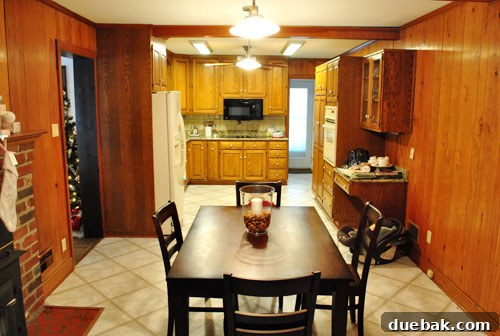
To truly appreciate the transformation, let’s take a moment to look back at our kitchen before we embarked on this ambitious priming and painting adventure. These images capture the space in its original, unpainted state:

For additional context, here’s an older shot of the kitchen from a different angle. This was taken some time ago, even before we removed the wood stove and painted the fireplace, giving you a fuller picture of the initial space:
Step-by-Step: Navigating the Low-VOC Priming & Painting Process
Our journey to bright, beautiful paneling involved several steps, a few unexpected detours, and a good deal of persistence. Here’s the detailed breakdown of our process:
Step 1: Meticulous Preparation for Lasting Results
Every successful paint job begins with thorough preparation. We started by wiping down all the paneling, beams, and trim with a moist cloth. This crucial step removes any dust, grease, or grime that could prevent proper paint adhesion. While some DIYers opt for a stronger cleaner like TSP (Trisodium Phosphate), we found a simple wipe-down sufficient, as we did with our previous paneling project. However, if your paneling feels particularly greasy or grimy, TSP can be a valuable addition to your prep routine.
Similarly, we chose not to sand the paneling. Sanding is often recommended for rough, splintery, or extremely glossy, shellacked surfaces to create a better profile for primer to grip. Our paneling wasn’t in such condition, making sanding an unnecessary extra step for us. Assess your own paneling to decide if this step is needed for your project.
Step 2: Clearing the Way: Removing Fixtures
To ensure a clean, professional finish, we meticulously removed all vent covers and outlet covers. This allowed us to paint seamlessly behind them. We had already planned to replace these old bisque-colored fixtures with fresh white ones, making their removal a straightforward decision.
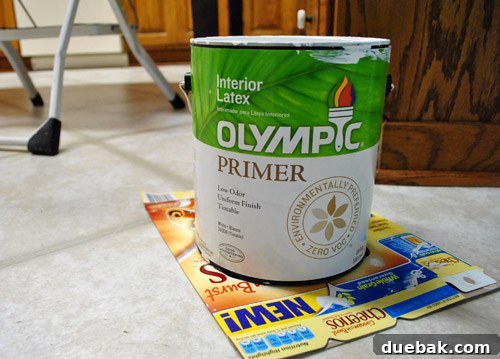
Step 3: The First Attempt: Olympic No-VOC Primer & Immediate Bleed-Through
With preparation complete, we eagerly applied the first coat of Olympic No-VOC primer to the trim, beams, and paneled walls. This took approximately three hours, and we were hopeful that our low-VOC choice would perform admirably.
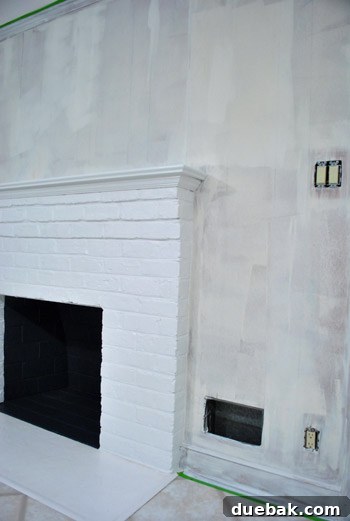
Fifteen minutes into application, our hopes began to waver. After the first coat, the paneling looked like this:
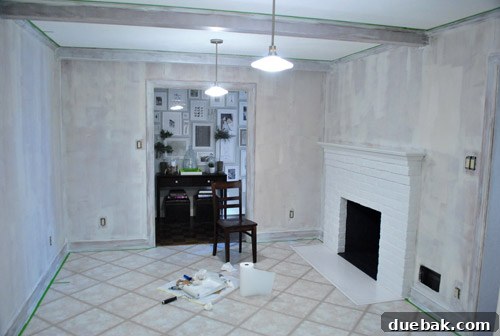
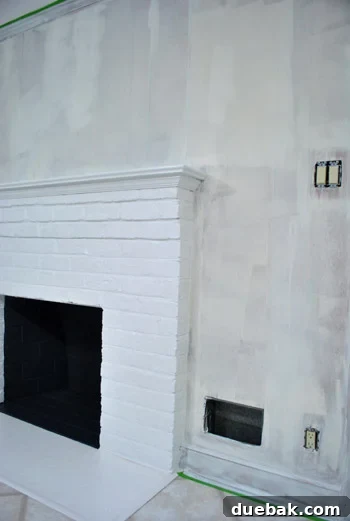
While primer isn’t expected to be perfectly opaque or consistent (its primary job is adhesion and creating a uniform base), we immediately noticed significant “bleed-through.” This is when the natural orangey-brown stains from the wood seep through the primer layer, threatening to ruin the final paint job. It was a disheartening sight, confirming our earlier concerns about the challenges of foregoing oil-based stainblockers.

Step 4: Double Down: A Second Coat of Olympic
Undeterred, we waited for the first coat to dry sufficiently and then applied a second coat of the same Olympic No-VOC primer to the most problematic, obviously bleeding spots. Our hope was that an additional layer might finally block the stubborn orange seepage. Unfortunately, it did not. The bleed-through persisted, albeit slightly less aggressively in some areas, but still very much present and concerning.
Step 5: A New Hope: Behr Primer + Paint
Scouring our basement for alternatives, we discovered a can of Behr Primer + Paint in white semi-gloss, leftover from a previous project. This product is low-VOC and known for its nice, thick consistency. Desperate for a solution, we decided to apply a full coat of this Behr product to everything – the trim, beams, and paneling. This marked our third layer of primer (or primer-like product) on the walls.
While the Behr paint-and-primer-in-one offered a thicker coverage, the bleed-through still wasn’t entirely resolved. It was less pronounced, but in certain areas, the ghostly orange stains stubbornly peeked through, driving us a little mad with frustration.
Step 6: The Game Changer: Kilz Clean Start No-VOC Stainblocker
With time ticking and our patience wearing thin, we made a crucial trip to Home Depot. Our mission: find a primer explicitly labeled as a “stainblocker” that was also No-VOC. We found Kilz Clean Start No-VOC primer, and its packaging promised stain-blocking power. With renewed (but cautious) optimism, we applied yet another full coat – our fourth distinct layer of primer – to all the trim, beams, and walls. This was it; our final hope in the low-VOC category.
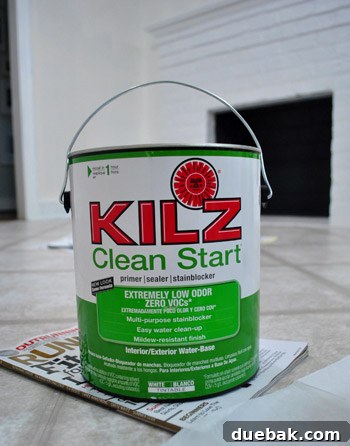
And then, a miracle! It worked! The Kilz Clean Start primer finally delivered, creating a pristine, bleed-free surface. It was a moment of pure triumph – angels sang, and two tired but immensely relieved DIYers rejoiced in the privacy of their finally, truly freshly primed kitchen.
Step 7: Bringing in the Bright: Painting the Trim and Beams
With the paneling flawlessly primed, we moved on to painting the trim and beams. We used our trusty Behr Primer + Paint in white semi-gloss. It’s crucial not to leave primed surfaces unpainted for too long, as primer is intentionally sticky for paint adhesion and can become a magnet for dust and dirt, leading to a grimy, hard-to-clean mess. Happily, the Behr semi-gloss paint offered excellent coverage over the Kilz primer, leaving the trim and beams looking glossy, crisp, and simply amazing. It was a welcome sight for our sore eyes (and aching arms!).
Step 8: The Finishing Touch: Perfect Tape Removal
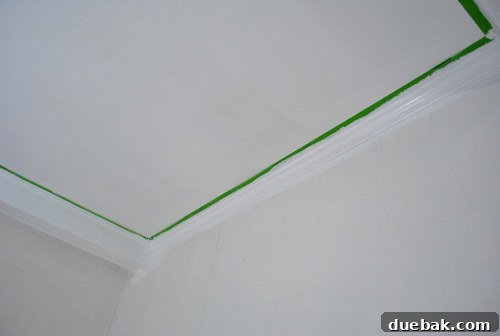
For the cleanest possible paint lines, we made sure to remove all the painter’s tape while the final coat of paint was still slightly wet. Waiting for the paint to fully dry can cause it to peel and tear when the tape is removed, leaving jagged edges. In instances where the paint or primer had bonded stubbornly to the tape, we carefully used an exacto knife to score along the edge of the tape, preventing any accidental peeling of the newly painted surface.
While I often prefer to freehand paint lines with a short-handled brush, my height, coupled with my role as the primary edger, meant that working on a stool required more precision. Therefore, taping around the ceiling trim and quickly laying down tape along the baseboards was incredibly helpful for maintaining speed and accuracy. For less critical areas like door frames and the fireplace, I was comfortable relying on my freehand skills.
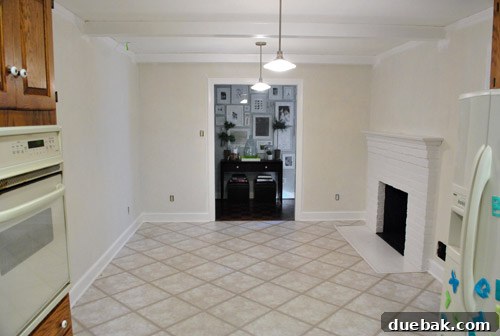
Approximately 48 hours after embarking on this priming odyssey, our kitchen finally reached this stage. The trim now boasts a brighter white finish compared to the walls, thanks to the semi-gloss Behr paint over the primer (which was a creamier, less pure white). The next step: painting the walls themselves!
Our Key Takeaways and Recommendations for Your Paneling Project
Our journey taught us valuable lessons, especially regarding low-VOC products. Here are our recommendations based on our experience:
- For a Low-VOC Approach: If you’re committed to avoiding fumes, we highly recommend 2-3 thin, even coats of Kilz Clean Start No-VOC primer. Its stain-blocking properties proved superior for us. Follow this with two thin and even coats of a high-quality latex paint. While we’re unsure if the Kilz worked perfectly because of its inherent qualities or because it was layered over other primers, its performance was undeniable. Consider doing a test patch if you’re concerned.
- For a More Traditional (and Faster) Approach: If VOCs aren’t your primary concern, the most reliably quick method involves one coat of an oil-based stain-blocking primer, followed by two thin and even coats of latex paint. This method is professionally recommended for its excellent bleed-through prevention. You can find more detailed step-by-step instructions on this method here.
- Time Commitment: Be prepared for a significant time investment if you choose the low/no-VOC route. What we hoped would be an afternoon project for priming alone turned into a two-day saga, even with some babysitting help!
- Is it Worth It? While it was far from “fun,” the satisfaction of achieving clean, white walls without the lingering fumes was absolutely worth the effort. It’s like crossing a rainbow bridge from “bleed-ville” to “clean-white-walls” – a true hallelujah moment.
- Long-Term Observations: In very rare cases, bleed-through can reappear weeks or even months later (a thought that makes us want to stick paintbrushes in our eyes!). However, we previously used a no-VOC method (four coats of Olympic Premium Paint without an oil-based primer) to paint the wood trim in our living room five months ago, and we’ve had no seepage. Given that the kitchen baseboards and trim are the exact same wood, all signs point to this method holding up. We promise to update you if any supremely annoying issues arise!
Beyond the Paint: Commiserating and Celebrating DIY Victories
So, if anyone out there would be so kind as to do a nap-time dance for Clara, we’d truly appreciate it. So far, gently swinging her stuffed giraffe and whispering, “you are getting sleeeepy,” isn’t quite doing the trick – though it’s certainly making *us* sleepy, and we’re not the target audience! Has anyone else ventured into painting paneling without VOCs? Or perhaps you’ve found yourself applying four or more coats of paint or primer for any reason at all? It sucks, right? Let’s commiserate in the comments – share your triumphs and tribulations!
Psst – For more details about our complete Phase 1 kitchen renovation plan, be sure to read all about it here.