
Revitalizing a Vintage Rocker: A Comprehensive DIY Upholstery & Refinishing Guide
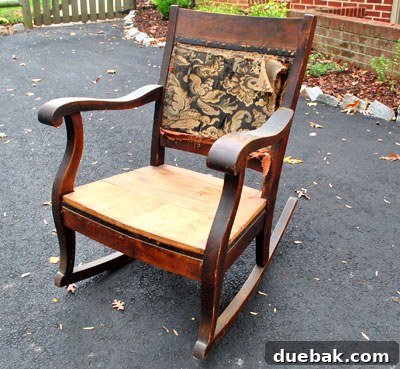
Every DIY enthusiast knows the thrill of a fantastic bargain. For me, it was a simple rocking chair, discovered on Craigslist for a mere $25. Its clean lines and timeless appeal instantly captivated me, sparking visions of a beautifully restored piece that would perfectly complement our home. However, as is often the case with ambitious projects, this beloved find sat patiently, accumulating dust and the occasional “stink eye” from me since last November – even before we moved into our new place. While significant undertakings like our office cabinets awaited attention, this rocker stubbornly held its ground, becoming a symbol of my procrastination. After an epic nine-month hiatus, the moment finally arrived to breathe new life into this forgotten treasure.
The Initial Upholstery Conundrum: A Design Challenge
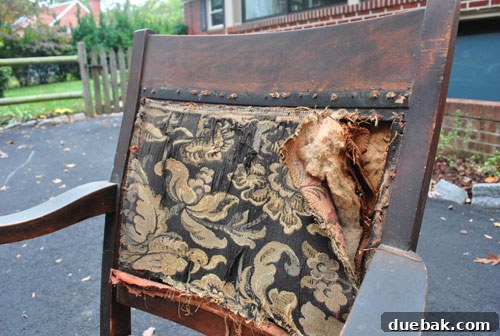
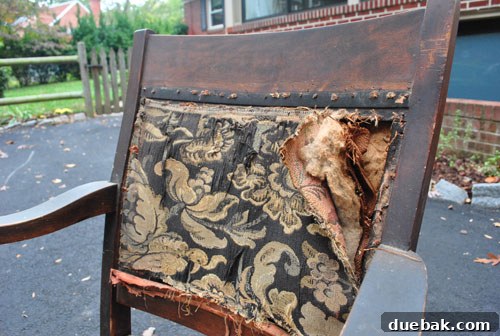
The reason for the prolonged delay was simple, yet daunting: I had no idea how to properly reupholster it. While I had experience with basic seat cushions, the unique design of this rocker presented a specific challenge. The top section featured an intricate opening that required a finished look on both sides, a detail that completely confounded my upholstery skills. Traditional methods for single-sided upholstery wouldn’t suffice, leaving me feeling utterly stumped. This complex design feature became the primary roadblock, transforming a simple “rocker restoration” into a full-blown upholstery enigma.
Seeking Wisdom: Community Advice and Creative Solutions
Faced with this intricate challenge, I turned to the collective wisdom of the internet, posting a plea for help. The response was overwhelmingly positive, with numerous experts and fellow DIYers offering invaluable insights and creative solutions. It was incredibly reassuring to learn that there wasn’t a single “right” way to tackle such a complex upholstery job; even seasoned professionals described a variety of approaches. This outpouring of advice, ranging from specific techniques to general encouragement, instilled the confidence I needed to finally embark on the project. It liberated me from the fear of making a mistake, allowing me to embrace an experimental, “learn-as-you-go” mindset for this chair makeover.
Before diving in, a quick disclaimer: my approach to this project was entirely unconventional. Much like an amateur chef experimenting with a new recipe, I decided to “go rogue.” I absorbed all the excellent advice shared by my wonderful online community, combined it with practical Google tips, and integrated suggestions from a friend who is an avid reupholstering enthusiast. Ultimately, I played it by ear, adapting and innovating as I progressed. This wasn’t a textbook restoration but a journey of discovery, a true “Me vs. Rocker” saga – distinct from any “Man vs. Wild” survival scenario (Bear Grylls, I am not). Due to the multi-day, multi-phase nature of this endeavor, packed with numerous photos, I’ve divided this detailed guide into two parts for easier digestion. Here is the first half of my rocking chair transformation!
Phase 1: Disassembly and Stripping the Old Upholstery
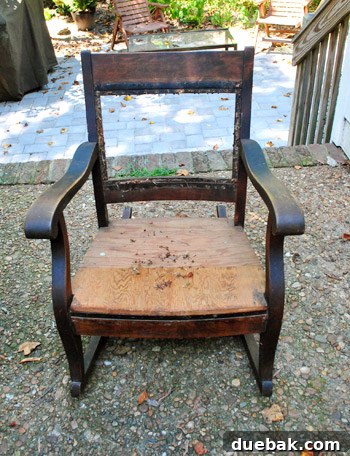
My journey began with a final, lingering “stink eye” at the rocker, a nostalgic nod to our long-standing standoff. Then, it was time for the arduous task of stripping away its past. The goal was to meticulously remove every staple, nail, and scrap of ratty old upholstery to reveal the chair’s bare frame. This initial step is critical for any successful upholstery project, as it allows for a thorough inspection of the frame and a clean slate for new materials.
A crucial tip for this phase: invest in a good pair of small channel lock pliers. I found them far more effective than the back of a hammer or needle-nosed pliers for gripping and extracting stubborn staples and tacks. While it still required considerable effort and strength, the superior grip prevented slippage, ensuring I didn’t lose my balance or momentum. Safety is paramount here; wearing gloves and eye protection is highly recommended to prevent injuries from flying staples or splintered wood. This process, though repetitive, offers a valuable insight into the chair’s original construction and prepares it for its renewed purpose.
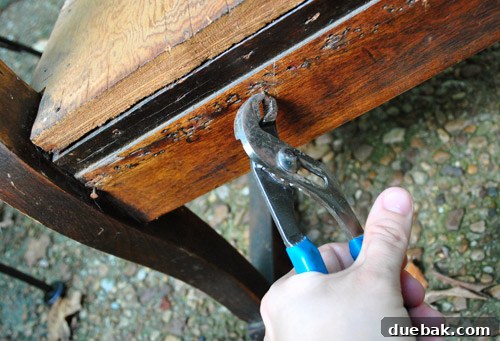
After about an hour of diligent work, I had accumulated a respectable pile of liberated staples and fabric scraps. However, this was merely the beginning; I estimated I was only about 30% complete with the stripping process. The sheer number of fasteners used in upholstery can be surprising, and patience is definitely a virtue at this stage. It’s an excellent opportunity to listen to a podcast or some music to make the time fly by.
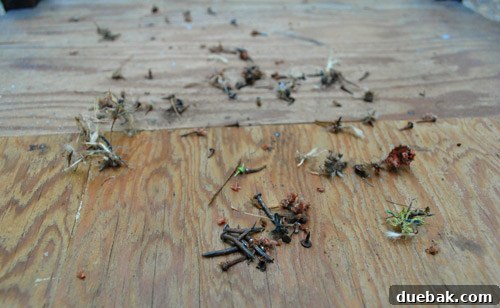
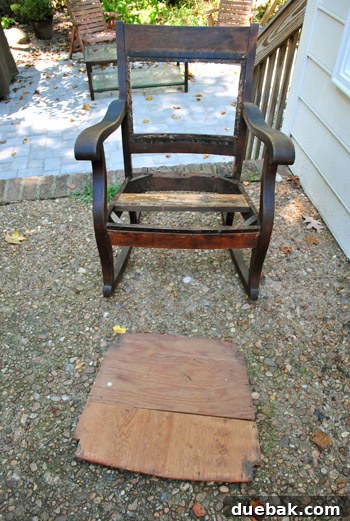
I continued to labor for a few more hours, systematically removing every last nail and tack. Once the frame was completely bare, I carefully detached the two wooden seat slats, leaving me with the fundamental skeletal structure of the rocker. This revealed the true condition of the wood, highlighting areas that would require repair and preparation before refinishing.
Phase 2: Upholstering the Seat – Layers of Comfort
Despite the three-plus hours spent on stripping, the chair’s bare frame was not a pretty sight. It was clear that extensive wood puttying and sanding would be necessary to prepare it for a beautiful, rich dark stain. However, feeling exhausted, I decided to postpone the more strenuous frame work and move on to a less physically demanding step: upholstering the seat. This seemed like a task I couldn’t possibly mess up, offering a welcome break from the relentless staple removal.
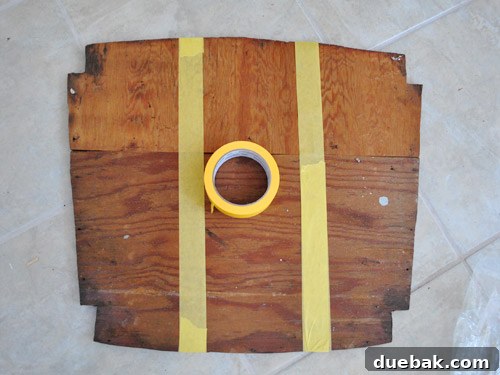
The seat itself comprised two separate pieces of wood. To ensure a seamless, unified upholstered finish without an awkward seam, I decided to tape them together. I opted for delicate surface painting tape, as it didn’t require heavy-duty adhesion. The primary purpose was to hold the pieces in place temporarily; I knew that once the batting and fabric were applied and stapled, they would provide the permanent structural integrity needed to keep the two seat sections joined for the long haul.
Next came the luxurious layers of extra-loft batting. I used “Soft N Crafty” batting from JoAnn, a purchase made way back in November when I optimistically believed I’d tackle the chair immediately. (Yes, it’s a bit embarrassing that it sat packed and untouched for eight months, but such is the DIY life!) While a large piece of foam is often used for seat cushions, I personally prefer the firmer feel of wood-seated rockers, similar to this style (John’s mom has an incredibly comfortable one). Therefore, I aimed for substantial padding without excessive squishiness. One single layer of batting wouldn’t provide the desired plushness, so I planned for multiple layers.
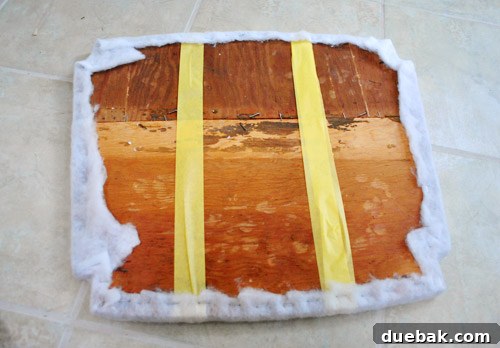
After the first layer, it was clear more was needed. So, I carefully applied a second layer, ensuring even distribution and secure stapling around the edges. Each layer was pulled taut to avoid wrinkles and ensure a smooth foundation for the fabric.
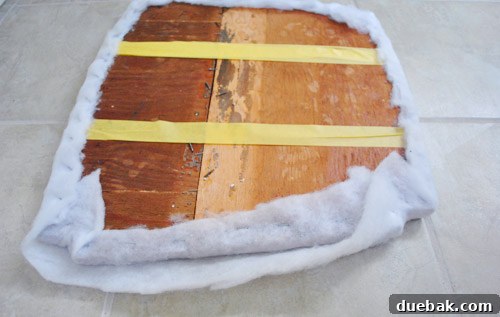
I continued this process, adding a third, fourth, and finally a fifth layer of batting. By the end, the seat was wonderfully plush and inviting, yet still firm enough to provide excellent support without that “sink-in” feeling I wanted to avoid. The combination achieved a perfect balance: soft comfort with a sturdy base. This multi-layer approach allows for customization of firmness and provides a professional, well-cushioned finish.
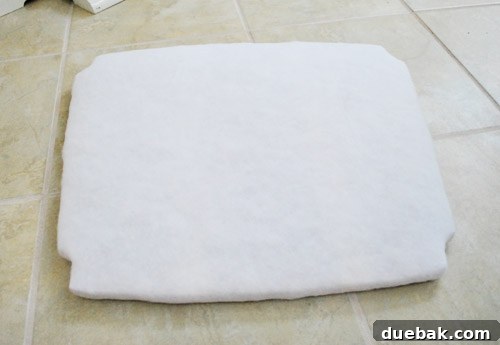
A Moment of Panic: The Seat That Wouldn’t Fit
It was at this point, after meticulously stapling five layers of batting, that a wave of despair washed over me. I realized that the now plumped-up seat needed to be able to bend slightly to fit past the chair’s arms and legs, allowing it to lay flat on the base. My perfectly padded seat, the result of considerable effort, now seemed too rigid. Visions of having to painstakingly unstaple all five layers of batting, separate the two wooden pieces, and then re-staple everything after forcing them into place, flashed before my eyes. I was truly ready to throw everything out the window.
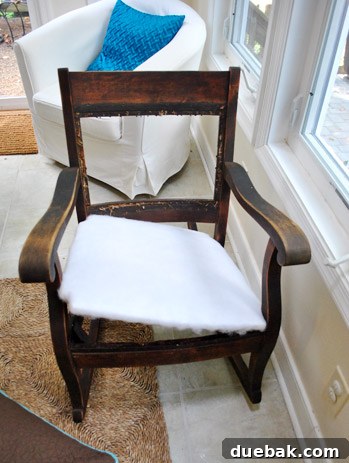
Thankfully, my incredibly insightful husband, whom I affectionately refer to as the “brains of this operation,” came to the rescue. With a simple suggestion, he alleviated my panic: there was no need to unstaple anything! He pointed out that I could simply turn the seat over, cut the yellow painter’s tape joining the two wooden pieces on the back, and the batting should be flexible enough to fold forward slightly, allowing the seat to hinge and slide into position. The batting wasn’t being stretched backward, so its integrity would remain intact. His logical thinking saved me hours of frustrating rework and nearly brought me to tears of relief.
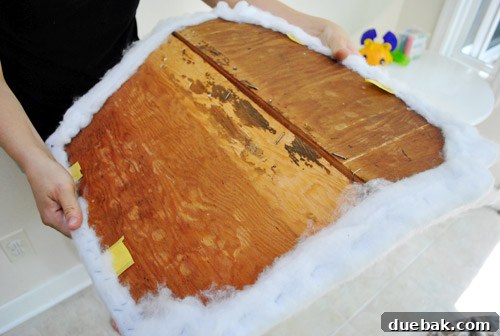
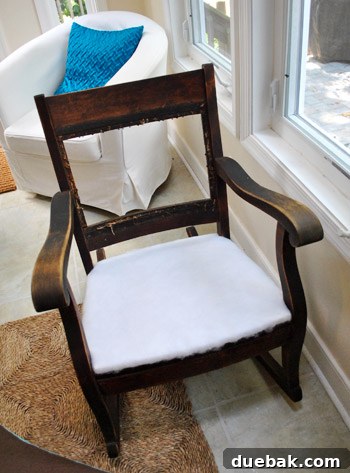
His brilliant solution worked like an absolute charm! The seat now flexed perfectly, allowing it to easily slip into the chair’s frame. My excitement was so profound that I apparently took this celebratory, albeit crooked, picture to commemorate the moment of triumph. It was a stark reminder that sometimes the simplest solutions are the most effective, and a fresh perspective can save a DIY project from utter disaster.
Phase 3: Fabric Upholstery – Precision and Pattern Matching
With the batting crisis averted, it was finally time for the most exciting part: reupholstering the seat with fabric. I was incredibly thrilled about the “Kravet Design” remnant fabric I’d found on clearance at JoAnn for an unbelievable $2 a yard – snagging two yards for just $4! At the time of purchase, I had no specific project in mind, but as I gazed mournfully at my “Mr. Rocker” sitting untouched in the sunroom, I realized this elegant fabric, paired with a rich dark stain for the frame, would create a truly stunning combination.
The intricate pattern of the fabric demanded meticulous attention to centering before any stapling began. This step is crucial for achieving a professional and aesthetically pleasing finish, especially when working with patterned textiles. I carefully draped and folded the fabric around the seat, visually assessing the alignment to find the perfect center line, ensuring the pattern would be evenly distributed and balanced once installed.
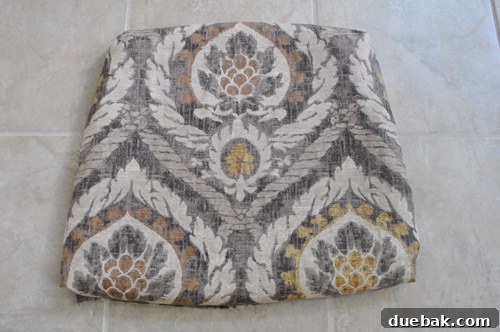
To confirm the centering, I flipped the seat over and secured just two initial staples: one in the top middle and one in the bottom middle, ensuring the fabric was pulled taut. This “test staple” method allowed me to flip the seat back over and verify that the pattern remained perfectly centered. If adjustments were needed, only two staples had to be easily removed with a flat-head screwdriver, minimizing rework. This meticulous approach is vital for achieving a flawless final look.
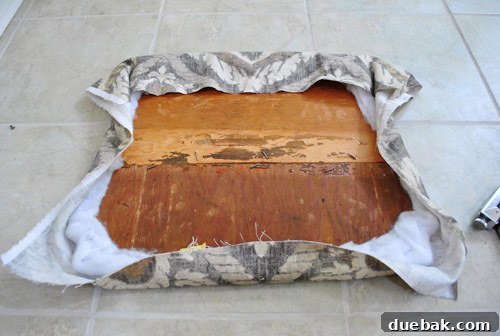
Happily, my initial centering was spot on! I then proceeded to pull the fabric firmly taut and added another staple to the middle of each side of the seat, effectively securing it at the “noon, three o’clock, six o’clock, and nine o’clock” positions. This evenly distributed tension is key to preventing puckering and wrinkles. From these anchor points, I continued to staple meticulously all around the rest of the perimeter, consistently pulling the fabric tight. For the carved-out corners, I employed a folding technique similar to wrapping a gift, creating crisp, clean pleats. Again, the goal was to keep the fabric taut and use multiple staples to firmly hold these folds in place, ensuring a smooth, tailored, and professional appearance from the front of the seat.
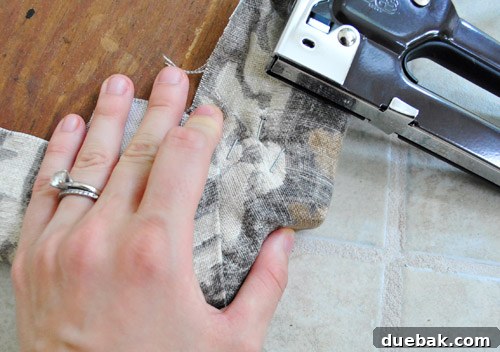
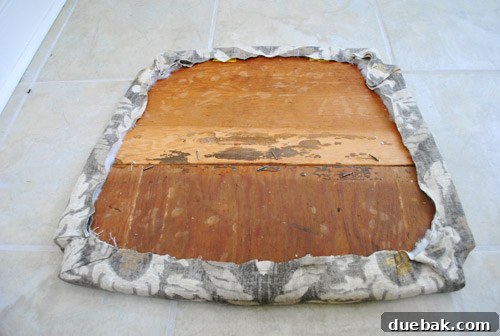
Here’s a glimpse of the underside of the seat, showcasing the completed stapling work. While the back isn’t seen, ensuring clean, secure staples here is essential for durability and preventing fabric unraveling. Every staple contributes to the longevity and finished quality of the piece.
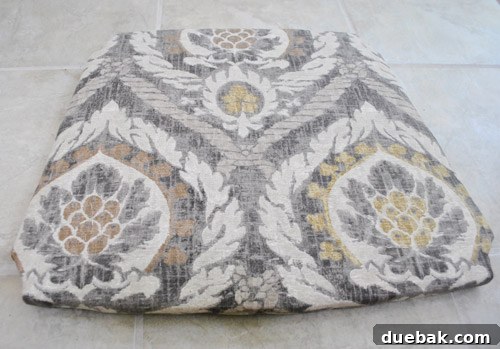
And now, the moment of truth – the front view! Quite pretty, wouldn’t you agree? The chosen fabric pattern truly transformed the seat, adding a touch of elegance and personality to the once-drab chair. The crisp lines and taut finish are a testament to careful execution and attention to detail.
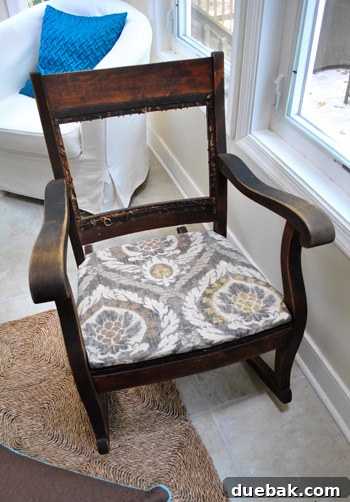
With the seat fully upholstered, I carefully shoved it back into the chair frame for a final fit check. It was a relief to confirm that the batting and fabric still allowed the seat to hinge forward slightly, enabling it to squeeze effortlessly into its designated spot. A true victory! I could almost hear angels singing in the distance, celebrating this significant milestone in the rocker’s rehabilitation. The sense of accomplishment after overcoming such a challenging phase was immense.
Phase 4: Frame Preparation and Refinishing – A Paint Transformation
Next came the more strenuous task of preparing the chair’s wooden frame for its new finish. This involved applying wood putty to fill any visible holes or imperfections, particularly those under the seat along the front framing, ensuring a smooth and flawless surface. Once the putty dried, I meticulously sanded the entire frame, starting with a lower grit sandpaper to rough up the surface and remove any old finishes or rough spots, then progressing to a higher grit paper to achieve a perfectly smooth texture. As an additional step, I gently swiped liquid deglosser over the entire chair after the rigorous sanding. Deglosser helps remove any lingering residue and provides a clean, receptive surface for the new finish, ensuring optimal adhesion and a professional result.
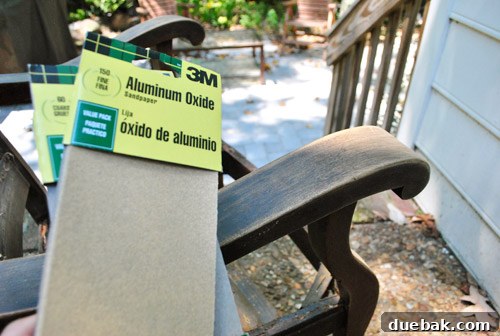
It was during this meticulous preparation that I was forced to face a difficult truth: even a rich dark stain would not deliver the flawless finish I desired for this chair. Despite all the effort with puttying, sanding, and deglossing, the wood’s inherent inconsistencies meant it wouldn’t absorb stain evenly. The result would be a blotchy, imperfect appearance, far from the polished look I envisioned. While some purists might never consider painting wood, we are entirely comfortable with it, especially given this was a $25 Craigslist find, not a precious family heirloom. So, I reluctantly abandoned my dark stain aspirations and turned to a trusted old friend: Oil-Rubbed Bronze (ORB) spray paint.
As I often confess, my name is Sherry, and I’m wholeheartedly addicted to oil-rubbed bronze spray paint! Its versatility and ability to transform pieces are unparalleled. Thanks to its convenient built-in primer and the application of three very thin, even coats, the ORB spray paint achieved a remarkably rich, dark wood-like appearance. Crucially, its subtle metallic quality imparted more depth and dimension than a plain chocolate paint ever could, creating a sophisticated finish that perfectly complemented the newly upholstered seat. For best results, remember to always hold the can about 6-8 inches away from the surface, keep your arm moving constantly, and apply multiple light coats rather than one heavy one to prevent drips and ensure an even sheen. Ample drying time between coats is also essential. This technique guarantees a durable, factory-like finish that elevates the entire piece.
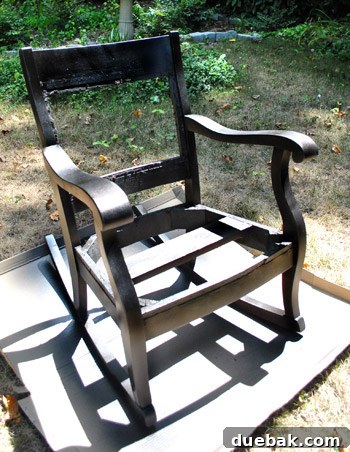
For more general spray painting tips and tricks, you can find a comprehensive guide here. Mastering the technique of lightly misting while maintaining continuous arm movement is truly the secret to a professional-looking finish.
Sneak Peek: The Almost-Finished Rocker!
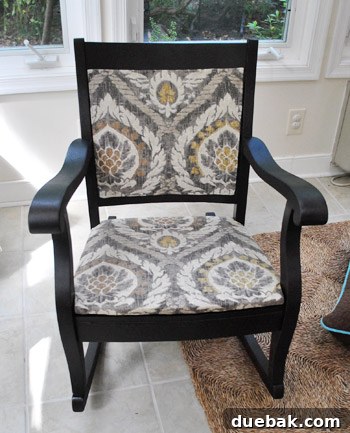
I couldn’t leave you with a poorly shot, halfway-painted image! So, allow me to fast forward slightly and offer a tantalizing glimpse into Part Two of “The Rocker Project.” Here she is, not entirely complete, but undeniably close to her final, magnificent form. The transformation is already striking, and I’m incredibly proud of the progress. Stay tuned for more intricate details of the final steps, including the installation of the back upholstery and some glorious “after” shots, which I’ll be sharing tomorrow!
An Unexpected Discovery: Valuing Our Fabric Find
Update: A wonderful commenter (thank you, Laura!) recently informed us of an exciting detail: our chosen chair fabric was featured on the cover of the Ballard Designs catalog! Inspired by this revelation, we quickly visited their website and discovered they sell a chair upholstered in this exact fabric for a staggering $600-800, depending on the chosen finish. Even more astonishing, the fabric alone retails for $32 a yard! This discovery truly underscored the incredible value of our $4 remnant find and the satisfaction of transforming a budget piece into something truly high-end.
Your DIY Journey: Share Your Challenges and Triumphs!
What about your own DIY adventures? Have you ever had a project that you’ve put off for an epically long time, only to tackle it with newfound determination? Is there a particular task or technique, like two-sided upholstery, that intimidates you? And are you entirely unsurprised that I consistently turn to Oil-Rubbed Bronze to solve nearly every design dilemma in my life? I’d love to hear your stories and insights. Can you believe that stubborn seat wouldn’t fit after five layers of batting? At that frustrating point, I genuinely considered setting the entire thing on fire! Share your biggest DIY challenges and your most ingenious solutions in the comments below.
Reference: https://www.productexpert.com/best-ergonomic-office-chairs/.