
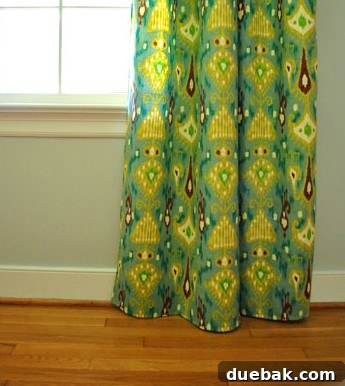
Our recent road trip to visit Katie and her beautiful home reignited our DIY momentum. We often work in bursts: a period of intense progress followed by a short break to recharge (sometimes that means a quick trip). After returning from the nine-and-a-half-hour drive, I woke up early, sorted through photos, wrote a shopping post, answered messages, and then — unexpectedly — made dining room curtains that ended up becoming one of my favorite things in the house.
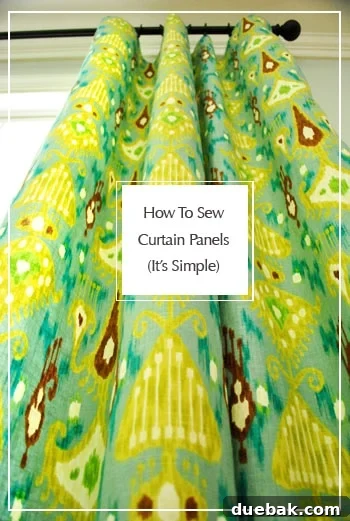
I love them. We’re big fans of statement details like our hallway frame gallery, the giant bedroom light fixture, and our oversized gray sectional, but these curtains feel special — even though they only took about an hour and a half to two hours to make. The inspiration and momentum from our trip made it easy to jump back into projects.
We picked up discounted Robert Allen upholstery fabric from a local outlet called U-Fab. It had a small irregularity — a thin white stripe along one edge — which made the price much lower than normal. At $12.99 a yard instead of $40+ a yard, the fabric was a great deal. I estimated five yards would yield two panels about 90 inches long each, putting the cost around $32 per panel — a fraction of the original price.
We don’t usually draw curtains closed for privacy — we prefer blinds or shades for that — but we like to hang curtains high and wide to create height and let light flood the room. Because of that approach, width wasn’t a limiting factor, and these patterned panels are a vivid upgrade from the plain white Ikea curtains we used in our previous house.
To make the panels I rolled the fabric out on a 5 x 8 foot rug to get a straight edge, then measured and cut each panel to 90 inches long. The fabric was about 57 inches wide off the bolt; I trimmed a few inches to remove the defective stripe while keeping enough fabric for a clean hem. One panel served as a template for the second to ensure matching sizes.
After cutting, I washed and dried both panels to preshrink them and make future laundering easier. I typically preshrink before cutting, but in this case I had just enough fabric for two panels no matter the order, so I washed after cutting. I took them out of the dryer promptly to minimize wrinkles.
I debated between iron-on hem tape and using my sewing machine. I decided to sew them to see how it would go. I first ironed a half-inch fold along the short sides to create a seam, then folded the edge over one more time to enclose the raw edge and sewed the hem. This ironing-first method avoided pinning and produced a tidy finished look on both front and back. The long 90-inch sides folded and hemmed just as smoothly as the short edges, and the defect was hidden within the hem when folded.
Once the hems were sewn, I attached seven oil-rubbed bronze ring clips to each panel and slid them onto a long oil-rubbed bronze rod. Ring clips make hanging simple — no rod pockets needed. I bought a 144-inch rod to achieve the extra-wide look we wanted.
We hang curtains by having one person stand on a chair with the rod while the other steps back to evaluate length and placement. The seated partner adjusts the rod until the standing partner yells “perfect” and then a bracket is measured and marked. We like to extend the rod well beyond the window trim — in this case 19 inches on each side — so the panels frame the window and the wall, instead of blocking the side windows. That high-and-wide placement creates height and lets light pour in while allowing the curtains to drape slightly in front of the trim.
The photos in this post show a slight yellow-green cast in wider shots because the greenery outside was reflecting through the big window. The truest color is visible in the closer images: mostly blue with accents of green, chartreuse, white, and brown. The pattern brings energy to the space and ties in with details like the darker tones in the dining table and the built-ins. The oil-rubbed bronze rod complements those deep finishes, adding contrast like “eyeliner” for the window.
One of my favorite details in the fabric is the smeary turquoise motif, which echoes the teal on the back of the built-ins and the small chartreuse accents elsewhere in the room. Those accidental color connections are always satisfying.
I couldn’t resist setting the table, even though no one was coming over. I pulled out a runner, formatted place settings, and clipped a few branches from outside — just for the joy of it. I plan to leave the table like that overnight because I like the idea of waking up and wandering into the room to smile at the updated view.
Curtains can dramatically change the feel of a room, especially when combined with paint or a bold color on architectural elements like built-ins. The dining room has come a long way since we moved in: we’ve reimagined the space, shifted functions between rooms, and started visualizing future changes such as a wide doorway to the kitchen and a large chandelier over the table. Those additions will further balance the room and improve function.
Looking back at photos from our first walkthrough, it’s funny to remember how quickly we saw past furnishings and imagined the space as it could be. We tend to discount current decor and focus on layout and potential. That’s how we decided to swap room functions to better suit our family and open living preferences.
Have you made curtains recently, knocked down any walls, or set a table just for the fun of it? If sewing isn’t your thing, there are easy no-sew tutorials using iron-on hem tape for making curtains without a machine.