
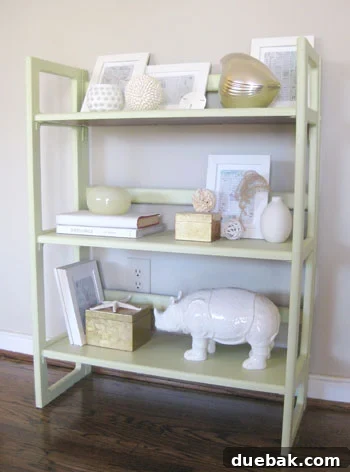
Many readers have asked for practical bookcase-styling tips. There’s no single correct method, but these guidelines reflect a straightforward, effective approach to arranging shelves so they look intentional, balanced, and visually pleasing. Experimentation is key: move things around until the overall composition feels right. Too many small items can read as clutter — try swapping a few for larger pieces. If one heavy item unbalances the display, introduce another object of similar scale elsewhere on the unit, even if it’s on a different shelf. The aim is balance, not strict symmetry.
This is the bookcase in our sunroom (it matches the green bookcase in the living room shown lower in the article). We used a wicker basket to counterbalance folded blankets on the opposite side of the shelf below, and limited the palette to white, tan, and blue to keep the display cohesive.
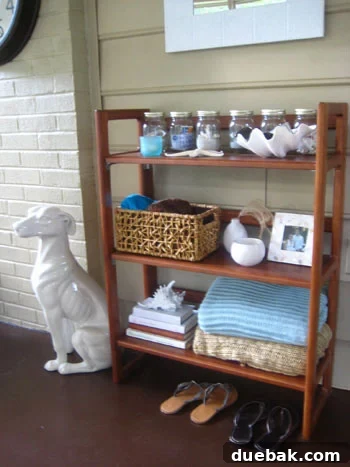
Follow these simple steps when styling a bookcase, built-ins, or open shelving:
1. Clear everything off to start fresh. It may feel faster to edit in place, but a full reset gives you a clean canvas and helps you build a stronger overall composition without endlessly tweaking individual pieces.
2. Add the largest items first. Use similarly sized large objects — stacks of hardcover books, rectangular wicker baskets, or framed boxes — placed in staggered, non-predictable positions to form the foundation of your display. Avoid obvious zig-zag patterns; instead aim for a seemingly random layout that still reads balanced from left to right and top to bottom. If your book spines clash, consider covering them with neutral craft paper for a uniform look; it’s optional but can create a more curated aesthetic.
3. Introduce medium-sized pieces. Fill remaining gaps with items like planters, vases, or medium boxes. We often recommend limiting picture frames, since mismatched frames can disrupt the flow and feel like clutter. Textural items — woven baskets, ceramics, and books — tend to layer together more harmoniously.
4. Finish with smaller accents. Add a few small decorative objects — three glass candle holders, a shell ball, or a white faux coral — but avoid crowding the shelves with too many tiny items. Larger, fewer pieces usually read cleaner and more intentional. If in doubt, replace several small pieces with one larger item and reassess.
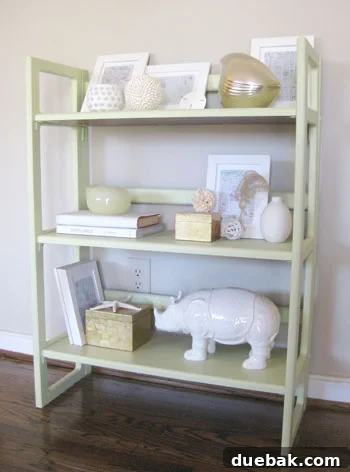
5. Check color and material balance. Step back and look for anything that distracts, like a single bright vase that draws the eye too strongly. If one side is dominated by one material (mercury glass, for example) and the other side by another (natural woven baskets), swap a few items to create harmony. Grouping like items can be powerful — three glass candlesticks together make a stronger statement than the same candlesticks scattered — but try to echo similar colors or textures elsewhere for balance. Sticking to a limited color palette, as we did with the pale green living-room bookcase, makes styling simpler and more cohesive.
6. Vary placement vertically and horizontally. Avoid repeating the same arrangement in a vertical line across shelves. If a stack of books topped with a votive appears on one shelf, shift the next similar grouping to another side or level. Keeping elements moving across the unit prevents the display from feeling predictable.
7. Step back, adjust, and refine. Assess balance, color, and scale from a distance. If bottom shelves feel too heavy, move some larger items higher. Look for gaps that need filling or areas that feel overcrowded and thin them out. If the arrangement looks too perfectly balanced, deliberately shift or remove an item for a more relaxed, “effortlessly curated” vibe. Realistically, achieving that casual look can take time — work carefully, then act like it was thrown together.
We’d love to hear your tricks. Do you have styling tips or favorite bookcase examples? Share them and inspire others.
Tip: study well-styled examples to learn how repeated shapes and materials are used to create a balanced yet casual look — subtle repetition and thoughtful placement are what make a bookcase feel both functional and stylish.