
Transforming Our Home Office: The Ultimate Guide to Spray Painting Trim for a Fresh Look
The journey to a beautifully updated home often begins with a single decision, and for us, that moment arrived last week during a discussion about our office plans. Your invaluable comments on the daunting blue trim situation in that room provided the much-needed push. We had been deluding ourselves into thinking we could tackle the extensive trim – encompassing baseboards, intricate crown molding, and five windows with a staggering total of 66 individual panes – all by hand. The sheer scale of the task demanded a more efficient approach. That’s when we decided to “bite the bullet,” retrieve our trusty paint sprayer, meticulously tape everything off, and cross every available finger and toe, hoping against hope for no bleed-through onto our cherished wood floors. With renewed determination, we declared “hasta la vista” to more blue trim this past weekend.

The Strategic Shift: Why We Chose a Paint Sprayer for Our Office Trim Renovation
Our experience with paint sprayers isn’t entirely new. We had previously painted all the upstairs trim with the sprayer before we even moved in, and crucially, before the new floors were installed. That was an effortless, no-brainer decision; there was nothing to worry about damaging. However, for the downstairs trim projects we’d undertaken thus far – specifically in the kitchen and foyer – we opted for the laborious hand-painting method. The primary reason was the necessity for those rooms to remain largely functional during the painting process. We simply couldn’t afford to envelop them in layers of paper, plastic, and tape, enduring a fog of airborne paint spray. The office, on the other hand, presented a different scenario. With minimal furniture to relocate and the ability to easily cordon it off into a “paint quarantine” zone for a few days, it became the perfect candidate for a spray painting experiment. So, we dove in.
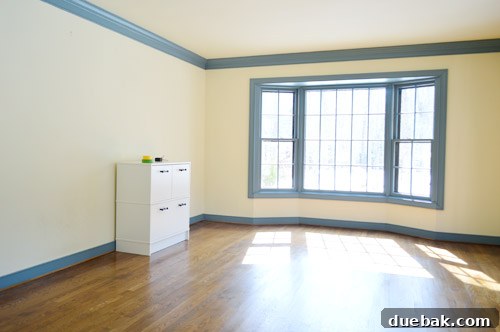
Thursday morning kicked off with a flurry of activity. We meticulously emptied the room, with the exception of a particularly heavy file cabinet that we simply chose to cover. The dining room and foyer temporarily transformed into storage areas, overflowing with displaced office items. By now, navigating such domestic chaos has become a comfortable, albeit frequently occurring, part of our DIY lives.
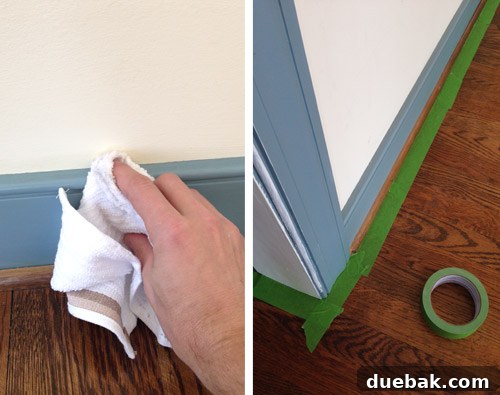
As much as we were thrilled to tackle this blue trim with a novel approach – this being our first time taping off an entire room for spraying – we were both genuinely curious to determine if it would ultimately prove to be a significant time-saver. The upfront preparation, we knew, would be considerably more intense. Of course, some tasks, such as thoroughly wiping down the surfaces to be painted and taping off the floor edges, would have been necessary regardless of the painting method. The real question was whether the increased prep time would be offset by faster painting.
Meticulous Preparation: The Unsung Hero of Spray Painting Success
Protecting Your Floors: The Rosin Paper Shield
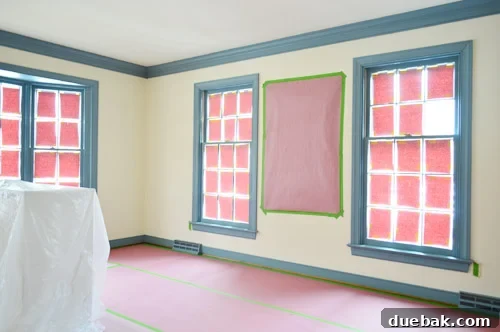
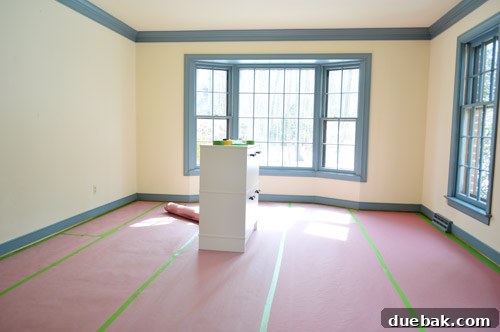
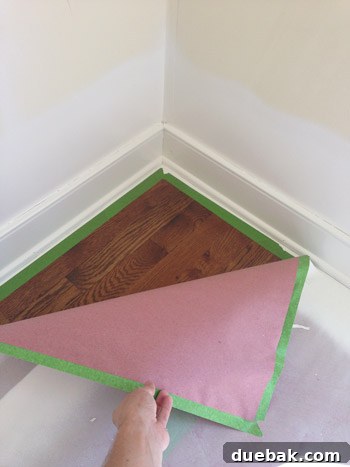
Our next crucial step involved rolling out rosin paper across the entire floor. This precaution stems from a hard-earned lesson: paint mist from our particular brand of sprayer (which, I confess, I’m growing less fond of – we’ve since upgraded to this model) tends to get absolutely everywhere. We strategically separated the tasks of tape edging and laying the rosin paper. This allowed us to devote our undivided attention to ensuring the taped edges were perfectly secure and flush against the trim – any paint on the hardwoods was our ultimate nightmare scenario. Only after achieving impeccable tape lines did we shift our focus to taping down each row of rosin paper. While this approach undoubtedly consumed more painter’s tape than strictly necessary, the extra layers of precaution felt like invaluable insurance for nervous first-timers embarking on a large-scale spray painting project.
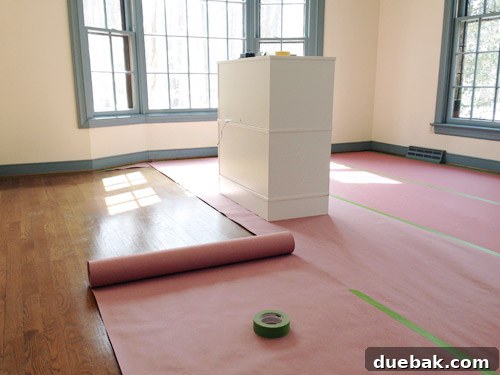
With the floors meticulously taped and covered, the room began its transformation into a protected zone. Clara, our daughter, found the entire setup incredibly exciting, especially when we granted her permission to draw on the paper-covered floors while we moved onto the next critical prep step: the windows.
Tackling Windows: The “Pane-Staking” Process for 66 Panes
I must admit, the prospect of masking the windows initially left me a bit perplexed. I’d heard considerable buzz about “liquid masking film,” a product you purportedly paint onto windows before spraying, which promises seamless peeling of dried paint afterward. It sounded absolutely revolutionary, a true DIY dream. However, after delving into various online message boards and forums, it began to feel a little too good to be true. Many professional painters lamented that it required two or three coats to be effective, with most ultimately recommending the tried-and-true old-fashioned scraping technique anyway. Given our goal to streamline the process, we were wary of adding more steps.
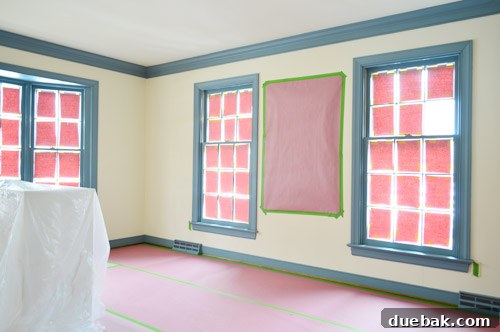
Seeking a practical solution, Sherry devised a brilliant idea: roughly cut squares of rosin paper and tape them directly to the center of each window pane. We didn’t bother with meticulous edge-to-edge coverage, reasoning that this would at least save us substantial time on the backend, preventing us from having to scrape the entirety of all 66 panes. To validate our strategy, I deliberately left one pane completely uncovered as a test. Spoiler alert: it was not a waste of time – that uncovered pane proved to be an absolute nightmare! Oh, and that large, paper-covered object between the windows? That’s Sherry’s overflowing bulletin board, a canvas for Clara’s latest artworks, which we opted to cover rather than painstakingly remove (it was nailed securely into the wall at all four corners, not merely hanging on a hook).
Creating a “Paint Quarantine”: The Instant Zipper Solution
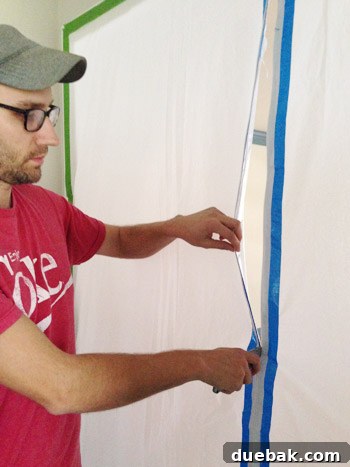
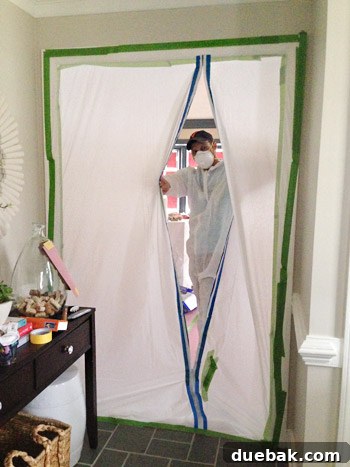
With furniture either removed or fully covered, floors meticulously protected, and windows strategically “dressed,” our final critical preparation step was to hermetically seal off the office from the rest of the house. We carefully taped a heavy-duty tarp across the doorway, securing it on both the inside and outside of the door frame. Then, we employed this ingenious instant zipper kit we discovered at Home Depot. This remarkable little gadget essentially adheres to any tarp, allowing you to slice an opening and then zip it closed, effectively creating a resealable doorway within your protective barrier. It was, without a doubt, the best $10 we invested in this entire project. That thing was truly airtight, single-handedly preventing any swirling primer or paint dust from escaping into the foyer, while simultaneously offering significantly easier entry and exit between coats compared to a fully taped-off tarp.
The Spraying Saga: Navigating Challenges and Embracing the Transformation
Next, Sherry offered a supportive salute and wished me good luck as I loaded in all my essential supplies: my paint sprayer (lately, we’ve been using this Wagner sprayer, though my enthusiasm for it waxes and wanes), an extension cord, and a can of primer (we opted for Kilz Premium). I then donned the full painter’s suit and booties I’d purchased, instructing Sherry to send in reinforcements if I didn’t emerge within a few hours. For some inexplicable reason, a genuine sense of nervousness settled over me about how this entire operation would unfold.
Rocky Start and Learning Curves
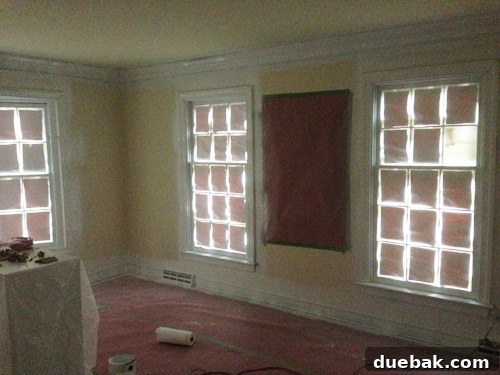
Well, to put it mildly, it didn’t exactly go great. In fact, it got off to a rather rocky start. Almost immediately, my paint sprayer decided to clog, transforming what should have been a smooth operation into a messy ordeal. Before I could even aim it at any of the stubborn blue trim, my hands were covered in primer, and the sprayer was sputtering and leaking profusely. After about 30 frustrating minutes, I finally managed to get it spraying somewhat consistently. By this point, it was approximately 4 PM, and with dark clouds rolling in coupled with all the paper covering the windows, the room had become surprisingly dim. It only grew darker as I proceeded to spray the windows with primer. I’m so accustomed to this room being incredibly bright that the need for supplementary work lights hadn’t even crossed my mind. Oops.
Primer Power and the Perfect White Finish
As it turned out, I didn’t own any work lights that I was willing to risk getting coated in paint mist (between this oversight and our recent purchase of a dolly, you might rightly question our overall preparedness!). So, after completing the primer coat, I made a quick dash to Home Depot. There, I acquired a couple of work lights along with the essential trim paint I’d need for the following morning: Benjamin Moore Simply White in semi-gloss. (For those exploring alternatives, here are some other top white paint colors we’ve considered.) The new lights quickly illuminated that my priming job wasn’t entirely perfect, but it was certainly sufficient to achieve the desired result.
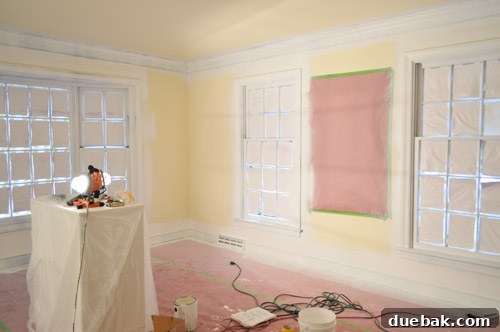
After allowing the primer to dry overnight – and thoroughly cleaning and de-clogging the sprayer once again – I awoke early the next morning (Friday), eager to apply the first coat of paint. This photograph captures the room immediately after I completed that initial layer. Notice the slight paint fog still lingering in the air, a testament to the sprayer’s reach.
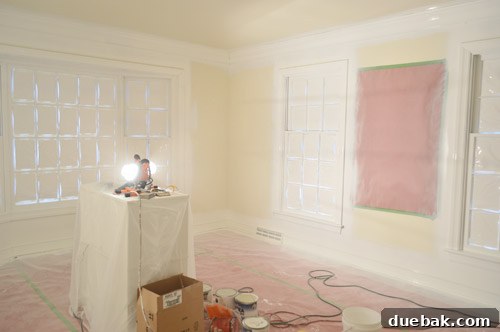
Following another meticulous cleaning of the sprayer, I allowed that first coat to dry for the entire day, as we had commitments related to a showhouse in Northern Virginia that afternoon. My optimistic hope was that the next morning (Saturday) would be solely dedicated to cleanup. However, upon inspection, we weren’t entirely satisfied with the single coat of paint. While it provided excellent coverage overall, it hadn’t quite penetrated all the various nooks, crannies, and subtle angles of the intricate trim.
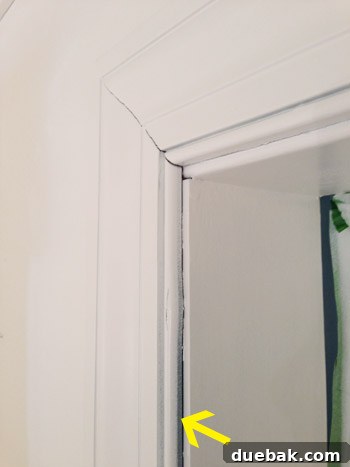
This outcome was, in truth, one of my underlying fears about spray painting this particular room. It’s virtually impossible to effectively hit all the complex angles and multiple sides of the trim in a single, sweeping pass. Furthermore, you can’t simply go back immediately and spray from a different angle, as this risks applying too much paint and inevitably causing unsightly drips. Consequently, instead of joining Sherry for the anticipated cleanup on Saturday, I found myself applying a second coat of paint, meticulously targeting those elusive spots that the first coat had missed.
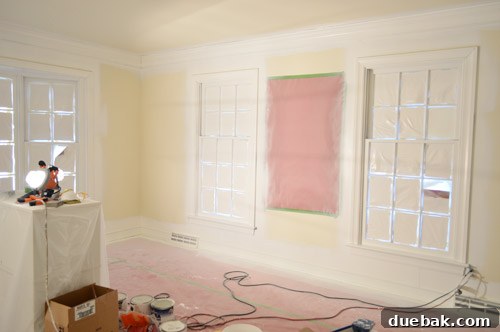
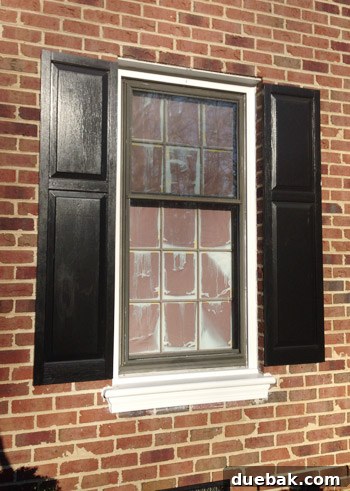
Thus, we found ourselves on Day 3 of our office’s “paint quarantine,” a situation that looked equally less-than-picturesque from the outside. Fortunately, by now, I believe our neighbors have grown accustomed to our perpetual state of DIY projects, so it rarely raises an eyebrow anymore.
Post-Spraying Reality: The Marathon of Cleanup and Finishing Touches
We allowed the second coat of paint to dry thoroughly all day Saturday, finally commencing the cleanup process yesterday morning. As the photo above clearly illustrates, our homemade window coverings were far from perfect. We learned just how imperfect they truly were as we began to peel them off, leaving behind frustrating chunks of rosin paper stubbornly stuck in various places. At that moment, I was on the verge of cursing our decision and the time we had invested in those quick-and-dirty coverings.
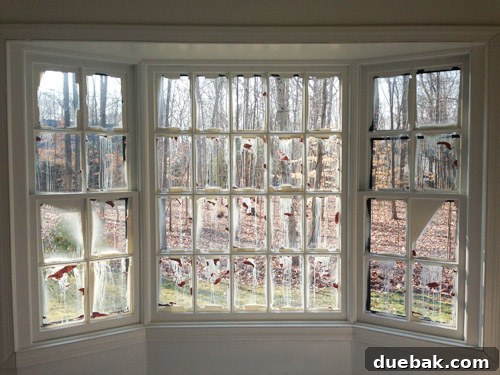
Sherry and I formed a tag-team for the window scraping marathon, as neither of us possessed the stamina (or the hand strength) to tackle all 66 windows ourselves. The paint coverage was incredibly thick – one coat of primer followed by two coats of paint – making it a significant effort to peel off. However, with serious scraping, we eventually got the job done. In the end, the most effective method we discovered involved using straight razors to clean the majority of the window glass, then meticulously going back to scrape the corners with an Exacto knife. (We also experimented with a putty knife for the corners, which was a bit larger and harder to control, but still offered semi-decent results.)
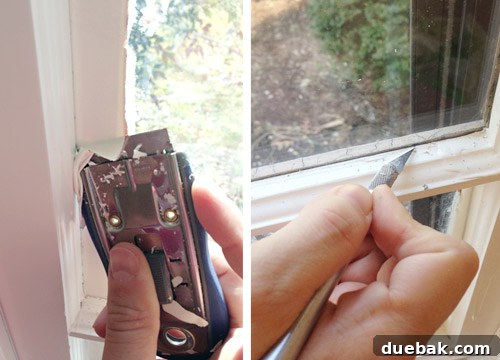
This arduous process consumed essentially half of our Sunday, punctuated by necessary breaks to feed Clara, provide her with new activities, and take essential bathroom breaks. I won’t lie; it was grueling. Throughout the entire ordeal, my mind was racing, brainstorming what I would do differently next time. Mostly, it boiled down to a less-than-practical solution: not owning any windows at all. While tempting, I don’t think that’s a viable long-term strategy.
Despite the frustration, I mentioned earlier that we don’t regret using the rosin squares on the windows. This is because the single pane we had deliberately left completely uncovered proved to be ten, possibly even a hundred, times worse. My optimistic fantasies of it magically peeling off in one giant, satisfying sheet were a distant cry from reality. The paint was incredibly hard and grippy, forcing us to chip it off painstakingly slowly, piece by tiny piece. It took Sherry a solid 30 minutes just to clean that one solitary pane. This stark comparison truly highlighted the value of even our imperfect masking technique.
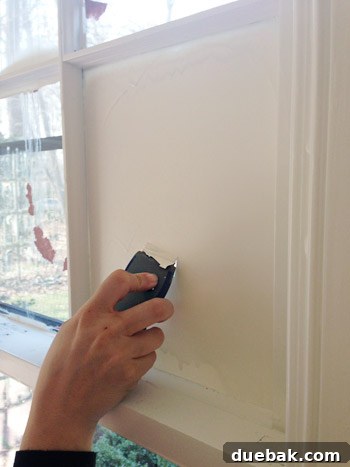
But by around one in the afternoon, all the windows were finally clean, and we celebrated with a well-deserved lunch. It was truly glorious to have our bright office back, and now, even brighter! We briefly considered calling it quits there, our hands aching from the scraping, and thought it might be advantageous to leave the rosin paper down while we tackled the rest of the room (walls and ceiling). However, a nagging paranoia began to set in: what if our rosin paper on the floor had performed as poorly as it had on the windows? I pictured giant blobs of paint having leaked through. So, we decided to push through and peel it up. To our immense relief, the floor was absolutely PERFECT! Phew!
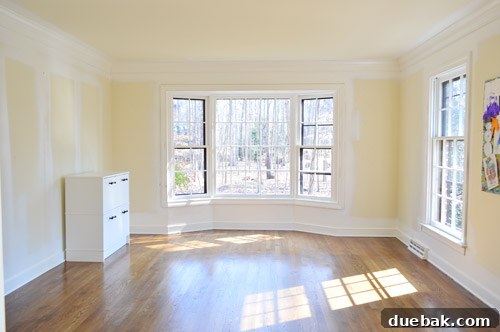
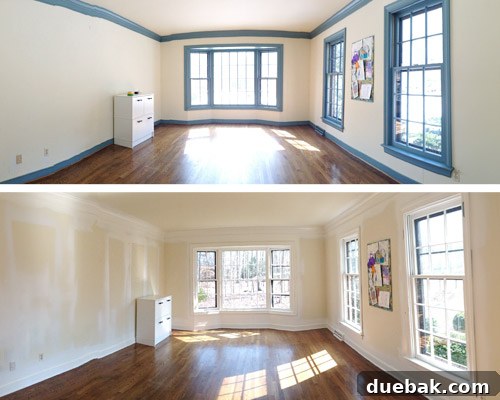
So, here’s the room as it stands now (Sunday afternoon, as I’m writing this). It’s looking a bit rough around the edges with all the overspray beyond the newly painted trim, splattered onto the walls and ceiling. But, critically, there’s not a speck of blue in sight!
Beyond the Blue: Envisioning the New Office Aesthetic
We’re incredibly excited to move forward and paint the ceiling and walls, reasoning that it will be significantly easier with all the furniture still out of the room. Moreover, we’re accustomed to painting without the floors being completely covered, so pulling up all that rosin paper ultimately caused no harm. However, our trim-painting odyssey isn’t quite complete. For some reason, my second coat of paint proved particularly prone to drips (once again, my affection for our current sprayer, which we are now replacing with this Wagner model, is at an all-time low). Consequently, we have a number of spots that require sanding down and subsequent hand-painted touch-ups.
The Importance of Caulking and Choosing the Right Wall Color
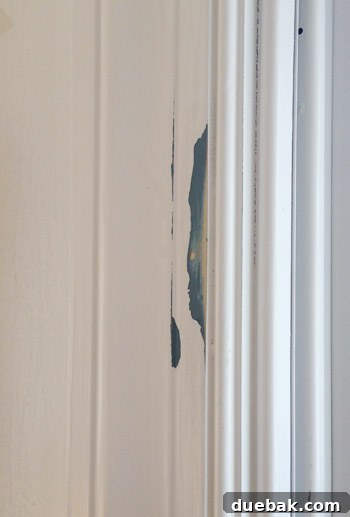
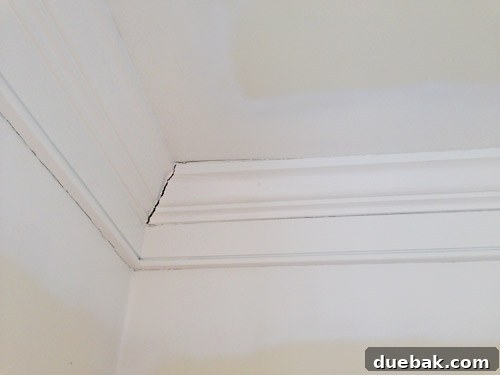
But before I even reach for the touch-up paint, another crucial step awaits: caulking. I honestly hadn’t realized how imperfect and rough some of our trim looked until it was all painted a crisp white. Now, numerous areas where the moldings meet the walls are screaming for some careful filling to create a seamless, professional finish.
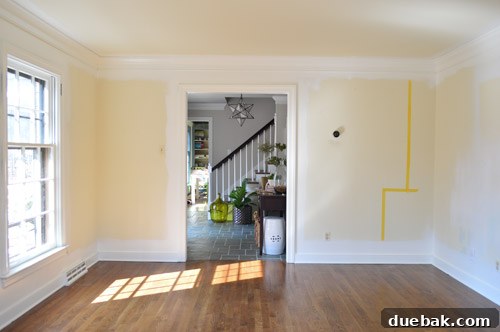
Furthermore, I never consciously noticed how yellow the original wall paint in the office was until now, juxtaposed against the fresh white trim. Sherry and I are still in the midst of debating wall colors. We’re both leaning towards something light and airy, but definitely not white – perhaps a subtle hint of color. The exact shade remains undecided. As you can see below, we’ve even started taping off potential locations for built-ins, an initial step in visualizing everything and making a final decision on the layout and placement of future elements.
Spraying vs. Hand Painting: A Comprehensive Verdict (So Far) and Future Plans
Ah, the ultimate verdict: spray painting versus hand painting. I’m not entirely ready to give a definitive answer just yet. When solely measuring the time spent actively painting, spraying was undeniably, overwhelmingly faster. It took me approximately 30 minutes to complete a single coat. This means one primer coat and two paint coats totaled a mere 1.5 hours of actual spraying time, a stark contrast to a single coat likely consuming around 4+ hours if done by hand. However, we still have some significant “kinks” to iron out in our preparation and cleanup system before I’m fully convinced that spraying is less trouble overall. For instance, when we paint by hand, we don’t get nearly as much paint on the windows, making scraping considerably easier. Moreover, we don’t typically encounter the same level of drips in the trim that later require painstaking sanding and touch-ups.
I would genuinely appreciate any tips or suggestions from those of you who are more seasoned practitioners in the art of paint spraying. We fully intend to spray the dining room when the time comes, as, much like the office, it boasts minimal furniture and can be easily sectioned off for containment. My goal is to work out these remaining challenges and refine our process before tackling that room. Afterwards, I’ll be sure to share all the “this worked better” tips and tricks we discover. Can you believe that the dining room will be our very last room with blue trim?! It will truly be a momentous day when that project is finally complete, signifying the end of an era of blue.