

Transform One Duvet Cover into Two: The Ultimate DIY Bedding Hack
Welcome back, fellow DIY enthusiasts! It’s Sherry, your ever-enthusiastic (and occasionally exasperated) seamstress, here to share another adventure from the world of fabric and thread. This time, I’m tackling a common dilemma with a creative, budget-friendly solution: transforming a single, beloved duvet cover into a perfectly matched pair for twin beds. Prepare for a journey filled with a dash of nervous anticipation, a sprinkle of triumph, and perhaps a moment or two of questioning my sanity, all culminating in a truly satisfying home décor hack.
The inspiration for this project stemmed from a simple, yet persistent, need. My best friend recently moved into a new home, finally having the space to set up her son’s inherited twin beds side-by-side. The only hitch? They had only one fantastic duvet cover from a few years back – a charming Garnet Hill piece that was no longer available for purchase. The thought of buying two entirely new duvet covers, sacrificing the existing beloved pattern, just didn’t sit right. That’s when my DIY instincts kicked in, and I, with an almost alarming amount of enthusiasm, proposed a daring solution: let me try to split the existing duvet cover into two. The stakes were low – if I failed, she’d buy new ones anyway. If I succeeded, well, I’d finally feel like I was paying her back for years of delicious meals and root beer floats!

The Challenge: From One to Two Matching Twin Duvets
The core of this project lies in leveraging the existing fabric. Many duvet covers are essentially two large pieces of fabric stitched together, forming a “bag” for your duvet insert. If both sides of your duvet cover feature the same pattern or a complementary solid color, you’re in business! This DIY relies on carefully separating those two sides and then ‘marrying’ each half to a new flat sheet, effectively creating two new duvet covers. Not only does this save a significant amount of money compared to buying two new high-quality duvet covers, but it also allows you to preserve a cherished design that might no longer be in production. It’s a sustainable approach to home decorating, breathing new life into existing items.
What You’ll Need for This Bedding Transformation:
- Your existing duvet cover (crucially, with the same or complementary fabric on both sides)
- Two new flat sheets (one size larger than your desired duvet size; e.g., Full for Twin duvets)
- Sharp fabric scissors or a seam ripper
- A sewing machine
- Matching thread
- Pins
- Measuring tape
- Iron and ironing board
- Optional: Buttons, needle (for hand sewing buttons/buttonholes)
Step-by-Step Guide to Splitting Your Duvet Cover
Step One: The Nerve-Wracking Disassembly
This is where the real fun begins – or, depending on your personality, where the immediate sense of dread sets in. Handing over a beloved item to be taken apart can be unnerving, even when your friend is laughing and snapping iPhone pictures of the process. My strategy was to tackle this slowly and deliberately. Instead of just cutting, I opted for a seam-ripping approach. I carefully perched on a kitchen stool and used small, sharp scissors to snip the tiny threads holding the front and back panels of the duvet cover together along the perimeter. The goal here is to *separate the fabric panels* without actually cutting into the main fabric itself. This meticulous process ensures you retain the original dimensions of each panel, which is vital for a clean finish.

After a good amount of patience, I was left with two nearly identical duvet cover panels. One side had the original buttonholes, and the other had the buttons. This initial separation is the cornerstone of creating your two new covers. The success of this project hinges on having a duvet cover where both sides are visually suitable. If one side is plain white and the other patterned, that’s perfectly fine, too! You’re essentially creating two “half” duvets that will be backed by your chosen flat sheets.
Choosing Your Flat Sheets: The New Backing
With your duvet panels liberated, it’s time to select their new partners: the flat sheets. We opted for classic white cotton flat sheets, which I found at Target for a mere $8 each. Here are some key considerations:
- Fabric Match: Whenever possible, choose flat sheets that are the same or a very similar fabric type to your duvet cover. For instance, if your duvet cover is 100% cotton, select 100% cotton flat sheets. This minimizes puckering and ensures a more cohesive drape when sewn together.
- Color Coordination: Select a color that beautifully complements your duvet cover’s pattern or existing color scheme. White is a versatile choice, but a soft gray, a muted blue, or even a contrasting bold color could work, depending on your aesthetic.
- Sizing Up is Key: This is a crucial tip! Always purchase flat sheets that are one size larger than your desired duvet size. For twin-sized duvets, I bought full-sized flat sheets. Why? Because the sheet needs to be *at least* as wide and as long as your duvet panel, allowing for generous trimming and hemming without compromising the final dimensions. Trying to make a twin sheet fit a twin panel perfectly will likely lead to frustration and a “wonky” result.

Step Two: Preparing Your Flat Sheets for Sewing
Before you even think about cutting, wash and dry your new flat sheets a few times. This pre-shrinks the fabric, preventing any unwelcome surprises after your first wash-and-dry cycle post-project. Once prepped, lay one duvet cover panel flat on a large surface, pattern-side up. Then, carefully lay one of your pre-shrunk flat sheets directly on top, aligning one of its existing hemmed edges with one of the duvet panel’s existing hemmed edges. This ensures you’re leveraging the factory-finished edges where possible, reducing your workload.
Now, trim the flat sheet to match the dimensions of your duvet cover panel. For any side you are cutting (which will typically be two of the four sides, as two will retain their original hems), leave an extra inch of fabric. This extra inch is your seam allowance and will be used to create a clean, durable hem. Before joining the sheet to the duvet panel, take the time to hem these cut edges. Simply fold over the raw edge by half an inch, press it, then fold it over another half-inch, press again, and stitch it securely in place with your sewing machine. This step prevents fraying and gives your finished duvet cover a professional appearance.
Throughout this meticulous process, feel free to have a tiny supervisor, like my friend’s chihuahua, inspect your work. Their discerning eyes (and occasional snores) add an extra layer of charm to any DIY project.

Step Three: Stitching the Panels Together
Now, it’s time to transform your separate panels into a functional duvet cover. Lay one of your duvet cover panels (pattern-side up) on your work surface. Place the prepared flat sheet (face-down) directly on top, ensuring all edges are perfectly aligned. Pin the pieces together along three of the four sides. Crucially, you will be stitching these three sides together *inside out*. This technique ensures that when you turn the duvet cover right-side out, all your raw seams are neatly hidden on the inside, resulting in a clean, professional finish.
Using your sewing machine, stitch along these three pinned sides with a straight stitch. Remember to backstitch at the beginning and end of each seam to reinforce it. You’ll be left with what essentially looks like a giant pillowcase. Don’t worry if your lines aren’t absolutely perfect; once the duvet insert is fluffed inside, minor imperfections tend to disappear. The aim is a sturdy, functional seam that will hold up over time. This step combines the original charm of the duvet cover with the fresh, clean look of your new backing sheet.

Step Four: Creating the Duvet Opening
With three sides sewn, you’ll have one open end – the crucial gateway for inserting your duvet! Most duvet covers don’t have an opening across the entire width; typically, a portion of the sides are sewn, leaving a central opening. To replicate this, turn your “giant pillowcase” inside out again. Observe the original duvet cover (if you still have it as a reference) to see how wide its opening was. For ours, approximately one-third of the side was left open in the middle. Carefully measure and mark the sections you want to sew shut on either end of the open side.
Then, stitch these outer corners together, using the same “inside out” method as before. This leaves a neat, well-defined opening in the middle of that fourth side. This opening provides easy access for inserting and removing your duvet, while the sewn outer corners ensure the duvet insert stays securely contained within the cover.
Step Five: Attaching Buttons for Closure (Duvet Cover One)
One of your newly separated duvet panels will already have buttonholes, but no corresponding buttons on its new white sheet backing. This is where your spare buttons come in! For this project, John’s old cargo shorts heroically donated a set of brown buttons – a true testament to the upcycling spirit.
Turn the duvet cover with the existing buttonholes inside out. Align the white sheet backing with the patterned panel. For each existing buttonhole on the patterned side, mark the corresponding spot on the inside hem of the white sheet. This is where you’ll hand-sew your buttons. The trick here is to sew the buttons onto the *inside hem* of the white sheet. This strategic placement allows the duvet cover to fold over itself slightly when buttoned, effectively hiding the buttons and creating a very clean, professional closure. If you’ve ever owned a high-quality duvet cover with a hidden button placket, you’ll know exactly what I mean. The buttons disappear, leaving a smooth, unbroken line.


Step Six: Crafting Buttonholes for Closure (Duvet Cover Two)
The second duvet cover presented a slightly greater challenge: it had buttons (from the original duvet cover’s other side) but no buttonholes on its new white sheet backing. Making buttonholes can be intimidating, especially if your sewing machine doesn’t have an automatic buttonhole function. I opted for a manual, hand-stitched approach, inspired by how professional buttonholes appear – a small slit reinforced with tight, continuous stitching.
First, carefully measure and mark the exact placement for each buttonhole on the white sheet, corresponding to the buttons on the patterned panel. Using a sharp pair of small scissors or a specialized buttonhole cutter, make a small, precise slit for each buttonhole. Be cautious and make the slit slightly smaller than the button itself; you can always enlarge it if needed. To prevent fraying and ensure durability, reinforce the raw edges of each slit with a hand-stitched buttonhole stitch (or a close blanket stitch). This involves creating a series of tight, knotted loops around the entire perimeter of the slit. I went around each buttonhole several times to ensure it was robust and fully covered, minimizing any chance of fraying after repeated washing and use. While my hand-stitched buttonholes might not have been “pro buttonholes” in the strictest sense, they were incredibly functional and, once buttoned, looked just as neat and tidy as their factory-made counterparts. This step, though requiring patience, is incredibly rewarding and gives your DIY duvet cover a truly custom, finished feel.


The relief when both duvet covers were complete and buttoned up was immense. Despite moments of doubt and the occasional threat of flinging my sewing machine out the window, the project was a resounding success. Both covers looked fantastic, perfectly matching, and ready for their new home. This DIY proves that with a little creativity and perseverance, you can tackle seemingly complex sewing tasks and achieve impressive results, even as a “mediocre seamstress.”

The Finished Look: A Roaring Success!
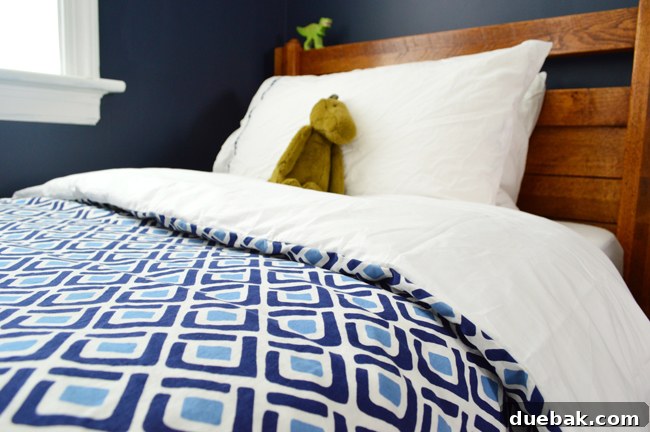
And there you have it! What started as one beloved duvet cover now stands as a perfectly matched set of two, ready to adorn twin beds with coordinated style. This project not only saved my friend money but also allowed her to keep a treasured pattern in her son’s newly designed room. The satisfaction of transforming something with your own hands is truly unparalleled, making all the temporary anxieties worthwhile. My trusty sewing machine, thankfully, remains intact in the guest room, ready for its next challenge!

Speaking of the room, my friend’s son is absolutely obsessed with dinosaurs – a true paleontologist in the making! He can name more prehistoric creatures than I ever thought possible, and patiently corrects me when I confuse a Brontosaurus with a Brachiosaurus. These new duvet covers fit perfectly into his dinosaur-themed sanctuary. Beyond the bedding, the room’s design embraced a resourceful approach, mixing new playful elements like a shark wall head, a dinosaur wall head, and a vibrant T-Rex lamp with existing pieces. Their trusty area rug and an old woven side table, repurposed as a nightstand, beautifully anchor the space. This blend of old and new, combined with the personalized touch of DIY bedding, creates a unique and inviting bedroom that’s both functional and full of character. I’m incredibly happy to have contributed to this transformation, proving that a little ingenuity can go a long way in creating magical spaces.

If this project has sparked your own love/hate relationship with sewing, check out some of my other adventures with fabric and thread:
- Sewing a patchwork quilt for my daughter
- Making a little stitched quilt for my son a few years later
- Sewing a beanbag pouf (Burger is hilarious in these pics)
- Making curtain panels for the dining room (it’s easy!)
- Using two cloth napkins to make accent pillows
- Making a drapey pom-pom-fringed canopyover our daughter’s bed
*This post contains affiliate links, which means I may earn a small commission if you make a purchase through them, at no extra cost to you. Your support helps keep this blog running!