
Happy Friday! We’re painting the foyer today (photos on Monday), but before that I wanted to share two bathroom updates — one of which was a bit of an oops. First up: the vanity.
We decided to remove the little side slab that felt unbalanced against the right wall. It’s a common detail on older vanities that isn’t necessary on most modern sinks, and removing it was a straightforward DIY. If you have a side backsplash or slab you don’t love, this approach might work for you.
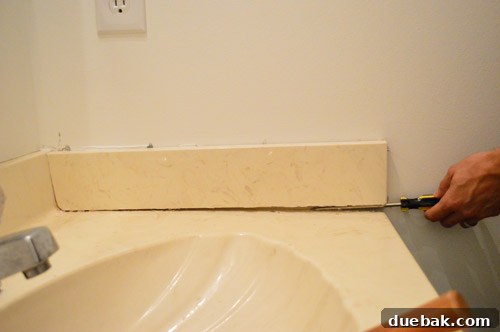
To start, we used a manual screwdriver to pry under the side slab, taking care not to gouge the sink. A rubber mallet or hammer can help tap the screwdriver blade under the panel along the top, bottom, or side seam. Work slowly so you loosen the slab without damaging the surrounding surfaces.
Once loose, we were able to pull the slab off, but the process left four small puncture marks along the top seam where the screwdriver dug into the drywall.
Next: calm down and tackle the repairs. I used a sanding block to remove any loose bits of drywall or dried glue, then applied spackle with a 2″ putty knife. I like Dap Crackshot Spackling paste because it’s easy to work with and smooths well. I built the spackle up slightly above the wall surface so I could sand it flush later.
After letting the spackle dry (I usually wait around five hours to be sure), I sanded with the block to keep the surface even. Sanding creates dust and often reveals small low spots, so resist the urge to stop after one pass.
Wipe away the sanding dust, then make a quick second pass of spackle on any low spots or tiny dings. That short extra step makes the difference between a wall that looks smooth and one that keeps catching your eye. After that second coat dried, I sanded again until the wall was smooth.
With the surface ready, I applied a bead of white paintable silicone caulk between the vanity and the wall. Paintable caulk is important so the finish looks seamless. Run a line of caulk into the gap and smooth it with your finger until it looks clean and finished — this keeps water from seeping down the side of the vanity and gives a polished look.
Finally, I touched up the paint to blend the repair into the wall. It’s tempting to skip that second spackle pass or the careful sanding, but taking the extra time really pays off in the finished result.
Now for the second update: we spilled about half a quart of the Baby Fern paint we used on the vanity all over the concrete garage floor. It was a gelatinous, messy spill — not ideal.
After a little panic, we decided not to try to wipe or thin it out. Instead we let it dry, hoping it would form a thick skin we could peel off. We waited about a week for the paint to fully cure, then started peeling.
To our surprise, most of it peeled away in nearly one piece. A few small spots came off a little later, and there was an initial faint discoloration beneath the peeled paint. After the remaining residue dried, the concrete mostly returned to its normal appearance — only a few slightly tinted spots remain, and once we moved things around in the garage the spill area wasn’t easy to spot.
I was relieved our leave-it-and-peel-it approach worked. Attempting to clean it wet might have made an even bigger mess, so in this case doing nothing and waiting was the best move. That strategy won’t work for every spill, but for a large glob of latex on concrete, letting it dry and peeling it away saved us a lot of time and effort.
**********************************
P.S. As a little Friday bonus, here are four projects and conversations happening over on the Forums — quick ideas and inspiration if you’re not ready to jump back into the workweek just yet.
| by ElizabethAnn | by KatyRICEdesigns | by KellyLawler1 | by ArtisanDesarts |